

TL;DR: Adobe (ADBE) makes the standard software for documents and creative work (Acrobat, Photoshop, Premiere) and sells marketing software to large companies. The Q3 FY2026 report was a beat and a raise, and the business is still one of the most profitable in software. At the same time, the stock is at 9.4x forward earnings, since the market expects AI tools to replace paid Adobe seats. I see a slowdown, not a decline. Without the Semrush acquisition, annual recurring revenue (ARR) grows ~9%, and buybacks provide half of the EPS growth. Verdict: a high-quality business priced for decline. Organic growth and the operating margin still move in the wrong direction. ADBE is just above my accumulation zone; my full fair price math and the accumulation zone are at the end of this post.
Investment Thesis
Adobe reported Q3 FY2026 on Sep 10 with record revenue, a higher full-year EPS target, and record Q3 operating cash flow. Over 5 years, consensus forward EPS more than doubled, and the share price lost 62%. My idea here is to separate what is really slowing inside the business from what the price already assumes.
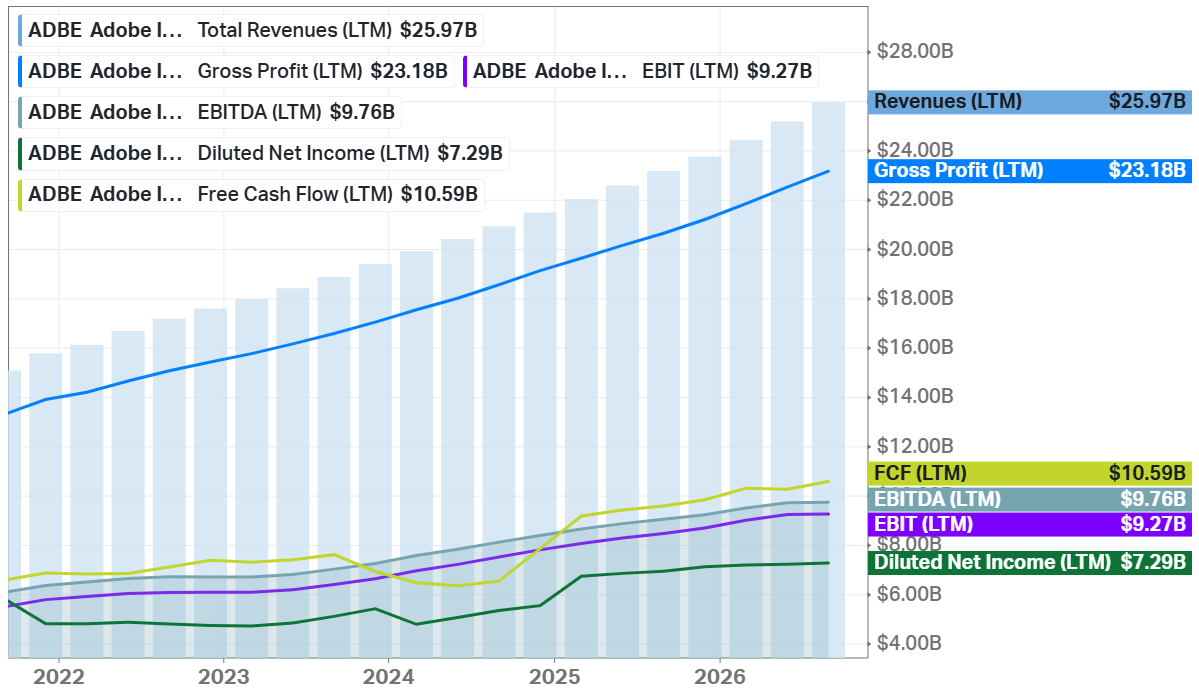
Growth is slower than the headline, but it is still there. Revenue increased 13% YoY to $6.76B, and total ARR increased 11.2% to $27.50B. Both numbers include Semrush, which Adobe bought in April. Without it, I estimate revenue growth at ~11% and ARR growth at ~9%.
The price assumes much less than consensus. The consensus 5Y EPS growth estimate is 13.92%, and ADBE trades at 9.4x forward earnings with a PEG ratio of 0.67. At a 12% required return, the free cash flow after stock-based compensation (SBC) implies only ~3.5% long-term growth.
The business is still one of the most profitable in software. LTM gross margin is 89.25%, the FCF margin is 40.79%, ROIC is 39.19%, and FCF reached $10.59B. The diluted share count decreased by 6.8% in 1 year.
The multiple already fell below every historical anchor. ADBE trades at 9.4x forward earnings against a 24.5x 5Y mean and a 15.2x -1 standard deviation band. And this despite the fact that consensus EPS for the next 12 months has increased every year.
The bear case: AI tools make a paid Creative Cloud seat less necessary, organic ARR growth slides below 8%, the non-GAAP operating margin keeps declining, and a new CEO takes over on Dec 01. My model takes this into account by keeping today’s 9x multiple as the Bear Case exit. Even then, ADBE is only 5% above my Bear Case fair price of $240.
Analyst’s note:
Adobe’s fiscal year ends in late November, so FY2026 ends soon. EPS in this post is non-GAAP because the estimates are built on it. GAAP EPS is ~$18 for FY2026, mostly because of SBC. The organic numbers are my estimates. The company disclosed ~$40M of revenue and ~$480M of ARR from Semrush for its first month. Its FY2026 targets include ~$280M of Semrush revenue for 7 months, which is ~$120M per quarter.
Company Overview
Next Earnings Date: 10 Dec 2026 (estimated)
Market Cap: $100.26B
Sector: Information Technology | Industry: Software
Type: Large Value
Short Interest: 4.5%
Adobe Inc. is a software company from San Jose, California, founded in 1982 by John Warnock and Charles Geschke. The first product was PostScript - the page description language behind desktop publishing. Photoshop followed in 1990, and the PDF format in 1993. In 2013, the company stopped selling boxed software and moved the creative suite to Creative Cloud subscriptions. Subscriptions are now 97% of revenue. Shantanu Narayen has been CEO since 2007. On Dec 01, 2026, Anil Chakravarthy (at Adobe since 2020, before that the CEO of Informatica) becomes CEO, and Narayen moves to Executive Chair.
The product range splits into two customer groups. The first one is Business Professionals & Consumers ($1.91B in Q3, +16% YoY): Acrobat, Reader, Acrobat Sign, and Express (the document and quick-design tools for everyday users). The second one is Creative & Marketing Professionals ($4.65B, +13% YoY): Creative Cloud (Photoshop, Illustrator, Premiere Pro, Lightroom, InDesign, After Effects), Firefly (the generative AI studio, plus its enterprise version), and Adobe CX Enterprise for marketers (Experience Platform, Experience Manager, and GenStudio). Semrush is reported inside Creative & Marketing Professionals.
Distribution is direct (web, app stores, and inside sales) plus resellers and multi-year enterprise agreements. By geography, 59% of revenue comes from the Americas, 27% from Europe, the Middle East, and Africa, and 14% from Asia.
Market Overview
The market itself is large. At its March 2024 investor meeting, Adobe estimated its addressable market at ~$205B for 2024 and ~$293B for 2027, which is ~13% growth per year. Customer experience software is ~$155B of the 2027 figure, creative software ~$91B, and document software ~$47B. In April 2026, the company described the opportunity as expanding to new surfaces such as AI chatbots and agentic browsers. If the estimate is right, Adobe’s organic ARR grows slower than its market. The risk is not fewer users, but fewer paid seats per user.
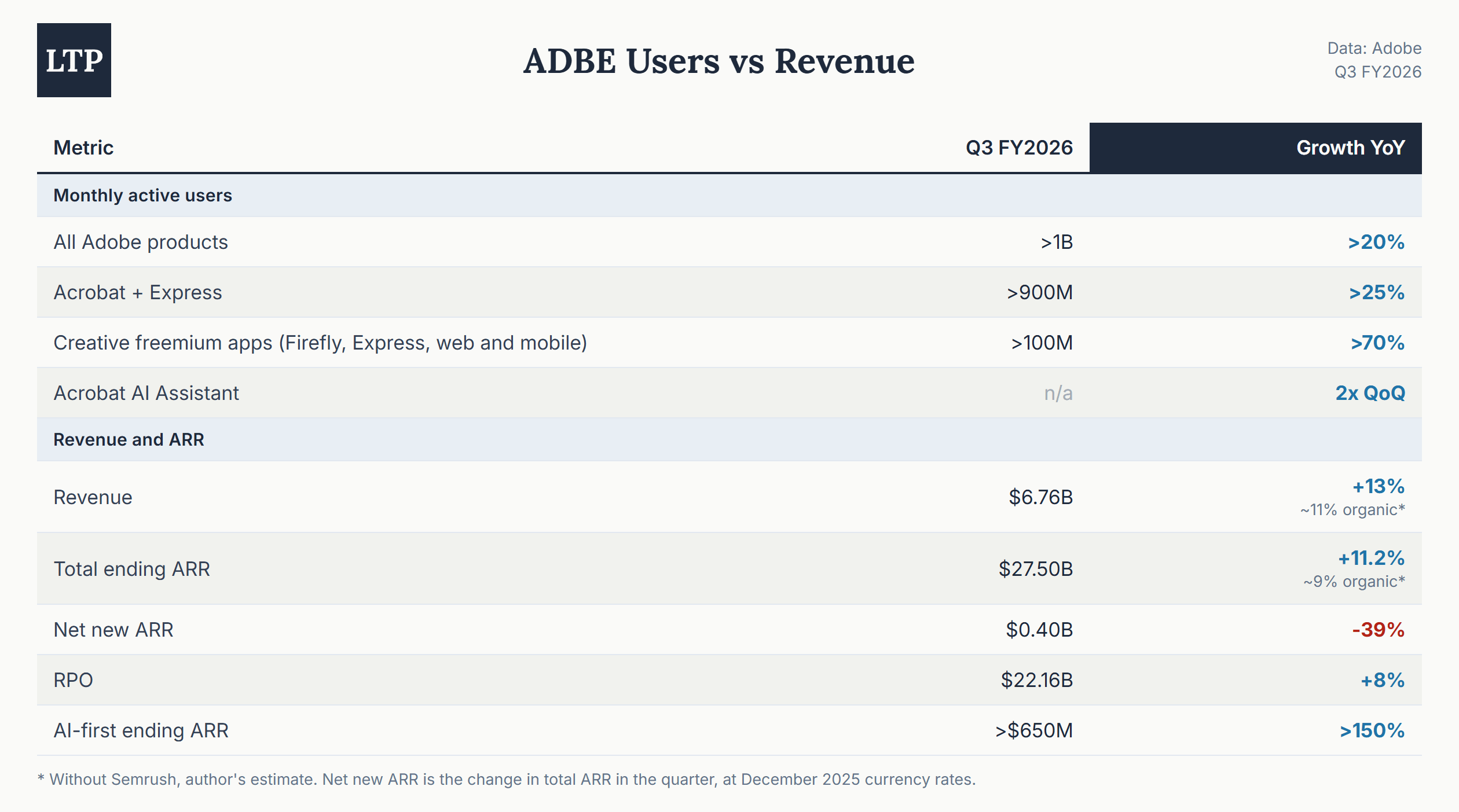
Adobe’s audience is growing faster than its revenue. More than 1 billion people use Adobe products every month, up more than 20% YoY. The creative freemium base (Firefly, Express, and the web and mobile versions of Photoshop, Premiere, and Lightroom) crossed 100 million monthly active users (MAU), up more than 70% YoY. Acrobat and Express together are used by more than 900 million people (up more than 25% YoY), and Acrobat AI Assistant users doubled in one quarter.
The competitors grew faster from much smaller bases. Figma (FIG) grew revenue 48% YoY to $370M in Q2 2026 and guides ~39% growth for the year, but it still reported a GAAP net loss of $112M in the quarter. Canva is private. It ended 2025 with ~$4B of ARR and more than 265 million MAU. Recently, it cut its revenue growth forecast from 30% to 20%, since it slowed its AI rollout to reduce the cost of AI tasks. In addition, image and video models from OpenAI and Google (GOOGL) produce good-enough visuals for free or inside a chatbot subscription. To compare, Adobe’s LTM revenue of $25.97B is ~18x Figma’s full-year guidance.
AI revenue is small, but it grows fast. AI-first ending ARR is more than $650M, growing more than 150% YoY. That is 2.4% of total ARR. Firefly ARR from the app and credit packs grew 40% QoQ. In my view, the model matters more than the size - Adobe sells the generative features as credits and higher plans, instead of giving them away to defend the base.
The marketing business grows faster than the creative one, but part of it is bought. Ending ARR for Experience Manager, GenStudio, and Experience Platform each grew more than 20% YoY. Digital Experience subscription revenue increased 22% YoY in Q3, and I estimate ~9 points of that is Semrush. Without it, the marketing side grew ~13%, against 11% for Digital Media (the creative and document products). More than 20,000 enterprises use Adobe’s customer experience software. CX Enterprise Coworker (an AI agent for marketing workflows) had more than 1,700 customers and early adopters after it became generally available in June.
The problem is monetization, not the audience. Total ARR growth decreased from 13.8% in Q1 FY2024 to 11.2% now. The FY2026 target is 10.2%, and it already includes the ~$480M of ARR that Adobe bought with Semrush. Net new ARR in Q3 was $0.40B against $0.66B a year ago. In June, the company said it had decided "to defer previously planned Creative Cloud second half line optimizations" (planned price changes) to push the free products first. The CEO put half of the ARR impact on this decision and half on the freemium push.
Economic Moat
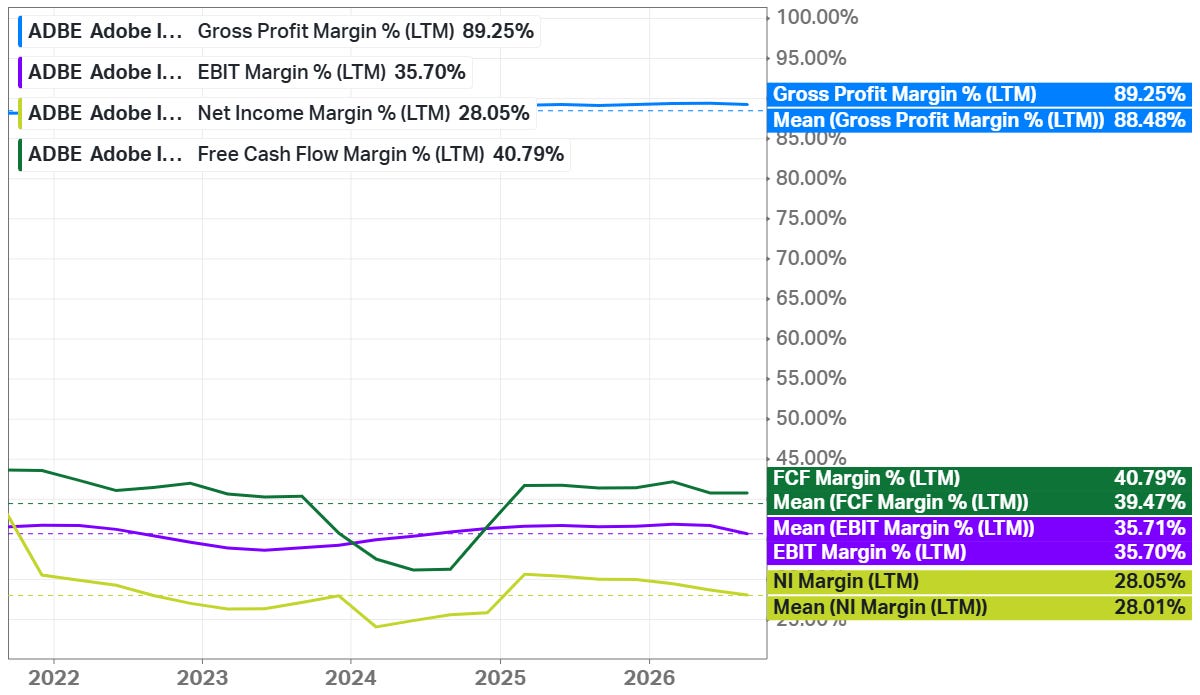
The LTM margins are still at or above their 5Y means: gross margin is 89.25% against an 88.48% mean, EBIT margin is 35.70% against 35.71%, net margin is 28.05% against 28.01%, and FCF margin is 40.79% against 39.47%. The quarterly trend in 2026 is weaker. The non-GAAP gross margin decreased from 90.5% in Q3 FY2025 to 89.5%, since subscription cost of revenue increased 24% YoY against 14% growth in subscription revenue. Semrush explains only a small part of it, since its gross margin was 80.5% in 2025. The company does not explain the rest, but I think the main reason is the compute cost of generative AI features.
Let’s see where this margin comes from. Most of it is switching costs. File formats: PDF is an ISO standard that Adobe created, and the PSD, AI, and INDD files of Photoshop, Illustrator, and InDesign are the working formats of design studios and print shops. Next, training: design schools teach Adobe tools, and job descriptions ask for them. Next, the bundle: Creative Cloud sells 20+ applications in one subscription, so an alternative has to replace the whole workflow, not one app. The weak point is pricing power. Adobe deferred its planned Creative Cloud price changes this year, so the moat has not been tested with higher prices in the AI era.
Figma is the clearest test of the moat. In 2022, Adobe agreed to buy Figma for ~$20B, half in cash and half in stock. In December 2023, the companies terminated the deal, since there was no clear path to approval from the European Commission and the UK Competition and Markets Authority. Adobe paid a $1B termination fee. Today, Figma is a listed competitor with 136% net dollar retention, which means its existing customers spend 36% more every year.
Worth mentioning also the enterprise contracts. Large customers sign multi-year agreements, and remaining performance obligations (RPO) of $22.16B equal 85% of LTM revenue. 67% of them are expected to be recognized over the next 12 months. Management reports “continued strength in retention” across enterprise customers, but it does not disclose a retention rate, so I cannot check it.
The marketing software is different. Adobe built most of it through acquisitions (Omniture in 2009, Marketo and Magento in 2018, Semrush in 2026), and it competes directly with Salesforce (CRM). I count it as the main source of growth, not as part of the moat.
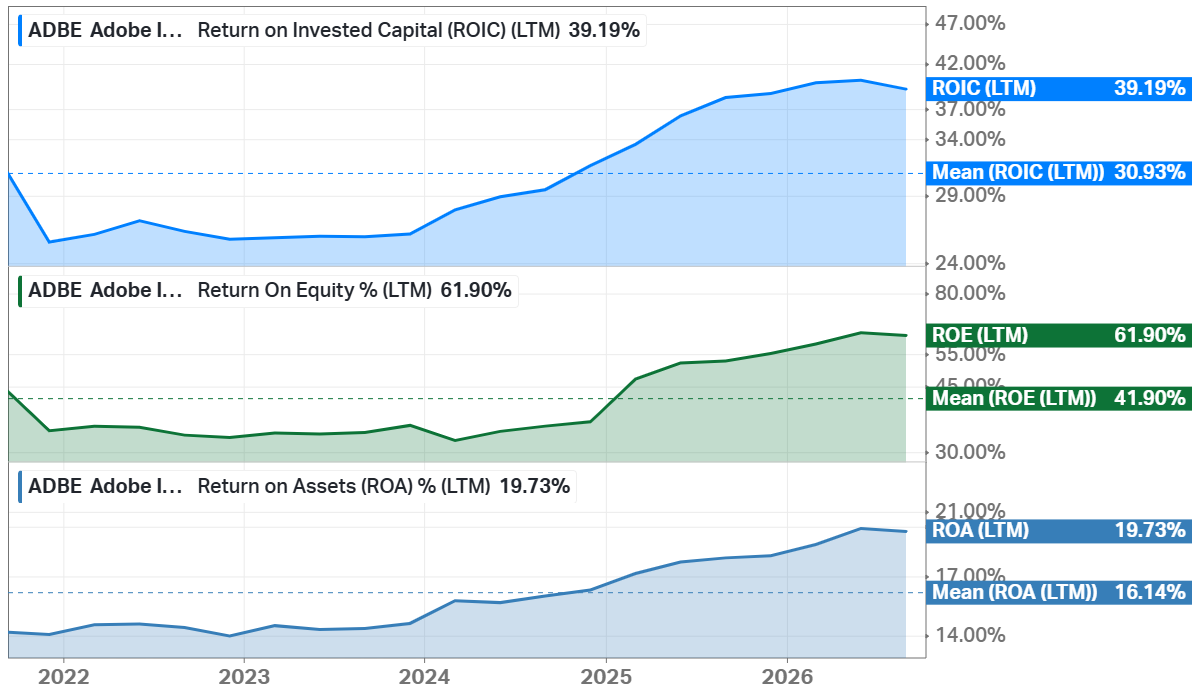
The returns on capital still support the moat: ROIC is 39.19% (5Y mean: 30.93%), ROE is 61.90% (41.90%), and ROA is 19.73% (16.14%). Worth noting that ROE is inflated by buybacks, since $55.6B of repurchased stock reduces the equity to $11.76B. ROIC is the cleaner number here, and it decreased slightly in the last quarter after 2 years of increases.
Business Strategy
Free first, paid later. Express, Firefly, Reader, and the web versions of the flagship apps have free tiers, and the paid step is a credit pack, a higher plan, or a team seat. The company states that this builds “long-term durable growth”. The data confirms the first half of the plan. The second half, conversion into ARR, is not visible yet. On the Q3 call, Anil Chakravarthy said that engagement “is starting to translate into ARR”, but by my estimate, organic ARR growth decreased from ~10.5% in Q2 to ~9% in Q3. The newest example is Saudi Arabia, where the Ministry of Communications and Information Technology and HUMAIN make Firefly and Express available to 27 million citizens and residents.
Agents inside the flagship apps. The Creative Agent now works in Photoshop and Premiere, the Productivity Agent in Acrobat turns documents into reports, slides, and audio summaries, and CX Enterprise Coworker executes marketing workflows. Adobe also routes tasks to third-party AI models inside its own apps. What I like: Adobe positions Firefly as commercially safe, which matters for enterprises that publish the output. Disney (DIS) Imagineering is integrating Firefly Foundry into its theme park design toolkit.
Go where the documents are opened. Acrobat is now available inside ChatGPT, Chrome, Claude, Edge, and WhatsApp. Instead of waiting for users to open Acrobat, Adobe puts it inside the tools they already use. Student Spaces in Acrobat targets universities, where the next generation of business professionals learns its software.
Buy the missing pieces. Semrush (closed on Apr 28) is now part of Adobe Brand Visibility - a tool that shows brands how they appear in ChatGPT, Google AI Mode, Copilot, and Perplexity. Paid customers of the brand visibility solutions doubled QoQ. Topaz Labs (an AI video and image enhancement company with more than 1 million users) is the next deal, expected to close in Q4.
A new leadership team. In March, Shantanu Narayen said he would step down once the board found a successor. On Sep 03, the board chose Anil Chakravarthy, who manages the customer experience business and worldwide field operations. David Wadhwani, president of the creativity and productivity business and seen as a candidate, then said he would leave. CFO Dan Durn left on Jun 15 for Marvell (MRVL), and Steve Day is the interim CFO. As I see it, the board chose the enterprise marketing side to lead the company, and the creative side lost its leader in the same week.
Capital Allocation
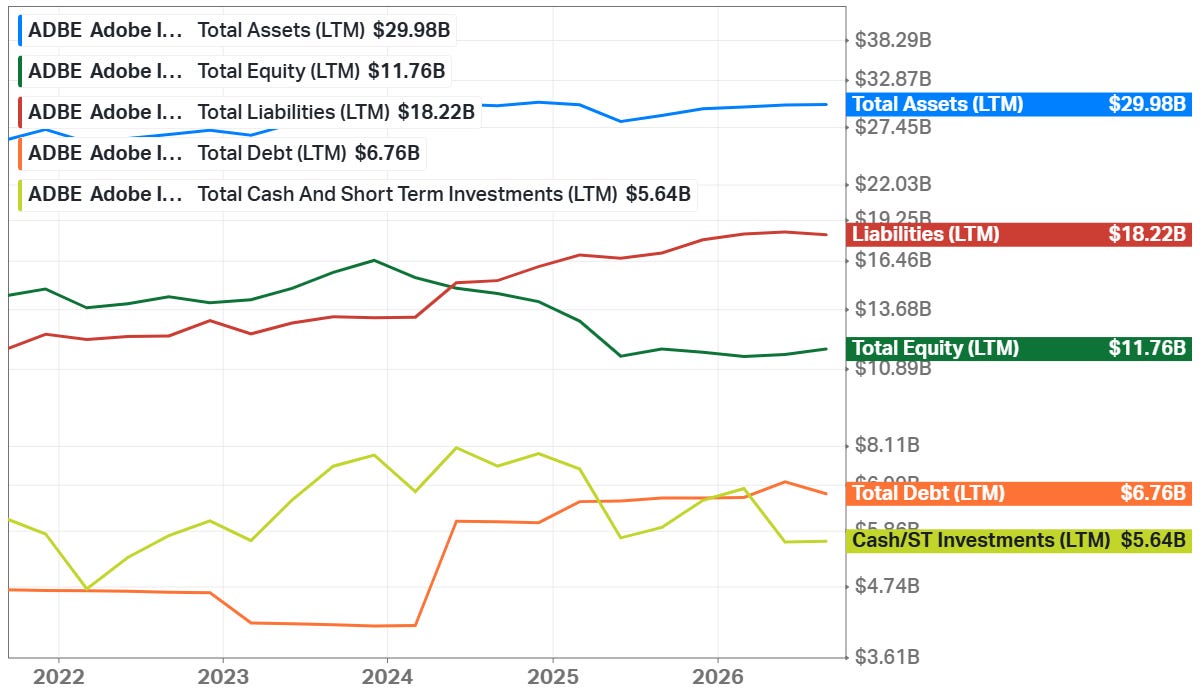
The balance sheet moved from net cash to net debt in 9 months. Cash and short-term investments decreased from $6.60B at the end of FY2025 to $5.64B, and borrowings increased from $6.21B to $6.36B. As a result, net cash of $0.39B became net debt of $0.72B. The Semrush deal explains most of it, since buybacks already use ~90% of FCF. Adobe paid ~$1.9B, ~4x the $471M of ARR that Semrush reported at the end of 2025. In 2025, Semrush grew revenue 18% with a 12% non-GAAP operating margin. In my view, the price is reasonable, but the deal adds growth, not margin. Worth noting that Koyfin's total debt of $6.76B also includes $0.40B of lease liabilities.
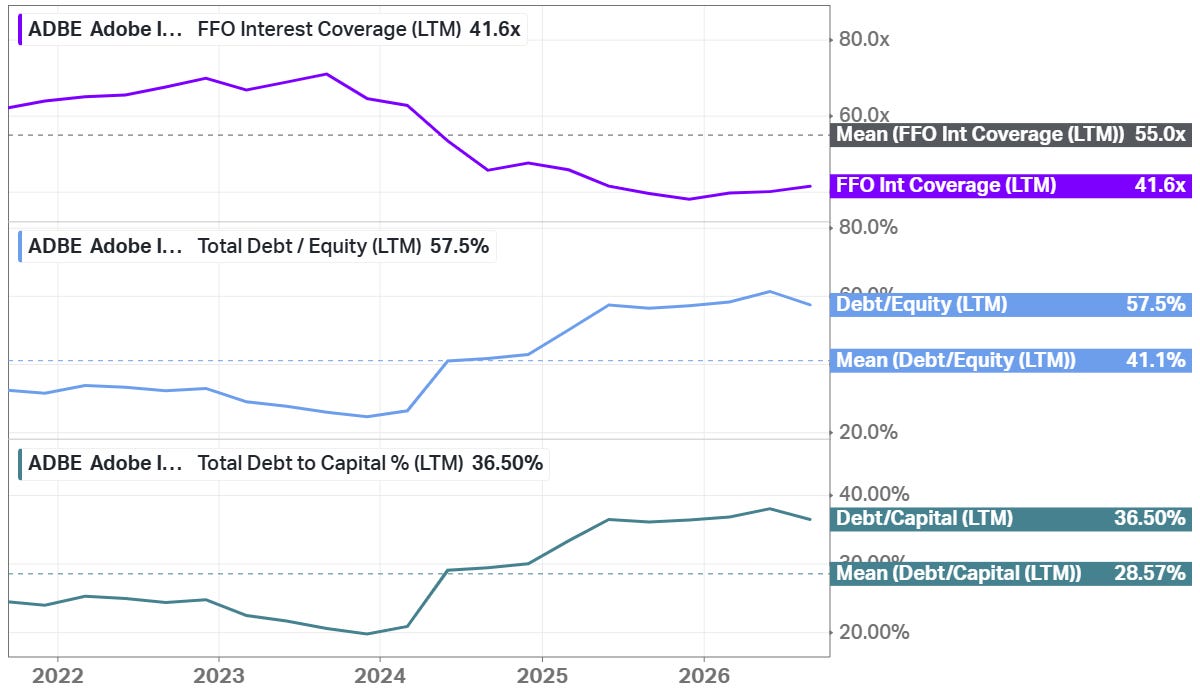
Leverage is still low relative to cash flow. Debt/Equity is 57.5% against a 41.1% 5Y mean, and Debt/Capital is 36.50% against 28.57%. Interest coverage based on funds from operations (FFO) is 41.6x against a 55.0x mean. The equity is small because of buybacks, so I prefer to compare debt with cash flow - total debt is 64% of one year of FCF.
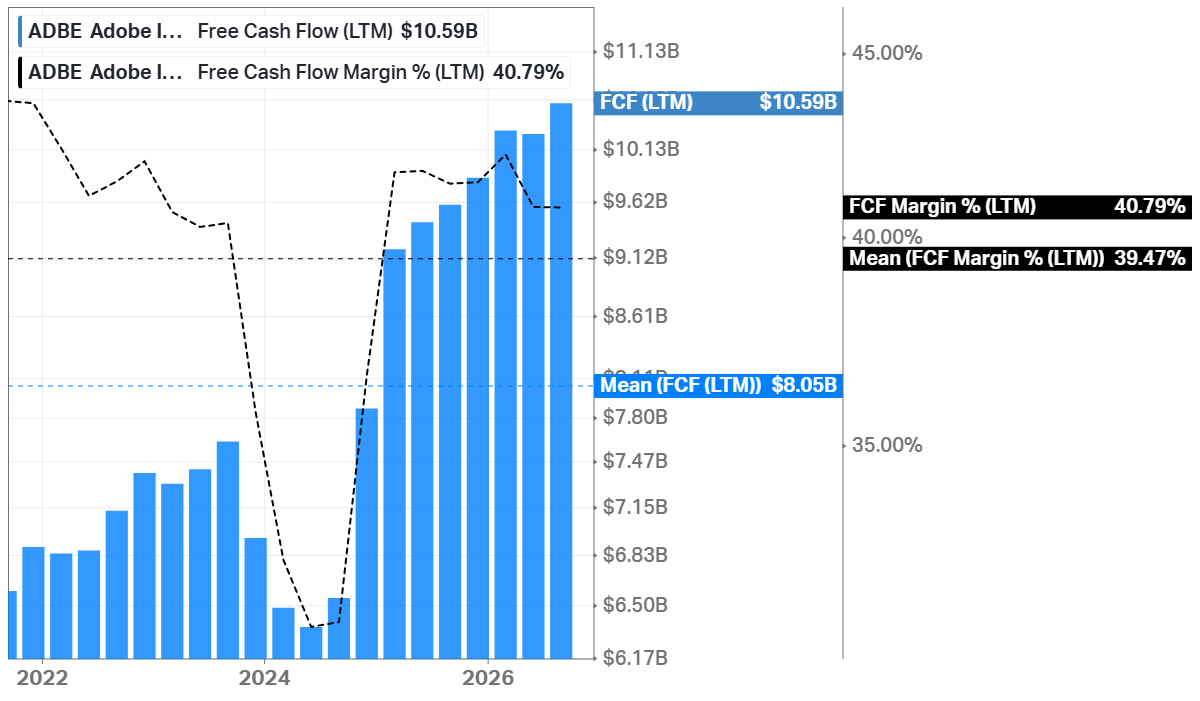
FCF reached $10.59B over the last 12 months, a 40.79% margin, against an $8.05B 5Y mean. Capex is $214M, less than 1% of revenue. Operating cash flow of $2.52B was a Q3 record.
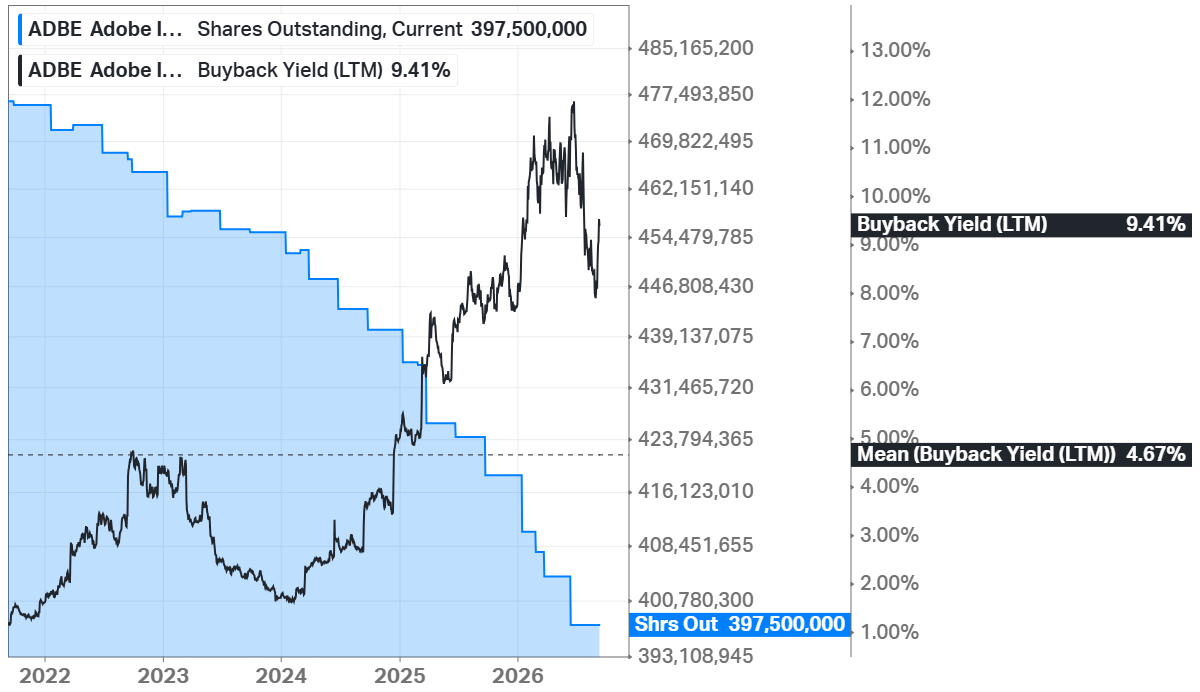
Adobe pays no dividend and returns cash through buybacks. The buyback yield is 9.41% against a 4.67% 5Y mean. The share count decreased from ~477M in 2021 to 397.5M. In Q3 alone, the company bought 9.5M shares for $2.23B, 92% of Q3 FCF, and $24.55B remains under the April 2026 authorization (~25% of the market cap). What I like: at 9.4x earnings, each dollar of buybacks retires ~2.6x more shares than at the 24.5x mean. Worth noting that past buybacks were made at much higher prices. In FY2025, Adobe bought 30.8M shares for $11.28B (~$366 per share on average), and ADBE now trades 31% below that average.
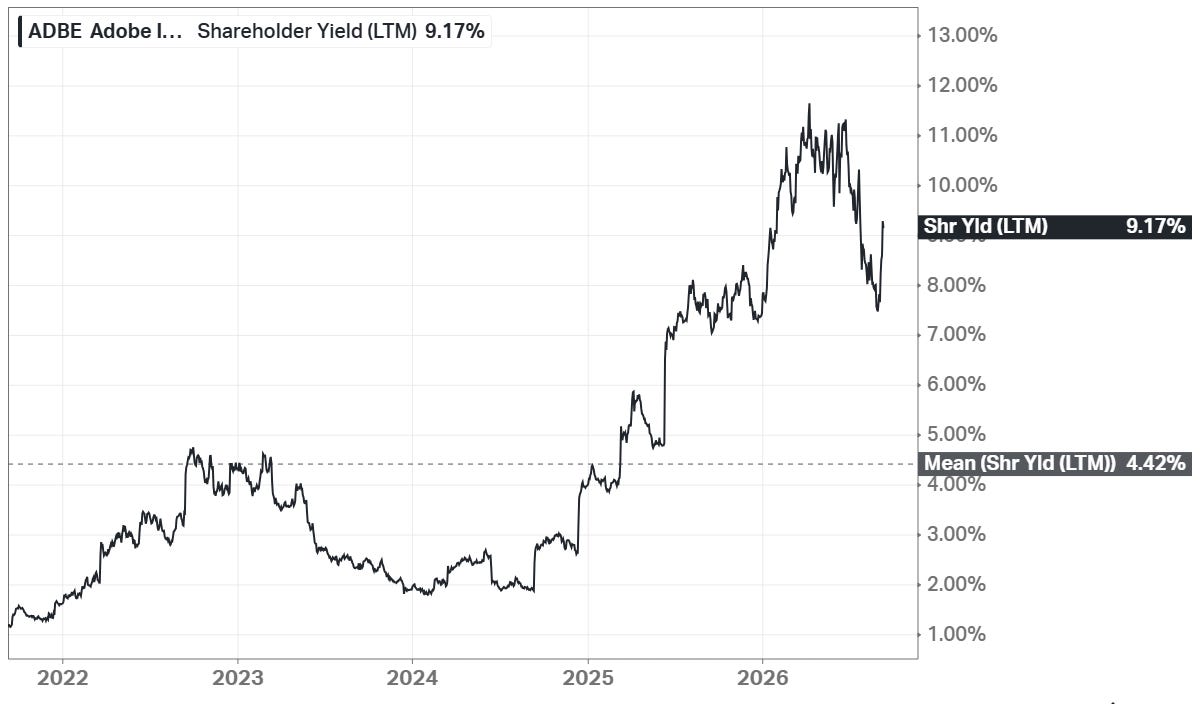
Shareholder yield is 9.17% against a 4.42% 5Y mean. It is 0.24 points below the buyback yield, since Adobe added a small amount of debt over the last 12 months.
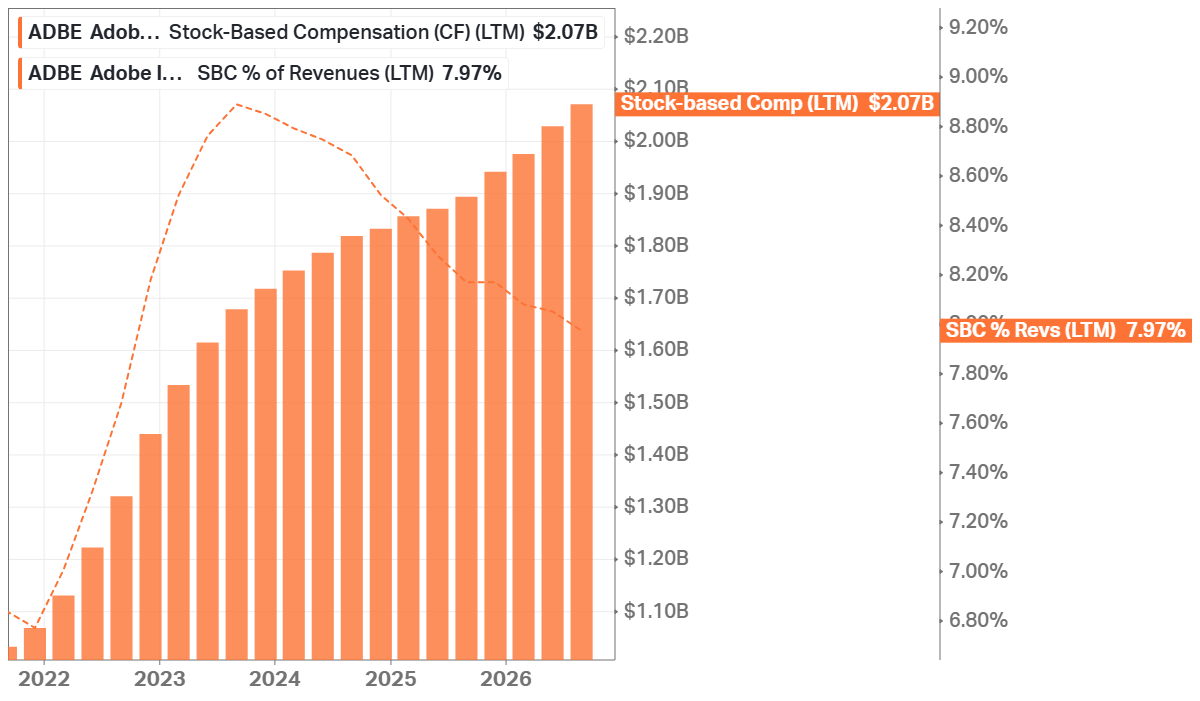
SBC is $2.07B, 7.97% of revenue, down from ~8.9% in 2023. The buybacks are ~4.6x SBC in dollars, so the share count decreases even after the dilution. At the same time, SBC is the main reason why the FY2026 GAAP EPS target (~$18) is ~26% below the non-GAAP one.
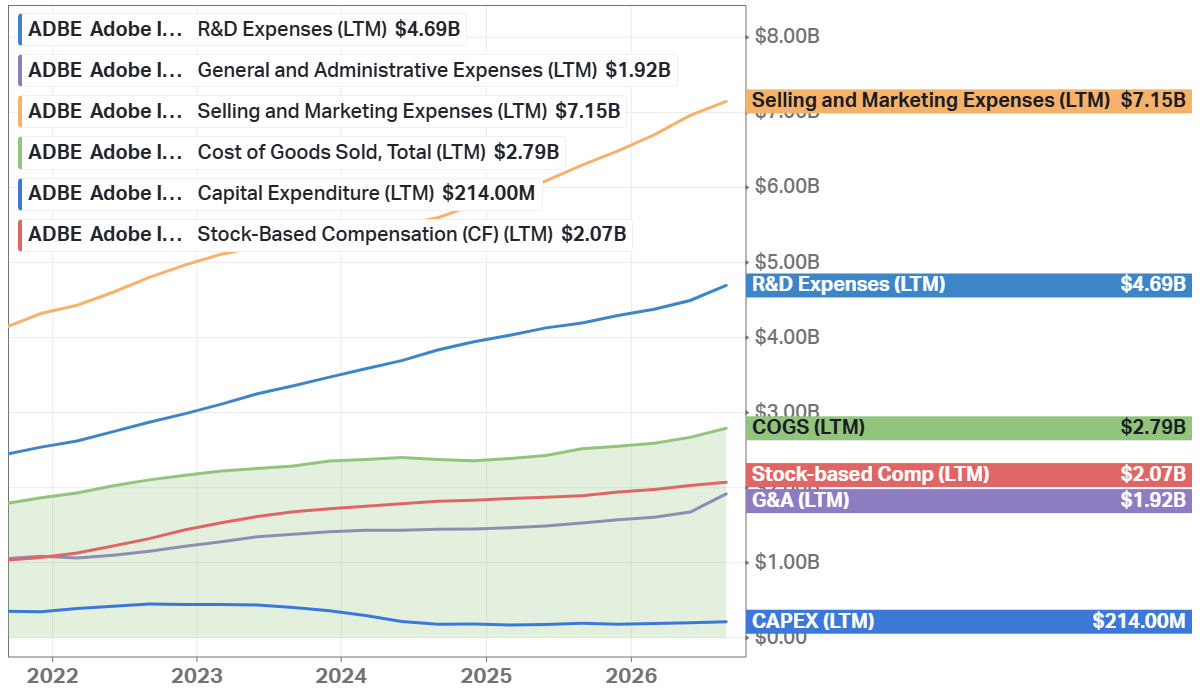
Operating costs grow faster than revenue this year. Over the last 12 months, sales and marketing were $7.15B, R&D $4.69B, G&A $1.92B, and cost of revenue $2.79B. In Q3, non-GAAP operating expenses increased 16% YoY against 13% revenue growth, and GAAP R&D expenses increased 18%. As a result, the non-GAAP operating margin decreased from 46.3% to 44.0%. By my estimate, Semrush explains ~0.6 points of that, since its margin is much lower. Management targets ~45% for FY2026 against 46.2% in FY2025.
In my view, the capital allocation is disciplined but not yet proven. The FY2025 buybacks lost value, and the extra spending has created users, not yet ARR.

Advantages
The cheapest high-return company in its group. ADBE trades at 9.4x forward earnings with a PEG ratio of 0.67, while Salesforce, Intuit (INTU), Autodesk (ADSK), and ServiceNow (NOW) trade at 13.3-29.3x. Adobe also has the highest ROIC and FCF margin of the 5.
Two standards nobody has replaced. PDF and Photoshop have been the defaults for more than 30 years, and more than 400 billion PDFs are opened in Acrobat every year. So far, AI tools have added users to Adobe’s free products instead of taking them away.
Cash flow that pays for the AI investment. $10.59B of FCF, capex of $214M, and $22.16B of contracted revenue in RPO. Adobe increased R&D 18% YoY in Q3 and still bought back ~$9.4B of stock over the last 12 months.
Buybacks at a low price. The diluted share count decreased 6.8% in 1 year, and $24.55B of authorization remains. Consensus expects ~9% revenue growth and ~13% EPS growth for FY2027. Most of the gap comes from buybacks.
The derating has already happened. From ~50x forward earnings in 2021 to 9.4x, while ROIC increased from ~26% to 39.19%. The downside from further derating is smaller at 9x than it was at 25x.
Disadvantages
AI competes for the seat. If a marketing team needs 3 Creative Cloud seats instead of 10, Adobe’s ARR decreases even if its AI features are the best. That would push revenue growth below the ~9% consensus for FY2027 and make the EPS estimates in my model too high.
Organic growth is slowing. Without Semrush, I estimate Q3 ARR growth at ~9% and the Q4 revenue guidance at ~8% growth. JPMorgan (JPM) notes that Adobe expects net new ARR to decline for the full FY2026.
Margins are declining. The non-GAAP operating margin decreased 2.3 points YoY in Q3, and the subscription gross margin decreased from 91.2% to 90.4%. If compute costs keep growing faster than revenue, EPS growth will come mostly from buybacks.
New management in a difficult year. A new CEO from Dec 01, the head of the creative business leaving, and an interim CFO since June. The planned Creative Cloud price changes are deferred, and the next CEO has to decide when to bring them back.
Net debt and GAAP earnings. Net cash became net debt of $0.72B in 9 months. On GAAP EPS, ADBE trades at 13.9x FY2026 earnings, not 10.3x. The difference is mostly SBC, which is a real cost to shareholders even when buybacks offset the dilution.
What the bears get right: the free products grow much faster than the revenue. ARR growth decreased to 11.2%, and ~2 points of that was bought with Semrush. Even an analyst with a positive rating says so. On Sep 11, JPMorgan cut its target from $340 to $315 and kept its Buy rating. The analyst pointed to 8% RPO growth and the deferred Creative Cloud pricing. If organic ARR growth falls below 7% and stays there, my 9x Bear Case multiple is too optimistic, not too conservative. In my view, the key risk is the conversion of free users into paying ones, not the quality of the AI features. Position size should reflect the chance that I am wrong here.
Competitors
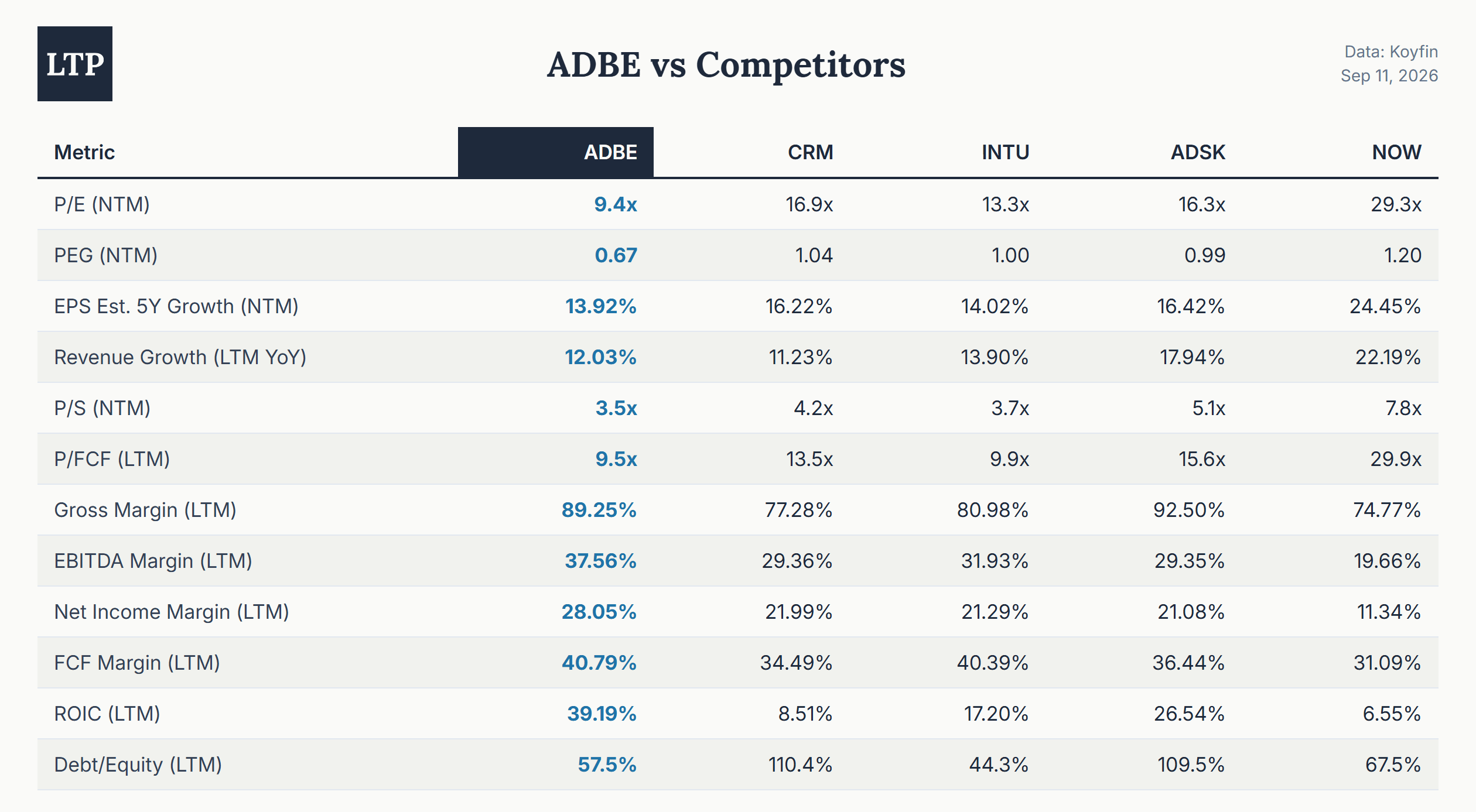
I compare Adobe with 4 large application software companies. Salesforce is the leader in customer and marketing software; Autodesk has the closest business model (design software sold as subscriptions); Intuit is a quality benchmark in application software; the market treats ServiceNow as a winner of AI in software. Figma and Canva compete more directly in design, but Figma has no 5Y history as a public company, and Canva is private.
ADBE is the cheapest of the 5 on every price multiple. The forward P/E is 9.4x against 13.3x for Intuit, 16.3x for Autodesk, 16.9x for Salesforce, and 29.3x for ServiceNow. Growth does not explain the gap. Consensus 5Y EPS growth is 13.92% for Adobe, 14.02% for Intuit, 16.22% for Salesforce, 16.42% for Autodesk, and 24.45% for ServiceNow. As a result, the PEG ratio is 0.67 for ADBE and 0.99-1.20 for the others. To compare, ServiceNow is expected to grow EPS ~1.8x faster and trades at ~3.1x the multiple. The weak spot is LTM revenue growth - Adobe's 12.03% is ahead of Salesforce (11.23%) only.
On returns and margins, Adobe leads the group. ROIC is 39.19% against 26.54% for Autodesk, 17.20% for Intuit, 8.51% for Salesforce, and 6.55% for ServiceNow. Adobe also has the highest net margin (28.05%), FCF margin (40.79%), and EBITDA margin (37.56%). Autodesk has the higher gross margin (92.50% against 89.25%). Debt/Equity of 57.5% is in the middle: Intuit is at 44.3%, ServiceNow at 67.5%, and Salesforce and Autodesk are above 100%.
In my view, no other company here has a ROIC above 30%, an FCF margin above 40%, and a P/E below 10x at the same time. The next-best alternative on quality is Autodesk, with a 26.54% ROIC and 16.42% expected EPS growth, but at 16.3x earnings. There are reasons for the discount. Adobe has the most direct exposure to AI-generated images and video of the 5, and its revenue growth is the second lowest. The market pays ~29x earnings for ServiceNow, which it sees as a winner of AI, and ~9x for ADBE, since it sees Adobe's creative software as a loser. So far, the data supports a much smaller difference than that.
Past
Q3 FY2026 (ended August 28, all USD, YoY):
Revenue +13% to $6.76B (+12% constant currency), including ~$120M from Semrush, by my estimate
Non-GAAP EPS +15% to $6.13, while non-GAAP net income increased 7%; GAAP EPS +11% to $4.62
Total ARR +11.2% to $27.50B; net new ARR $0.40B against $0.66B a year ago
Non-GAAP operating margin 44.0% against 46.3% a year ago
Operating cash flow $2.52B (a Q3 record); 9.5M shares repurchased for $2.23B
LTM: revenue $25.97B, net income $7.29B, FCF $10.59B, and ROIC 39.19%
Why did ADBE fall 14% in the first 2 weeks of September? Most of the move happened before the report. The reasons, from the largest to the smallest:
The leadership change. On Sep 03, the board chose Anil Chakravarthy as the next CEO, and David Wadhwani said he would leave. ADBE fell 6.73% on Sep 04 and 3.47% on Sep 08.
The Q4 revenue guidance. The $6.825B midpoint is 0.4% below the $6.85B LSEG consensus and implies ~10% growth after 13% in Q3. Adobe beat the midpoint of its own Q3 revenue guidance by $65M but raised the full-year target by only $51M, so the implied Q4 decreased by ~$14M.
The organic slowdown. Without Semrush, the Q4 guidance is ~8% growth, by my estimate.
The forward indicators. RPO grew 8% YoY to $22.16B, after 13% in Q2.
Freemium without conversion yet. The free products bring users, but ARR growth decreased, and the planned Creative Cloud price changes are deferred.
At the same time, the report itself was solid. Revenue, EPS, and both customer groups came in above the top of Adobe’s own guidance. Revenue beat the LSEG consensus by 0.9% and EPS by 0.7%, and consensus FY2027 EPS increased from $27.50 to $27.67 the day after the report. On Sep 11, ADBE closed 1.4% higher. In my view, the leadership change explains the size of the move better than the numbers do, since the report changed the implied Q4 revenue by only ~$14M.
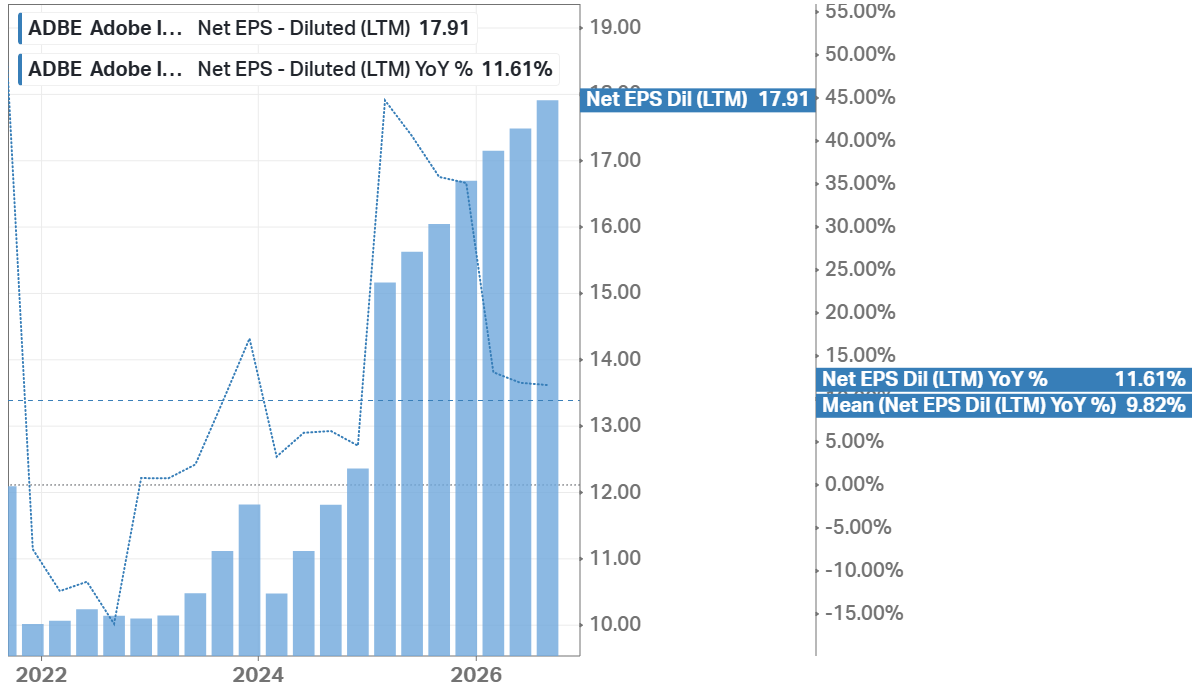
The longer history is more important. GAAP EPS increased from $10.02 in FY2021 to $17.91 over the last 12 months, and LTM EPS growth is 11.61% against a 9.82% mean. In FY2021, GAAP EPS decreased 7% after a one-time tax benefit in FY2020, and in FY2022, it increased only 0.8%. Consensus forward EPS more than doubled over 5 years, from ~$13 to $26.89.
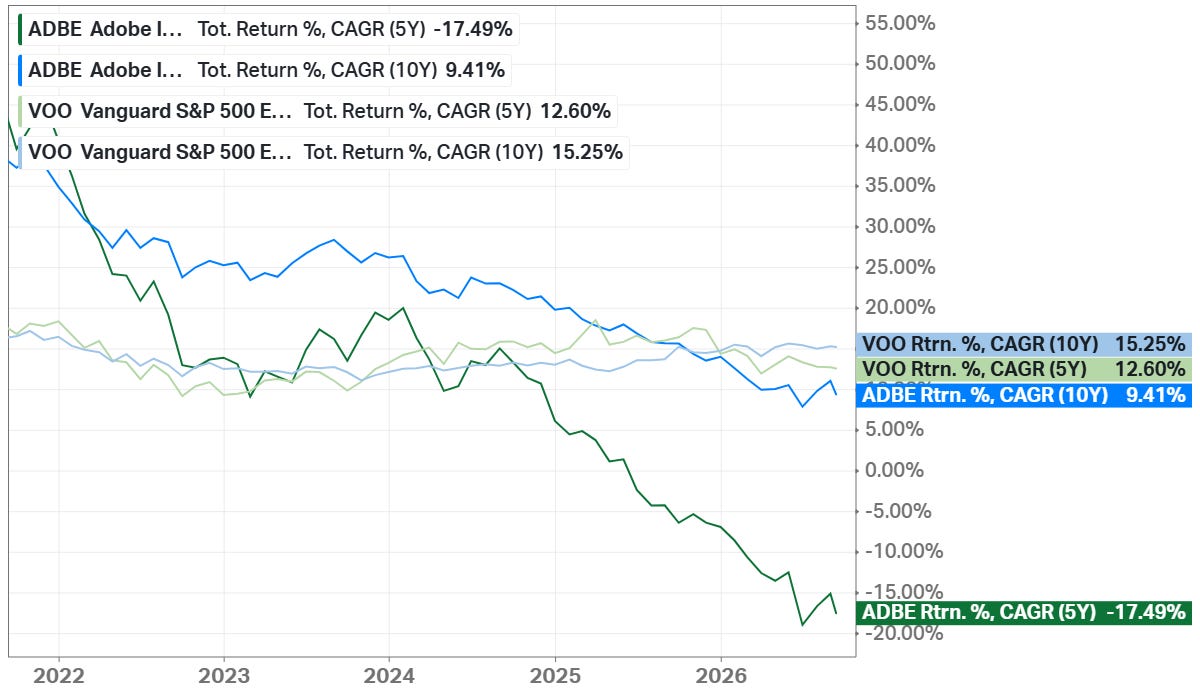
At the same time, the stock was a poor investment. The total return was -17.49% per year over 5 years against 12.60% for the S&P 500 (VOO), and 9.41% per year over 10 years against 15.25%. The whole difference is the multiple, which decreased from ~50x forward earnings in 2021 to 9.4x.
Future
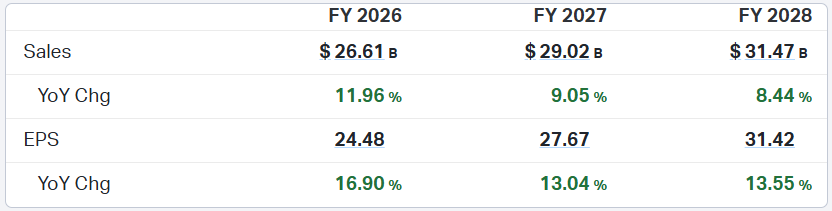
Consensus revenue: FY2026 $26.61B (+11.96%), FY2027 $29.02B (+9.05%), FY2028 $31.47B (+8.44%) - the slowdown is already in the estimates
Consensus EPS: $24.48 -> $27.67 -> $31.42 (FY2026-FY2028); the FY2026 number is inside the company’s guidance, and FY2027 EPS increased 1.0% since Aug 24
5Y forward EPS growth estimate: 13.92%, against a 15.88% 5Y mean and below the -1 standard deviation band (14.52%); it decreased from ~17.6% at the end of 2024 to ~13% in early 2026. To compare, non-GAAP EPS grew ~14% per year from FY2021 ($12.48) to FY2025 ($20.94)
Analysts: 23 of 40 rate the stock Hold (4 Strong Buy, 8 Buy, 23 Hold, 4 Sell, and 1 Strong Sell), average target $279.05, +10.63% from here (the range is $190.00 to $377.07)
Company guidance: FY2026 revenue $26.576-26.626B, non-GAAP EPS $24.45-24.50, ending ARR growth 10.2% (Semrush included), and non-GAAP operating margin ~45%; Q4 revenue $6.80-6.85B and non-GAAP EPS $6.30-6.35
What has to happen for the thesis to work. Consensus expects ~9% revenue growth and ~13% EPS growth in FY2027. In my view, this is realistic if three things happen: organic ARR growth stays at ~8-9%, the non-GAAP operating margin stops declining at ~44%, and buybacks keep reducing the share count by ~5% a year. The buybacks are the most reliable part, since they depend on FCF, not on AI. The first two are the ones to check. My model assumes 13.92% EPS growth per year for 5 years, so all three have to hold well beyond FY2027. The next checkpoints are Adobe MAX in November and the December report, which normally includes the targets for the next fiscal year and will be the first one under the new CEO.
Current Valuation
Current vs 5Y mean:
Price/Fwd Earnings: 9.4x vs 24.5x
Price/Fwd Sales: 3.5x vs 9.1x
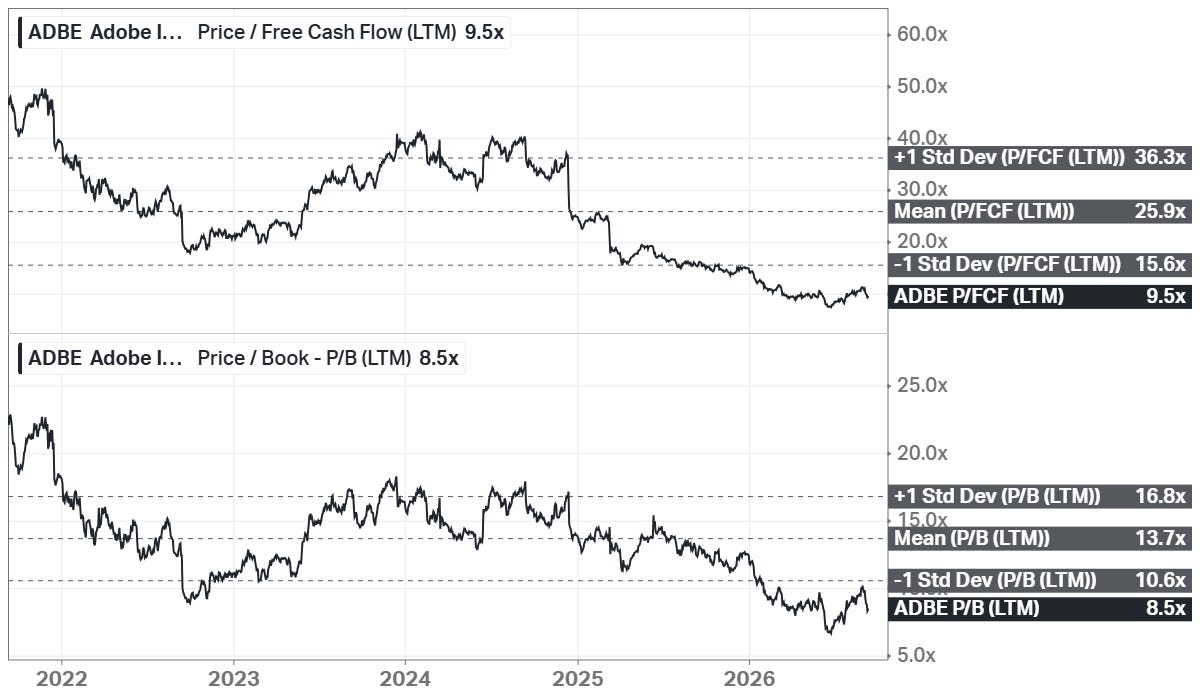
Price/FCF: 9.5x vs 25.9x
Price/Book: 8.5x vs 13.7x
PEG: 0.67 vs 1.57
Forward Earnings Yield: 9.7%
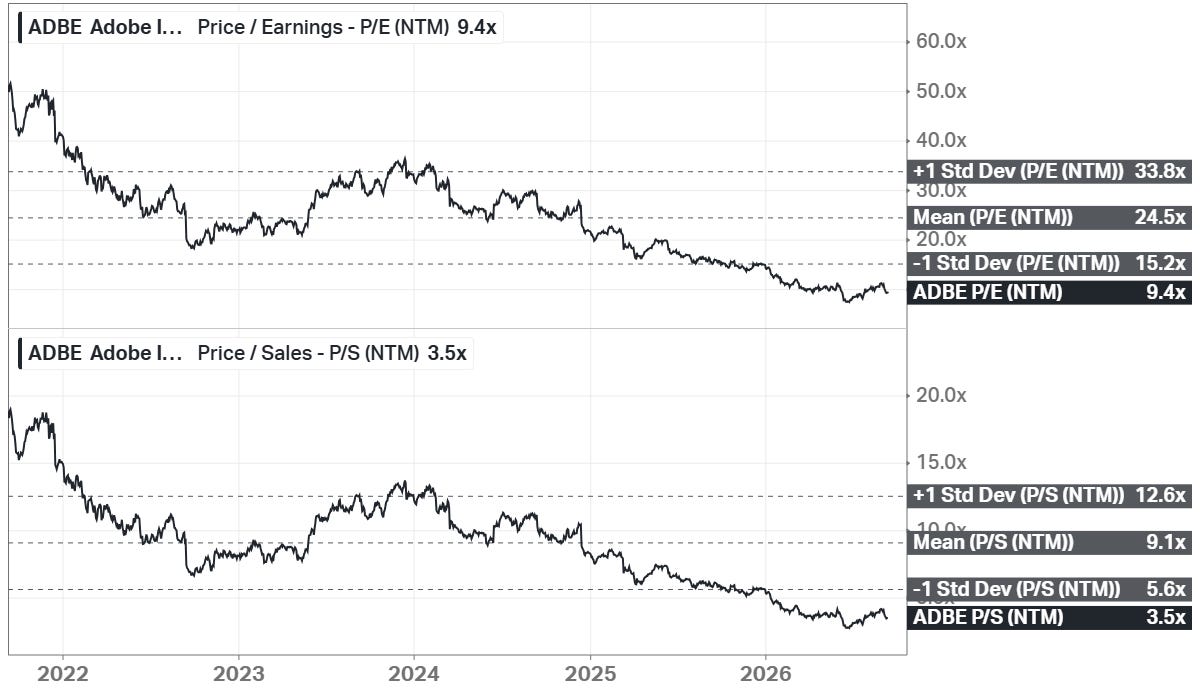
All five multiples are below their -1 standard deviation bands. The forward P/E is 9.4x against a 15.2x band, Price/Sales is 3.5x against 5.6x, and Price/FCF is 9.5x against 15.6x. ADBE trades at a 9.7% forward earnings yield and a ~10.6% FCF yield. To compare, the 4 competitors trade at 13.3-29.3x forward earnings. In my view, these yields are high for a company whose revenue still grows ~11% organically.
Analyst’s note:
The 5Y means include late 2021, when ADBE traded at 40-50x forward earnings, so the 24.5x P/E mean is inflated, and I do not use it as the Base Case. Also, Koyfin’s 9.4x uses next-12-months EPS (mostly FY2027, since the fiscal year ends in November). On FY2026 EPS of $24.48, the P/E is 10.3x. The exit multiples in my model start from today’s 9.4x.
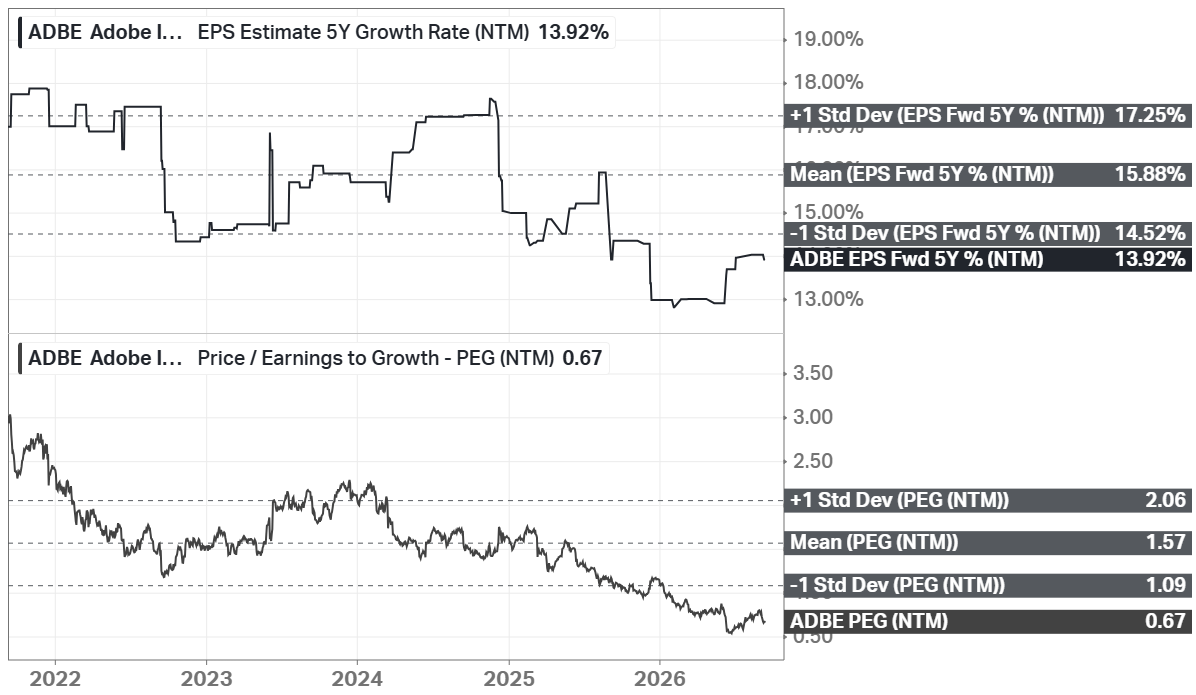
The market cut the multiple much more than the growth. The 5Y EPS growth estimate decreased from a 15.88% mean to 13.92%, while the PEG ratio decreased from a 1.57 mean to 0.67. Even at the mean growth rate, today’s P/E would be a PEG of ~0.6.
What does the price already assume? With my 12% required return, ADBE needs ~15% annual EPS growth if the multiple stays at 9x. If the multiple recovers only to 12x, ~9% EPS growth is enough, and at 15x, ~4% is enough.
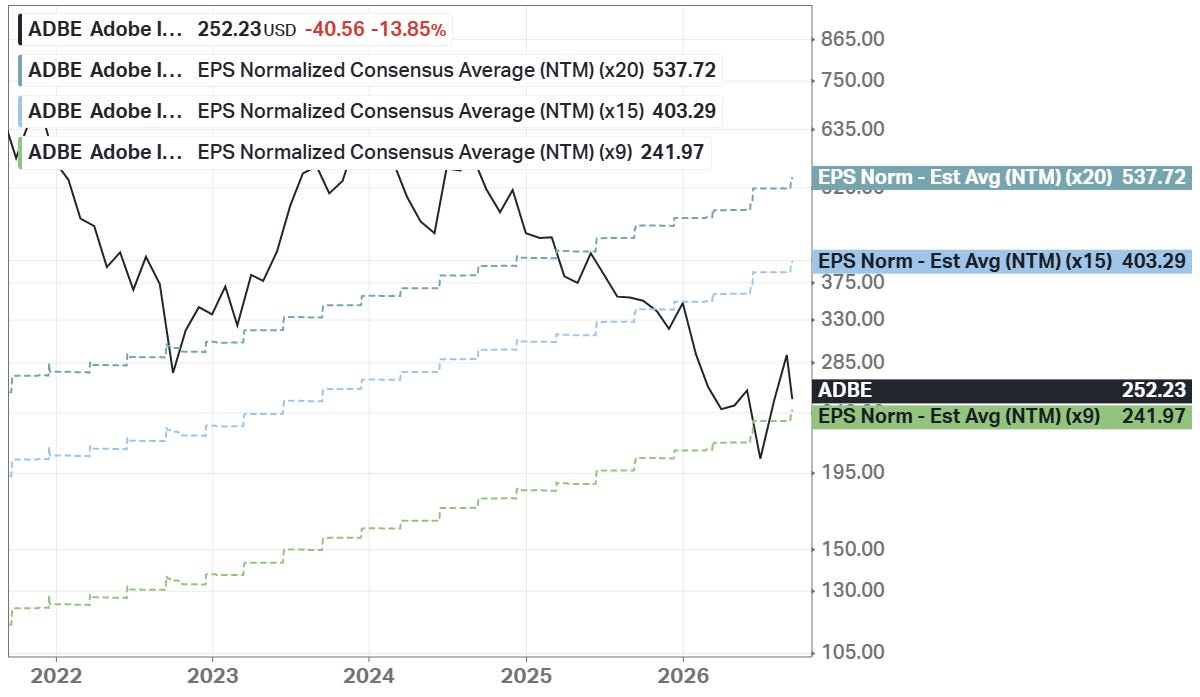
One chart frames this whole section. It applies the three exit multiples of my model (9x, 15x, and 20x) to the consensus forward EPS and compares the result with the price.
Fair Price
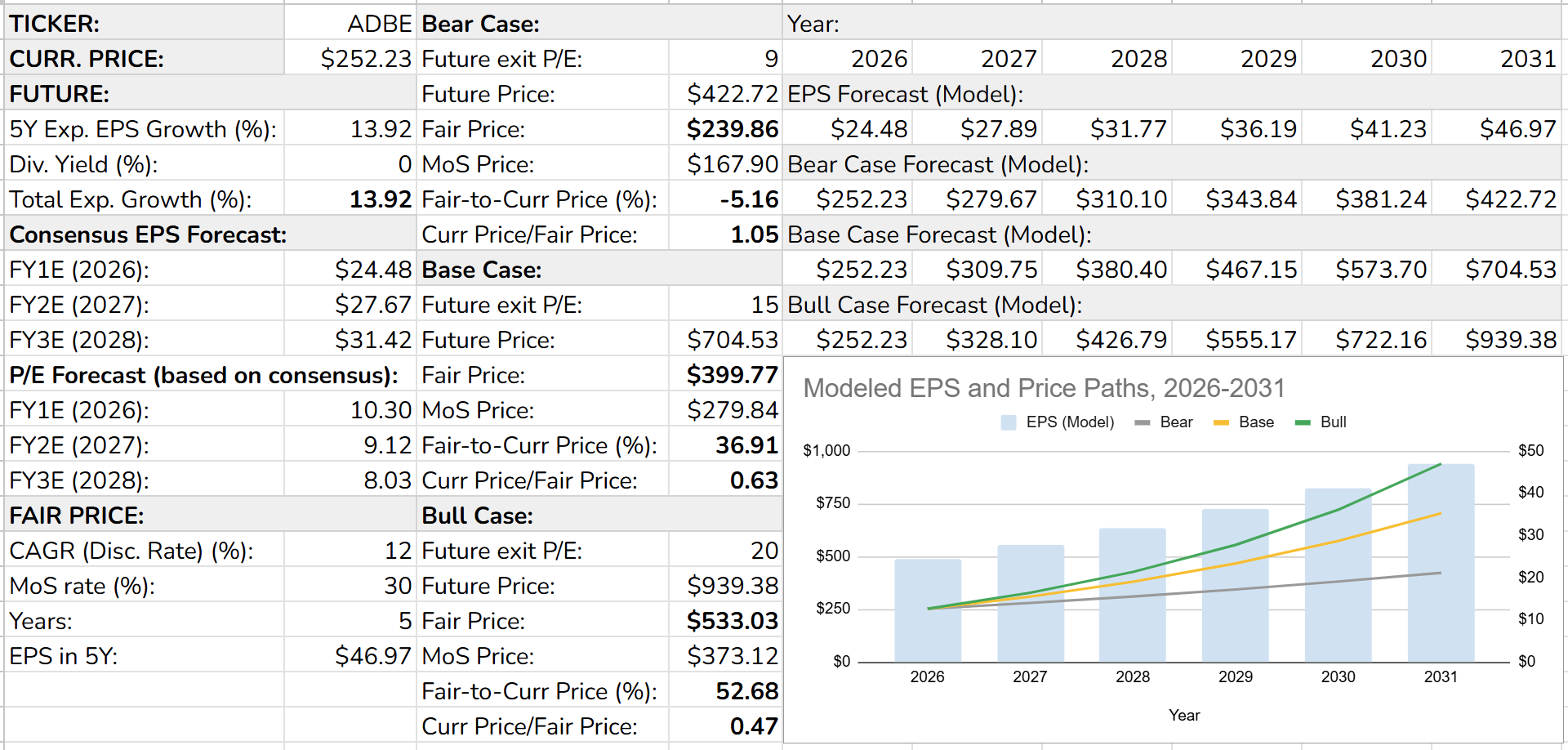
My model projects consensus EPS 5 years forward. It takes the risk of overly optimistic estimates into account by capping future growth at 20% per year. Here the cap does not bind. The consensus 5Y estimate is 13.92% per year, and Adobe pays no dividend, so the model uses 13.92%. Starting EPS is $24.48 (FY2026), which compounds to $46.97 in FY2031.
The discount rate is 12%; the margin of safety is 30%. The exit multiples are 9x, 15x, and 20x. 9x is today’s multiple rounded down, so this case assumes the market never re-rates ADBE, even with 14% EPS growth. 15x is the -1 standard deviation band (15.2x), where ADBE traded at the end of 2025, and a PEG of ~1.1. 20x is a PEG of ~1.4 and still below the 24.5x 5Y mean, which the 2021 period inflates.
Bear Case (exit P/E 9x): fair price $240 - MoS price $168
Base Case (exit P/E 15x): fair price $400 - MoS price $280
Bull Case (exit P/E 20x): fair price $533 - MoS price $373
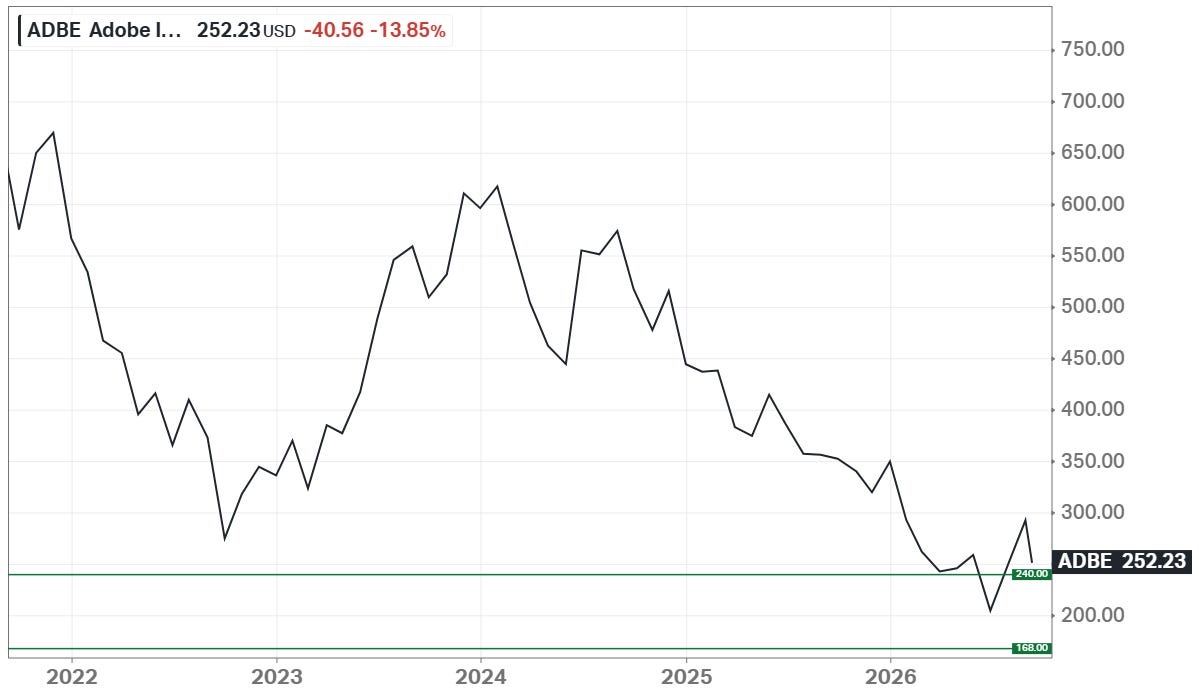
At $252, ADBE trades 5% above the Bear Case fair price and 37% below the Base Case. The accumulation zone is $168-240. The model is sensitive to growth. At 10% annual EPS growth instead of 13.92%, the fair prices decrease to $201/$336/$447, and ADBE would be 25% above the Bear Case. Since growth is the least certain input here, the lower end of the zone ($168) is a more conservative anchor than the Bear Case fair price. Worth noting that the Base Case of $400 is 6% above the highest street target ($377). The corridor is more optimistic than the street on the multiple, with the same consensus EPS.
Due Diligence
Profitability (11 of 15):
Positive Gross Profit: $23.18B
Positive Operating Income: $9.27B
Positive Net Income: $7.29B
Positive FCF: $10.59B
Gross margin >= 40%: Yes (89.25%)
Net margin >= 10%: Yes (28.05%)
FCF margin >= 10%: Yes (40.79%)
Management (ROIC, ROE, ROA) >= 10%: Yes (39.19%/61.90%/19.73%)
Strong 3Y Revenue Growth: No (~10.5% per year)
Revenue Growth Forecast: No (~10% per year over the next 3 years)
ROE is increasing: ~36% -> 62%
ROIC is increasing: ~26% -> 39%
Revenue surprises in the last 5Y in a row: No (in line in Q3 FY2022 and Q4 FY2022)
EPS surprises in the last 5Y in a row: Yes
EPS growth YoY 5Y in a row: No (GAAP decline in FY2021 after a one-time tax benefit in FY2020)
Financial Strength (5 of 6):
Total assets ($29.98B) exceed total liabilities ($18.22B) by 1.65x
Negative Net Debt: No ($0.72B of net debt, with cash and short-term investments of $5.64B against $6.36B of borrowings)
Low Debt/Equity: 0.58 (5Y mean: 0.41)
Debt/Capital: 0.37 (5Y mean: 0.29)
Interest coverage (FFO): 41.6x
Piotroski F-Score: 8 of 9 (not passed: higher current ratio YoY)
Valuation and Advantage (3 of 4):
Valuation < 5Y mean: Yes
Valuation < the industry: Yes (the lowest P/E, P/S, and P/FCF among the competitors)
Does it have a moat: Yes (narrow)
Outperformed the S&P 500 over 5Y: No (-17.49% vs 12.60% CAGR)
Shares (2 of 3):
Insider ownership >= 5%: No (0.45%)
Fewer shares outstanding YoY: Yes (395M vs 424M diluted)
Insider buys in the last 6M: Yes (a director in June)
Price (4 of 4):
1Y price forecast > 10%: +10.63%
Next 5Y EPS growth estimate (CAGR) > 10%: Yes (13.92%)
DCF Value: ~$579 (base case: revenue growth 7.7% - below consensus, 8.8% discount rate); undervalued by ~56%
Short Interest < 5%: Yes (4.5%)
Verdict
ADBE belongs in a long-term portfolio as a satellite value position, not as a core holding, until organic growth and the operating margin stabilize. The company is the standard in documents and creative software, with more than 1 billion monthly users, an 89% gross margin, a 39% ROIC, and $10.6B of FCF that goes into buybacks. ADBE is priced at 9.4x forward earnings and a PEG of 0.67, below its -1 standard deviation band on every multiple. My model uses the consensus 13.92% growth and today’s 9x multiple as the Bear Case. The fair price corridor is $240-533, and the accumulation zone is $168-240. At $252, ADBE is just above that zone. In my view, the realistic bear case is not a crash but dead money: organic ARR growth slides to ~7%, the multiple stays at 9x, and the return is mostly the buyback yield. Accumulate inside the zone with a multi-year horizon, and judge the thesis on organic ARR growth and the non-GAAP operating margin, not the share price.
One-Pager
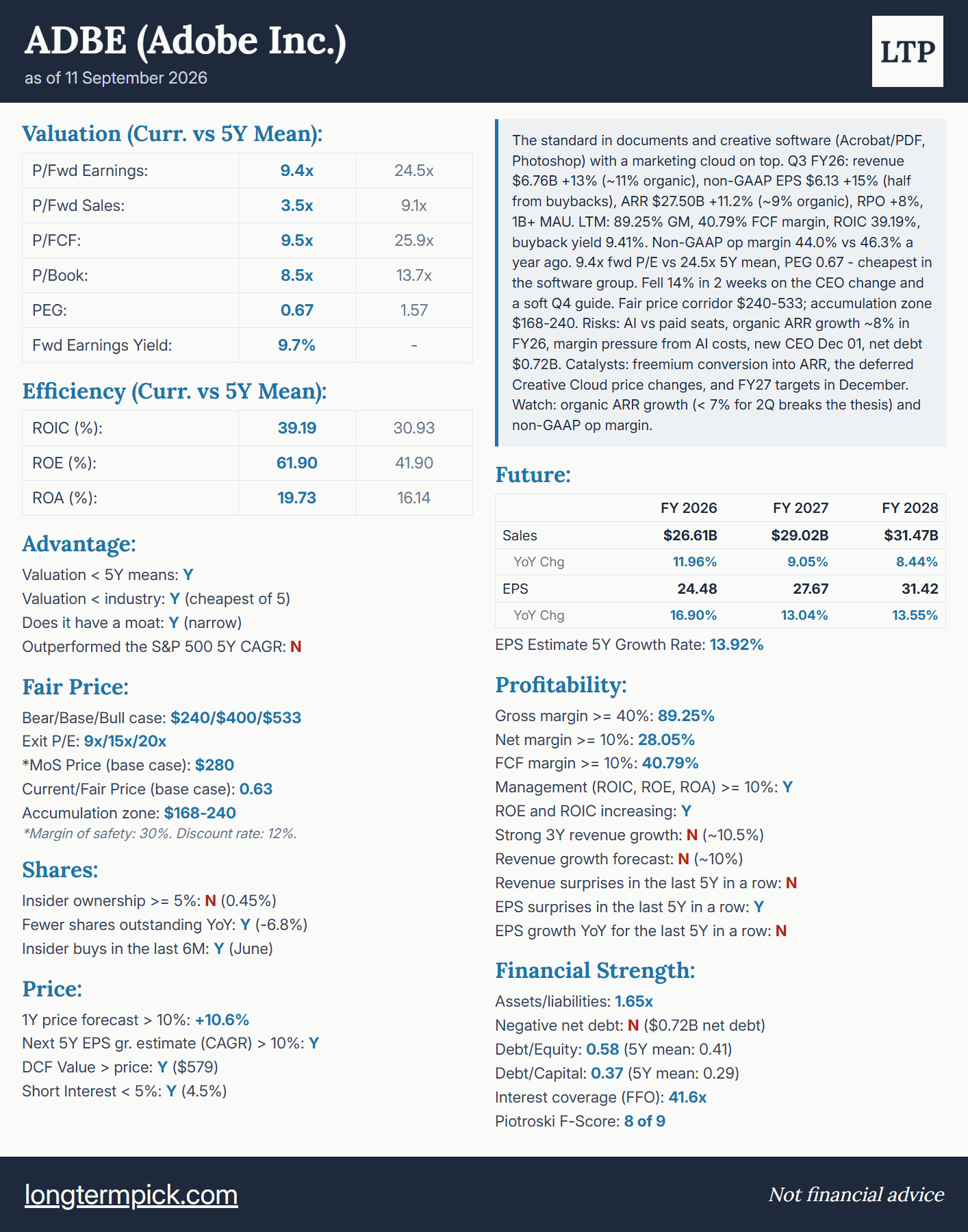
This is not a financial or investing recommendation. It is solely for educational purposes.