

Paid subscribers read this analysis before Tuesday. Upgrade to get the next one early.
Analyst’s note:
All prices and multiples in this post are as of the Sep 15 close ($150.39). On Sep 16, the stock closed at $161.49, 7% higher, and the price is now above my $106-151 accumulation zone. The fair prices and the zone do not change, since they do not depend on the price. What changes: the forward P/E is ~22x instead of 20.6x, the PEG ratio is ~0.44 instead of 0.41, the stock is 18% below the Base Case instead of 23%, and the drop since the report is 22%, not 27%. The rule from the Verdict stays the same: accumulate gradually inside the zone.
TL;DR: Credo (CRDO) sells the connections inside AI clusters: active electrical cables (AECs), optical transceivers and the chips inside them, and retimers. The Q1 FY2027 report was another beat, and the company raised its full-year growth outlook to more than 85%. At the same time, the stock fell 20% the next day and is now 42% below its mid-August price. I see smaller beats, not a weaker business. The rest of the year depends on a new optical business, and stock-based compensation (SBC) is close to 20% of revenue in the Q2 guidance. Verdict: a very profitable company priced as if its growth were temporary. CRDO trades at 21x forward earnings for 50% consensus EPS growth, and the price is just inside the zone of my model; my full fair price math and the accumulation zone are at the end of this post.
Investment Thesis
Credo reported Q1 FY2027 on Sep 01 with record revenue, a higher full-year growth outlook, and record non-GAAP EPS of $1.20. CRDO fell 20% the next day and 27% in 2 weeks. It is now 50% below its June high, while consensus EPS for the next 12 months is at a record. My idea here is to check whether the report changed the long-term economics of the company or only the shape of this year.
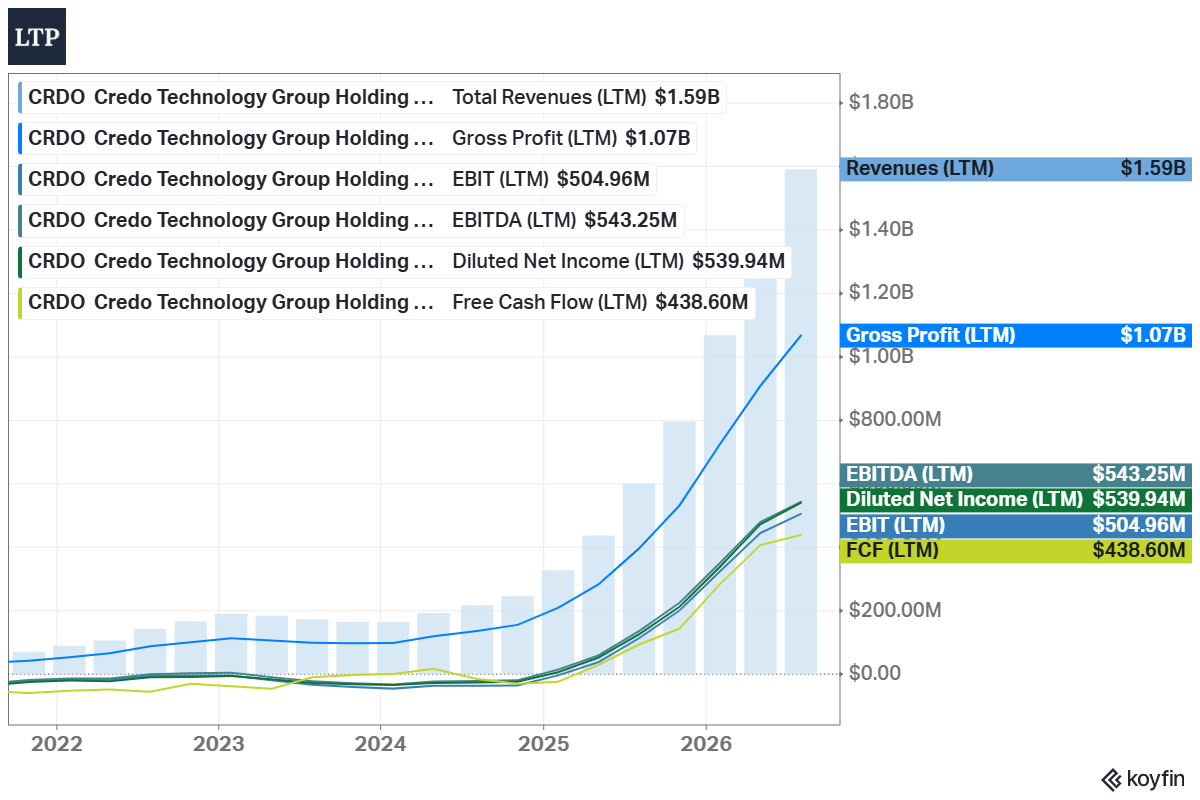
Growth is still very high, but the beats became small. Revenue increased 115% YoY to $479.0M, the seventh quarter in a row of triple-digit growth. In the three quarters before Q4 FY2026, Credo beat the top of its own revenue guidance by 12-18%. In the last two quarters, the beat was below 1%.
The market prices in a much weaker future than analysts expect. The consensus 5Y EPS growth estimate is 50.0%, and CRDO trades at 20.6x forward earnings, a PEG ratio of 0.41. At a 12% required return and a 22x exit multiple, today’s price needs only ~14% annual EPS growth.
The business is already very profitable. LTM gross margin is 67.07%, net margin 33.83%, and ROIC 20.8%. FCF over the last 12 months is $439M. Credo has no borrowings and $764M of cash and short-term investments.
The multiple is near the bottom of its range. CRDO trades at 20.6x forward earnings, 25% above its 16.5x -1 standard deviation band. The 88.7x mean since the IPO comes from the loss-making years, so I do not use it. And this despite the fact that analysts expect record EPS for the next 12 months.
The bear case: two customers bring 71% of revenue, the second half depends on optical products that have just started to ship, SBC is ~20% of revenue in the Q2 guidance, and the diluted share count increased 5% in 1 year. My model takes this into account by capping future growth at 20%, far below consensus, and by using the 17x -1 standard deviation band as the Bear Case exit. Even with these limits, the price of $150 is $1 under my Bear Case fair price ($151).
Analyst’s note:
EPS in this post is non-GAAP, since the estimates are built on it. The difference is large. In Q1, GAAP EPS was $0.67 against $1.20 non-GAAP, mostly because of SBC, acquisition costs, and the amortization of acquired intangibles. The 71% is the share of the two largest contracting customers in the 10-Q. By end customer, the top four brought 84% of revenue.
Company Overview
Next Earnings Date: Dec 02, 2026 (estimated)
Market Cap: $28.27B
Sector: Information Technology | Industry: Semiconductors
Type: Large Growth
Short Interest: 3.3%
Credo Technology Group was founded in 2008 in San Jose, California, and it is incorporated in the Cayman Islands. It started with serializer/deserializer (SerDes) technology - the circuits that move data between chips at high speed. Its engineers began to work on active electrical cables in 2017, and production of the first HiWire AECs started in 2019. An AEC is a copper cable with Credo chips at both ends, which clean and boost the signal. Credo created this product category, and AECs are still its largest business. The IPO was in January 2022 at $10 per share. Bill Brennan has been CEO for 13 years, and the two founders, Lawrence Cheng (CTO) and Job Lam (COO), are still in management and on the board.
The product range has four groups. AECs connect GPUs and servers with the first switch at distances of up to 7 meters. The optical business includes digital signal processors (DSPs) for optical transceivers, silicon photonics photonic integrated circuits (PICs) from the DustPhotonics acquisition, and ZeroFlap optical transceivers that Credo builds itself. Retimers (Screaming Eagle, Blue Heron, and Toucan) keep the signal clean inside servers and in scale-up networks. The rest is SerDes IP licensing and chiplets. Most products work with PILOT, Credo’s diagnostics software. The company is fabless - TSMC (TSM) makes its chips, and Amkor (AMKR) and ASE (ASX) package and test them. 616 of its 807 employees are engineers, according to the 10-K.
Credo sells to hyperscalers and neoclouds directly and through cable and optical module makers. By shipment destination (Q1 10-Q), 53% of Q1 revenue went to the US, 19% to Hong Kong, and 16% to Malaysia. Mainland China decreased from 23% of revenue a year ago to 0.2%.
Market Overview
The optical market is growing faster than almost any other part of the data center. According to LightCounting (January 2026), sales of Ethernet optical transceivers and co-packaged optics (CPO) for AI clusters reached $16.5B in 2025 and should reach $26B in 2026, +60% in both years. In April 2026, it forecast 65% growth for all Ethernet transceivers in 2026, after +93% in 2024. In March 2026, it wrote that there is “a reasonable chance” for AI cluster optics to reach $100B per year by 2030. To compare, Credo’s optical target of more than $600M for FY2027 is less than 3% of the 2026 market.
Copper still makes most of the connections, and AECs extend its reach. According to Brennan, copper is still more than 95% of the connections in a data center, the same share as 12 years ago. AECs cover the short end of the pluggable market, up to 7 meters. According to Brennan, the only switch between the two media so far went the other way - copper replaced optics at lengths of up to 7 meters, first of all because it is more reliable, and also because it uses less power. Credo does not report AEC revenue separately, but management says it more than doubled in FY2025 and more than tripled in FY2026. I did not find a reliable, recent third-party estimate of the AEC market. The published ones are far below Credo’s own AEC sales (AECs brought over $230M of extra revenue in Q1 alone), so I do not use them.
The buyers are few. LightCounting estimates that four cloud companies are responsible for more than 50% of AI spending on optical transceivers: Amazon (AMZN), Google (GOOGL), Meta (META), and Microsoft (MSFT). In its January report, it also expects optics to be 3.1% of the capex of the top 5 cloud companies in 2026, up from 2.7% in 2025. Credo has the same structure on a smaller scale, with two customers at 71% of revenue.
The risk is the timing, not the size. In its newest forecast (April 2026), LightCounting writes that demand exceeds supply by 30%, and that the shortages should go away by the end of 2026. It also warns that transceiver sales usually drop once the shortages ease, even while capex still grows: "This will happen again in the current cycle, but we just don't know when." In March, it pointed to a possible flat or negative year in 2027-2028. Credo plans its fastest growth for exactly this period: ~20% QoQ in Q3 (November-January) and ~30% in Q4 (February-April). In my view, this is the most important market question for CRDO today. A pause in orders across the industry would hurt a company whose guidance needs acceleration.