

Content:
• $600B AI Spending Is Coming
• AI CapEx Hits 54% of Sales
• AppLovin Shows Extreme Profitability
• NVIDIA Approaches $1B Per Day
• Global Uncertainty Hits Record High
• Buffett Sold 77% of Amazon
• Big Tech’s Lowest Level of Buybacks
• Diversification Works Again
$600B AI Spending Is Coming
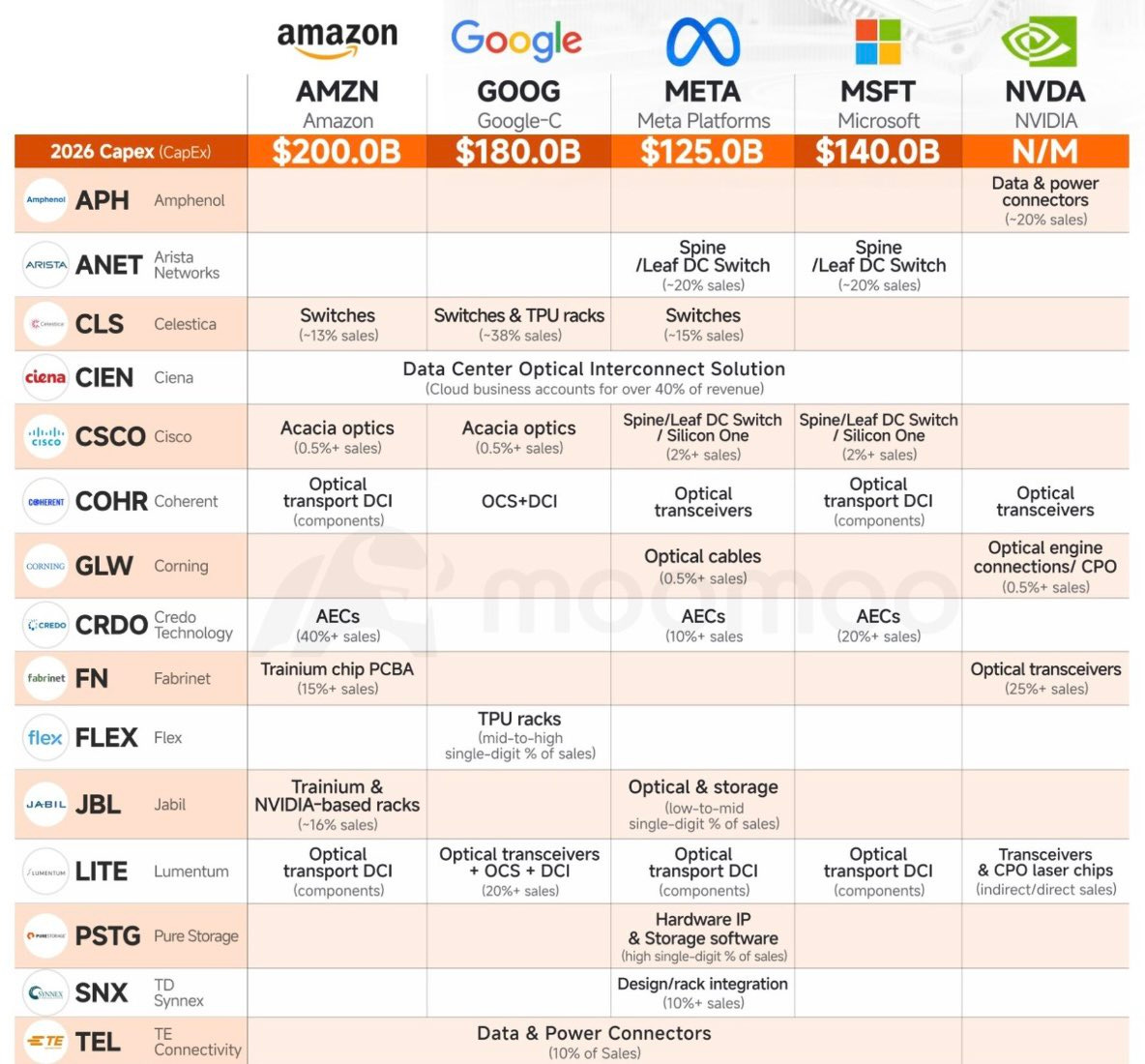
Major tech companies are planning enormous capital spending on AI infrastructure in 2026. Amazon, Google, Microsoft, and Meta alone are expected to invest well over $600B combined over the next cycle, building data centers, networks, and compute capacity.
The key investment question is not whether AI demand will grow, but which parts of the supply chain capture pricing power. Chips get the most attention, but networking, optical components, and system integration are also critical parts. As capacity expands, margins often concentrate in the layers with limited competition or technical complexity. Infrastructure providers can benefit regardless of which AI model or application wins.
Stocks & ETFs to watch:
NVDA – Nvidia (AI compute GPUs)
ANET – Arista Networks (AI networking switches)
CSCO – Cisco (data center networking)
LITE – Lumentum (optical components)
COHR – Coherent (optical transceivers)
CIEN – Ciena (optical networking systems)
JBL – Jabil (system integration manufacturing)
FN – Fabrinet (precision optical manufacturing)
SMH – VanEck Semiconductor ETF (AI hardware exposure)
Previous Notes:

AI CapEx Hits 54% of Sales
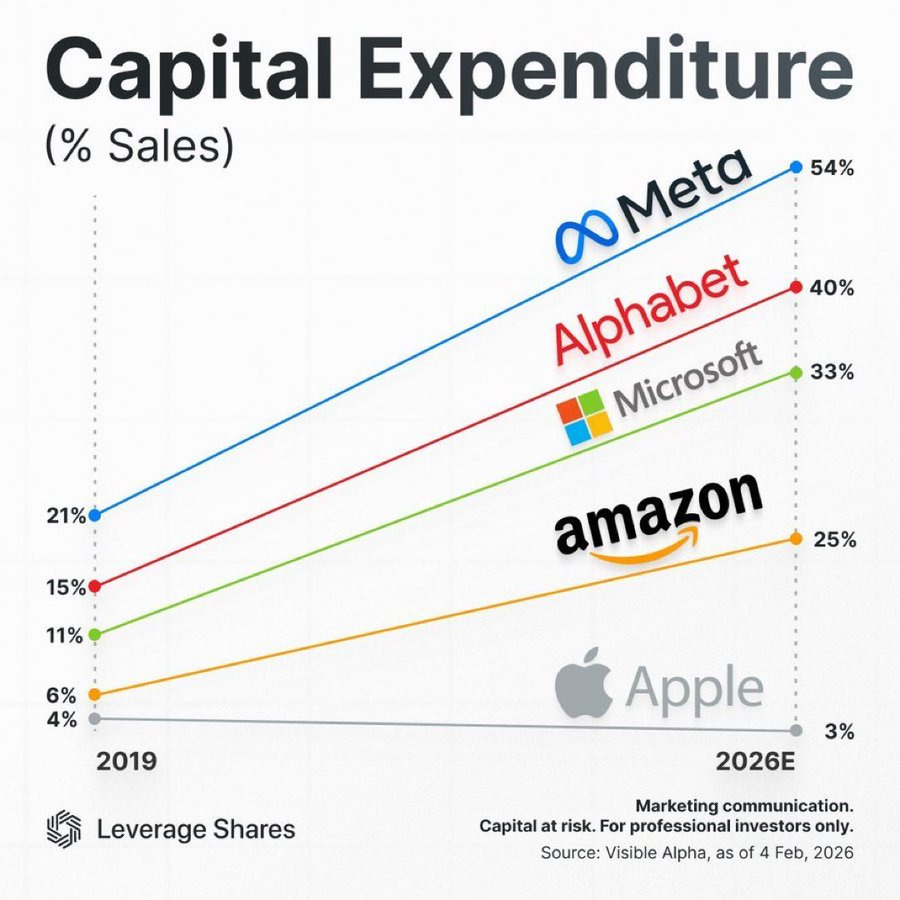
In addition to the previous note, large tech platforms are rapidly increasing capital expenditures as a share of revenue. Meta could spend around 54% of sales on capex by 2026, followed by Alphabet near 40%, Microsoft about 33%, and Amazon around 25%, while Apple remains far lower.
This shows the shift from software companies to infrastructure providers. The goal is not only to sell services but to own the computing layer itself. Once a company controls compute capacity, other developers and businesses build on top of that stack, creating recurring demand.
The strategy resembles a toll road model. Instead of competing only in applications, these companies invest heavily upfront to capture long-term margins from every AI workload running on their platforms.
Stocks & ETFs to watch:
MSFT – cloud and enterprise AI platform
GOOGL – cloud and model infrastructure
META – AI training and inference infrastructure
AMZN – AWS compute backbone
SMH – semiconductor infrastructure exposure
IGV – software layer built on top of compute
AppLovin Shows Extreme Profitability
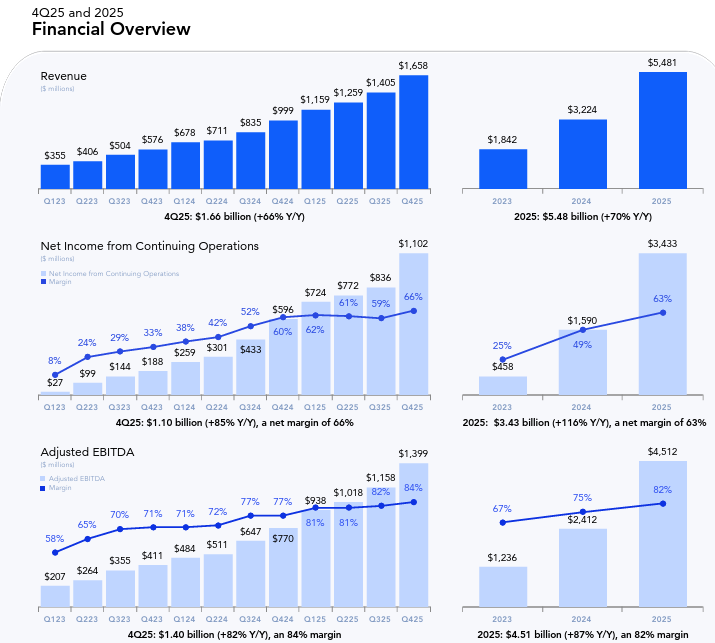
AppLovin (APP) continues to deliver unusually high profitability for a software company. In 2025, the company is expected to reach about $5.48B in revenue, $3.43B in net income, and $4.51B in adjusted EBITDA. That implies margins of roughly 82% EBITDA and 63% net income, levels rarely seen among large public tech companies.
The business model is focused on monetization and user engagement rather than content creation itself. As AI makes building apps and games easier, supply increases, but user attention remains limited. Platforms that can efficiently match content with users become more valuable, which strengthens AppLovin’s position.

APP Current Valuation vs 5-Year Mean:
Price/Forward Earnings: 27.6x / 30.2x
Price/Forward Sales: 17.0x / 10.2x
PEG: 1.06
EPS Fwd 5Y CAGR: 41.30%Stocks & ETFs to watch:
APP – AppLovin (mobile app monetization platform)
META – Meta Platforms (digital advertising competitor)
GOOGL – Alphabet (ad ecosystem competitor)
TTD – The Trade Desk (programmatic advertising)
V – Visa (high-margin comparison business)
NVIDIA Approaches $1B Per Day
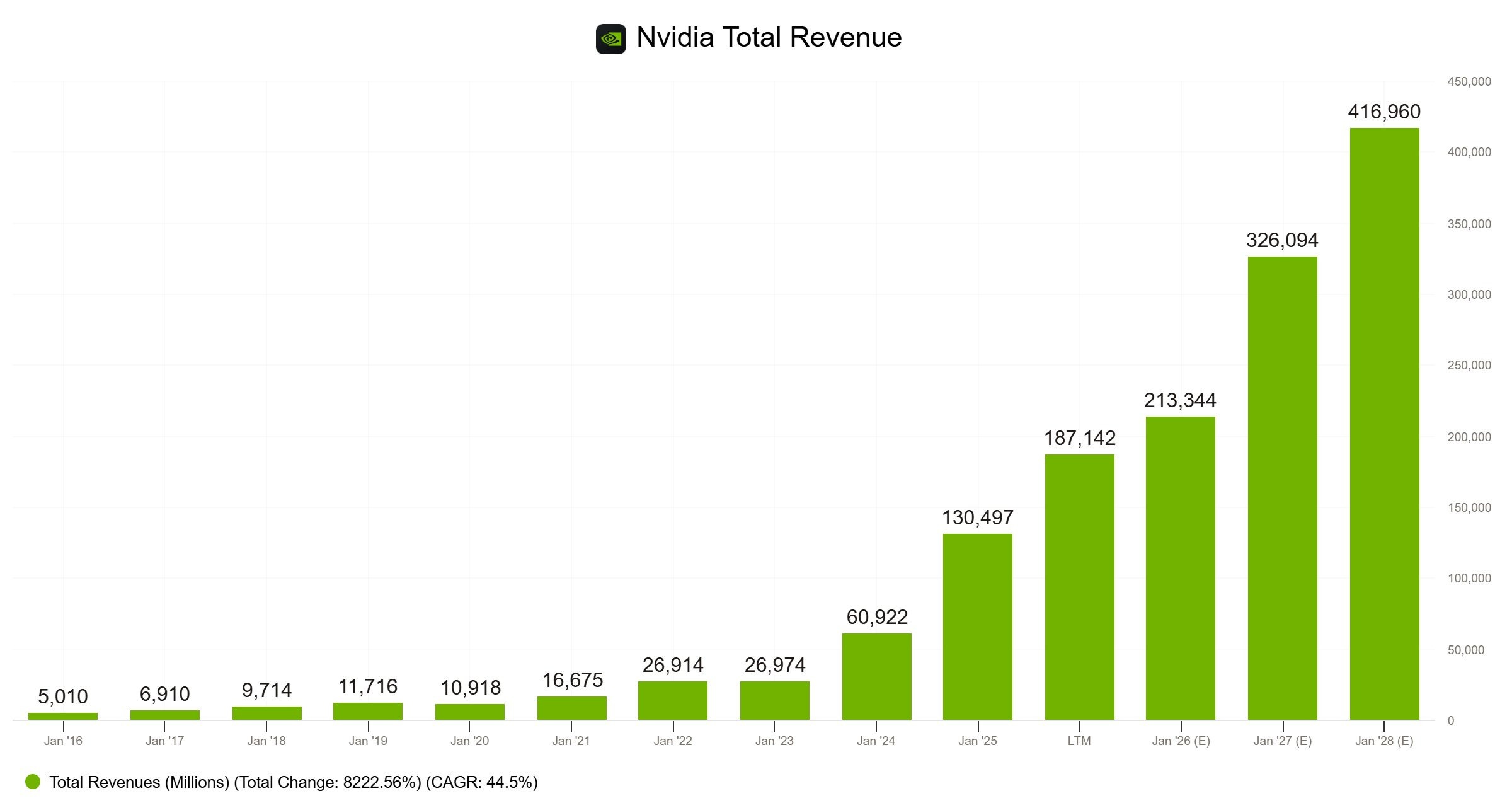
The chart suggests NVIDIA’s revenue could reach about $417B annually by 2028. That equals more than $1B per day in sales — something almost no company in history has achieved outside the largest consumer platforms.
AI infrastructure is becoming a utility layer. Every model training run, inference request, and enterprise deployment requires massive compute. NVIDIA is currently at the center of that stack, capturing value from hyperscalers, startups, and governments at the same time.
Importantly, this growth is not only cyclical hardware demand. It behaves more like platform adoption. As long as AI usage keeps expanding, compute demand scales with it, and Nvidia monetizes each step.
NVDA Current Valuation vs 5-Year Mean:
Price/Forward Earnings: 26.9x / 39.5x
Price/Forward Sales: 15.3x / 17.9x
PEG: 1.24 / 2.68
EPS Fwd 5Y CAGR: 37.89%
Global Uncertainty Hits Record High
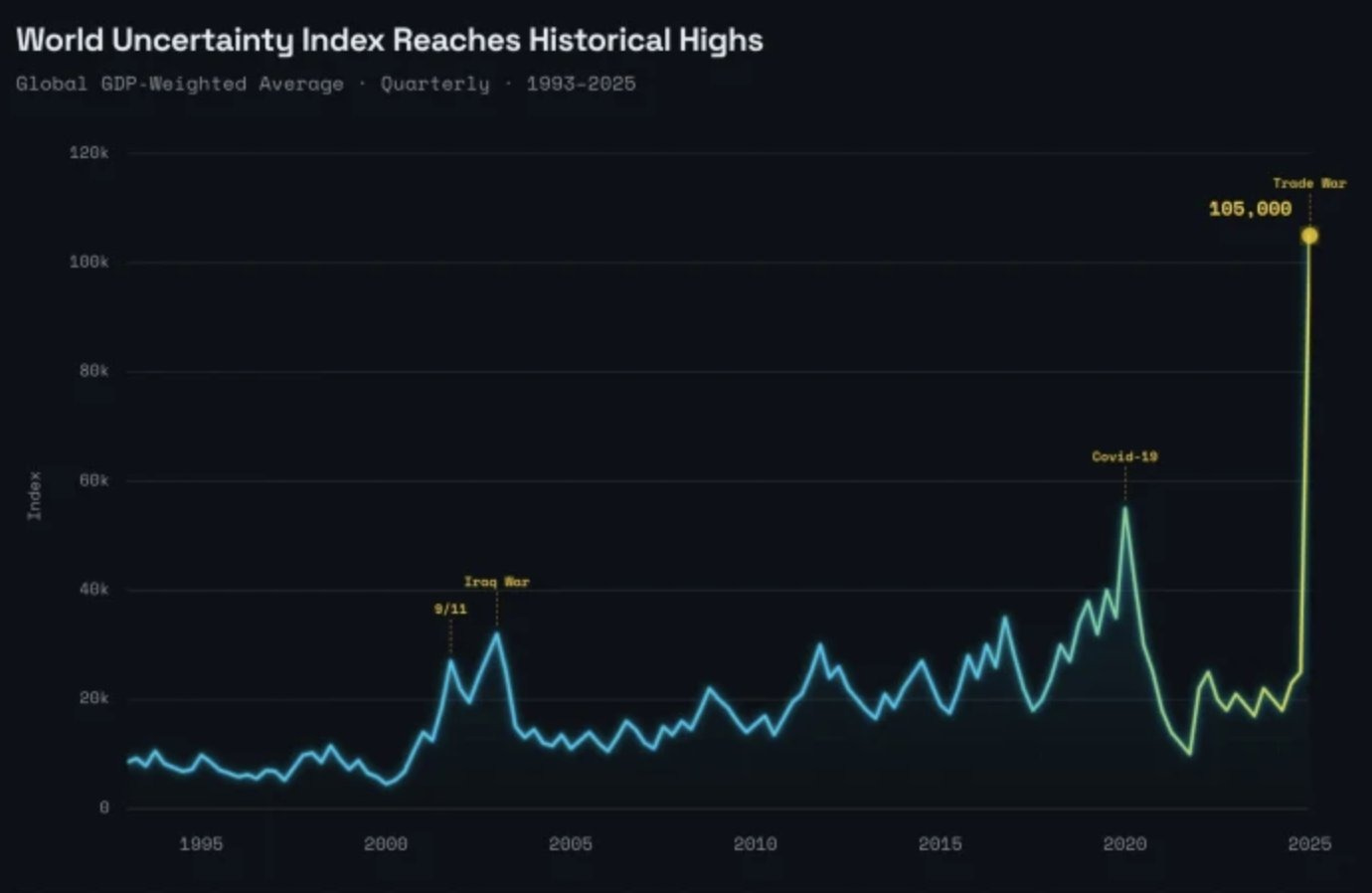
The global uncertainty index has reached its highest level on record, surpassing previous peaks seen during COVID-19, the Global Financial Crisis, and the Dot-Com era. The spike reflects rising geopolitical tensions, trade conflicts, and unclear economic policy direction across major economies.
Historically, sharp increases in uncertainty tend to slow business investment and hiring, as companies delay decisions until visibility improves. Consumers also become more cautious, which can weaken economic growth in the short term.
Periods like this often lead to higher market volatility and stronger demand for defensive assets while risk assets move more unpredictably.
Stocks & ETFs to watch:
GLD – SPDR Gold Shares (safe-haven demand)
TLT – iShares 20+ Year Treasury Bond ETF (flight to safety)
XLP – Consumer Staples Select Sector SPDR Fund (defensive equities)
Buffett Sold 77% of Amazon
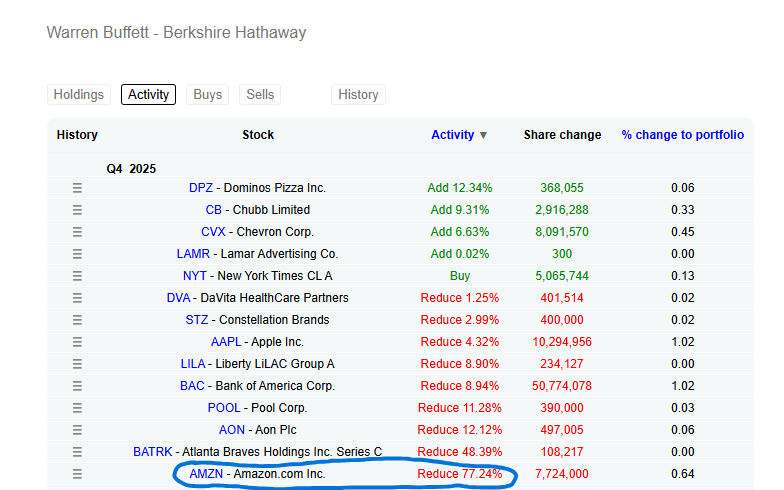
Berkshire Hathaway reduced its Amazon position by about 77% during Q4 2025. The move stands out because Buffett has historically held large technology winners for very long periods once they proved durable.
Warren Buffett has not retired and remains Chairman of Berkshire Hathaway. However, portfolio decisions today are often influenced by multiple managers inside Berkshire, so trades do not always reflect Buffett’s personal conviction alone.
Large reductions like this are usually portfolio management decisions rather than a direct negative view on the business. Berkshire often trims positions after strong performance, reallocating capital into new opportunities or increasing liquidity.
AMZN Current Valuation vs 5-Year Mean:
Price/Forward Earnings: 26.6x / 53.2x
Price/Forward Sales: 2.7x / 2.8x
PEG: 1.54 / 2.52
EPS Fwd 5Y CAGR: 17.30%
Stocks & ETFs to watch:
AMZN – Amazon (cloud and retail platform)
BRK.B – Berkshire Hathaway (capital allocation exposure)
AAPL – Apple (largest long-term Berkshire holding)
QQQ – Invesco QQQ Trust (mega-cap tech exposure)
Big Tech’s Lowest Level of Buybacks
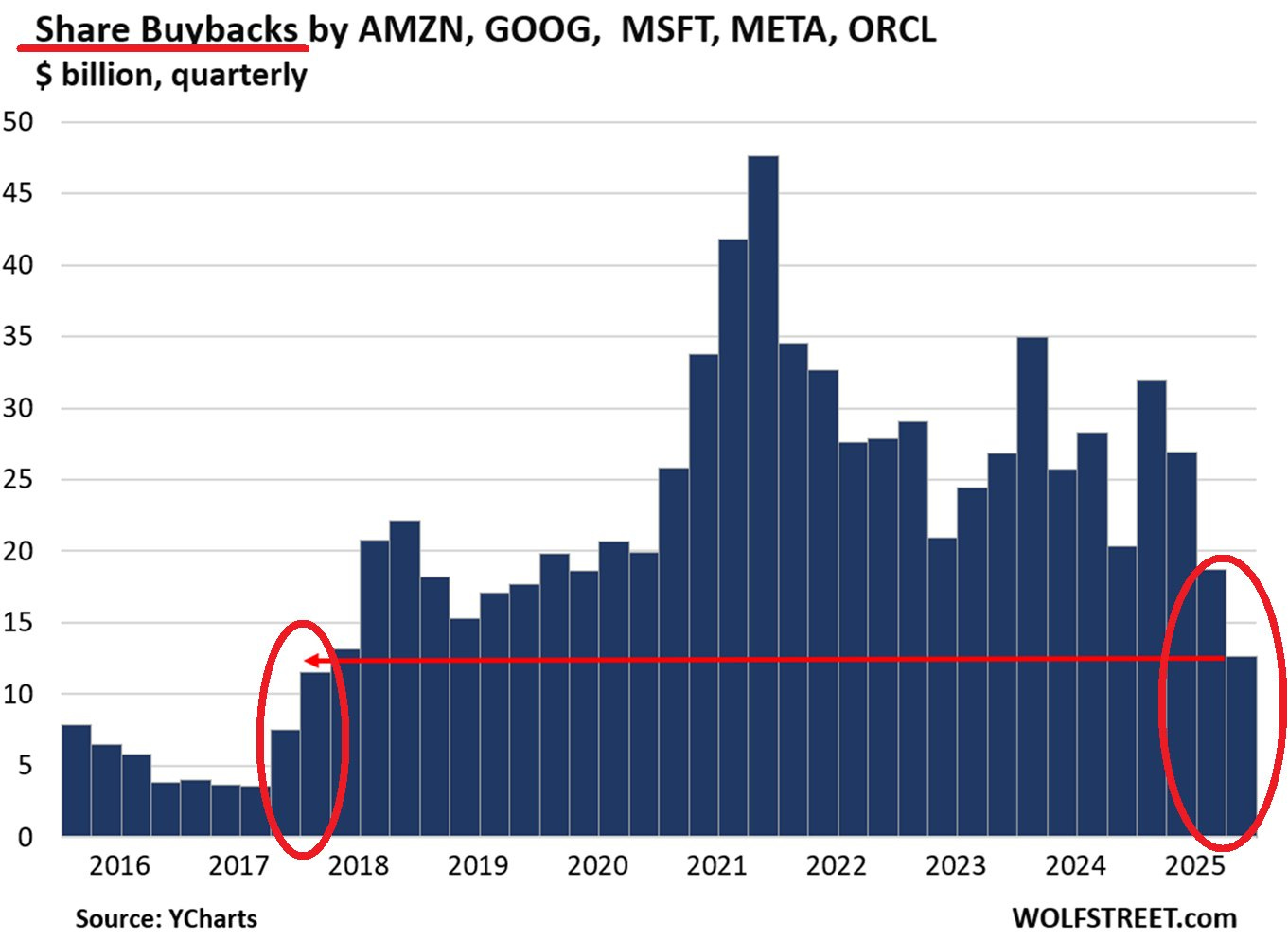
Combined share buybacks by Amazon, Alphabet, Microsoft, Meta, and Oracle dropped to about $12.6B in Q4 2025, the lowest level in seven years and roughly 70% below the 2021 peak.
When companies reduce repurchases, a major support for equity prices weakens. The shift appears linked to rising capital spending, as large tech firms redirect cash toward AI infrastructure, data centers, and chips.
Diversification Works Again
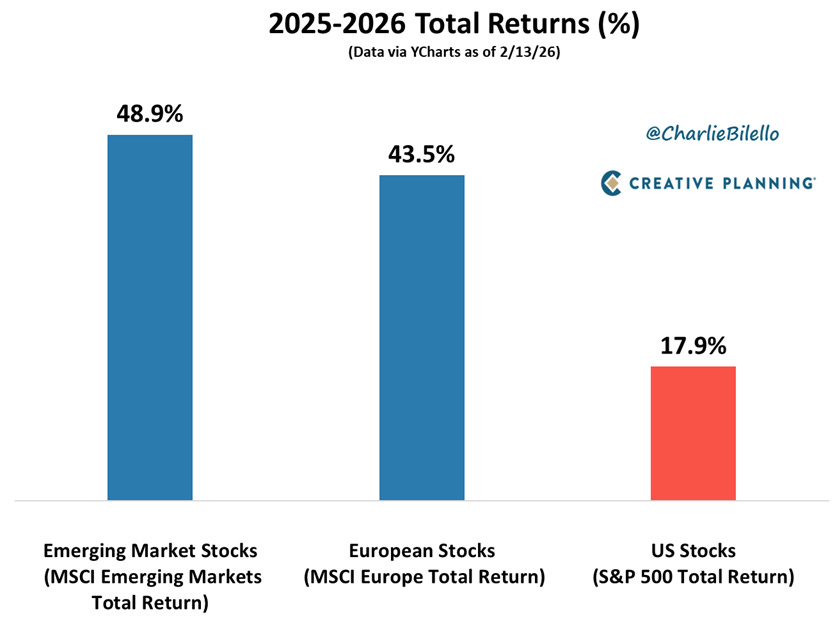
After years of US dominance, global markets have started to outperform. From 2025 to early 2026, emerging market stocks gained about 48.9% and European stocks rose roughly 43.5%, while US equities returned only around 17.9%.
At the end of 2024, many investors questioned the need for international diversification because the S&P 500 had consistently led performance. The recent period shows how leadership can change quickly once valuations, currencies, and economic cycles shift.
Market cycles rarely favor the same region forever. When capital rotates internationally, portfolios concentrated only in US equities can lag broader global exposure.
Stocks & ETFs to watch:
SPY – S&P 500 exposure
VXUS – total international stocks ex. US
VEA – developed markets
EEM – emerging markets
VGK – Europe equities
This is not a financial or investing recommendation. It is solely for educational purposes.