

TL;DR: Reddit is the largest archive of human conversation on the internet; ads bring ~95% of its revenue. Since my deep dive on Aug 11, the Q3 2026 report showed revenue up 53% YoY, but US daily users down 2%. The company also warned that total daily users could fall by a low double-digit percentage from Q3 if search traffic from Google keeps declining at the October rate. Since the deep dive, RDDT fell 43%, to $90.34. One of my two conditions, growing US users, broke; the second, revenue growth above 40%, is still open but likely to break in 2027. My rule is to buy below $153, a 30% margin of safety (MoS) to my Base Case fair price of $219. RDDT is 41% below $153; by my rule, it is a buy, with a weaker thesis than in August. It is also inside my accumulation zone of $76-109.

Thesis Check
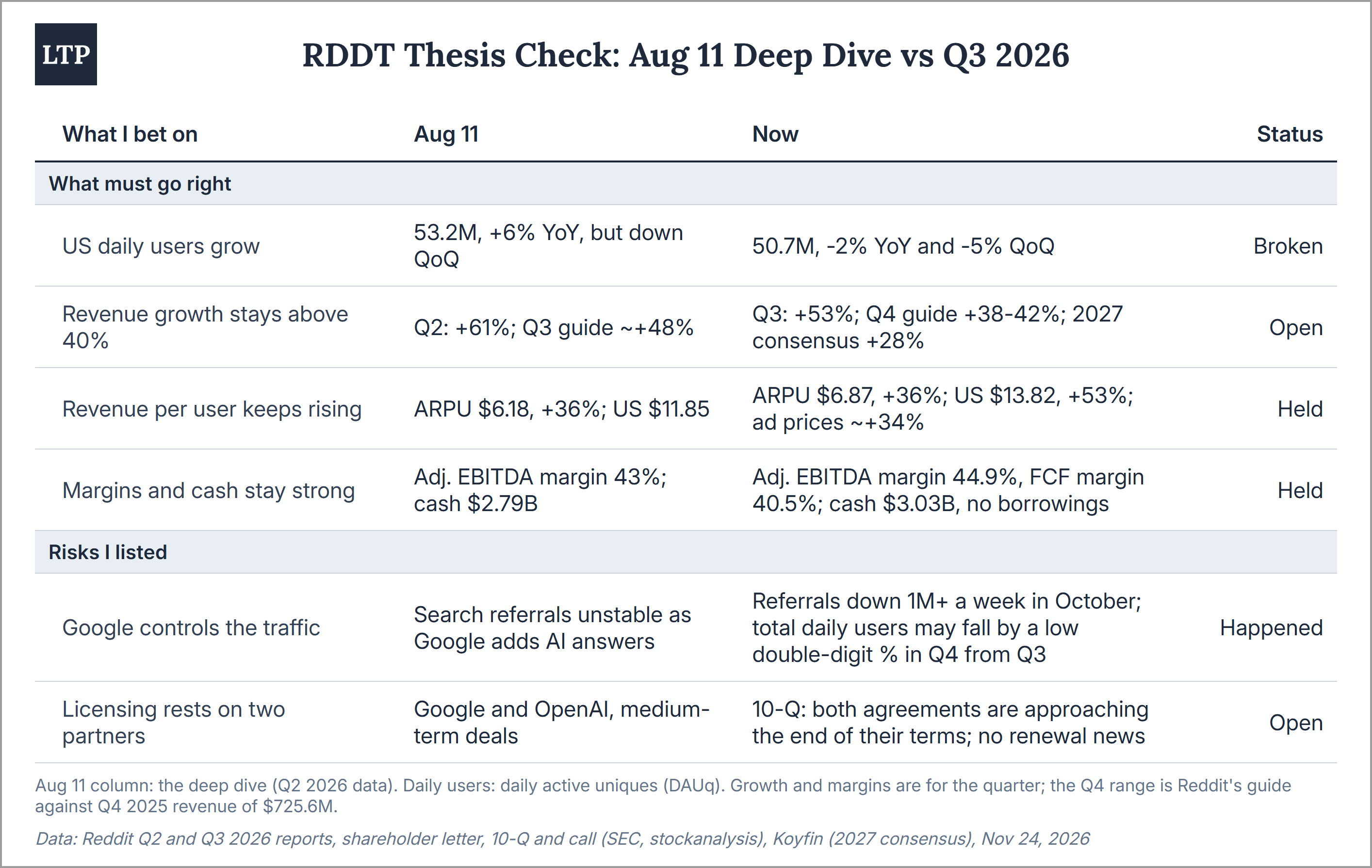
The money side held; the audience side did not. In the table, rows 1-2 are my two August conditions, rows 3-4 are the thesis behind them; the last two rows are the risks I listed. US daily users decreased to 50.7M from 53.2M in Q2. Reported revenue growth is still +53%, so the second condition stays Open. Still, the Q4 guide midpoint is ~40%; consensus expects +28% for 2027. As I see it, the thesis is weaker, not broken: Reddit earns more from each user (ARPU in the table), but it has fewer users in the US, its highest-paying market.
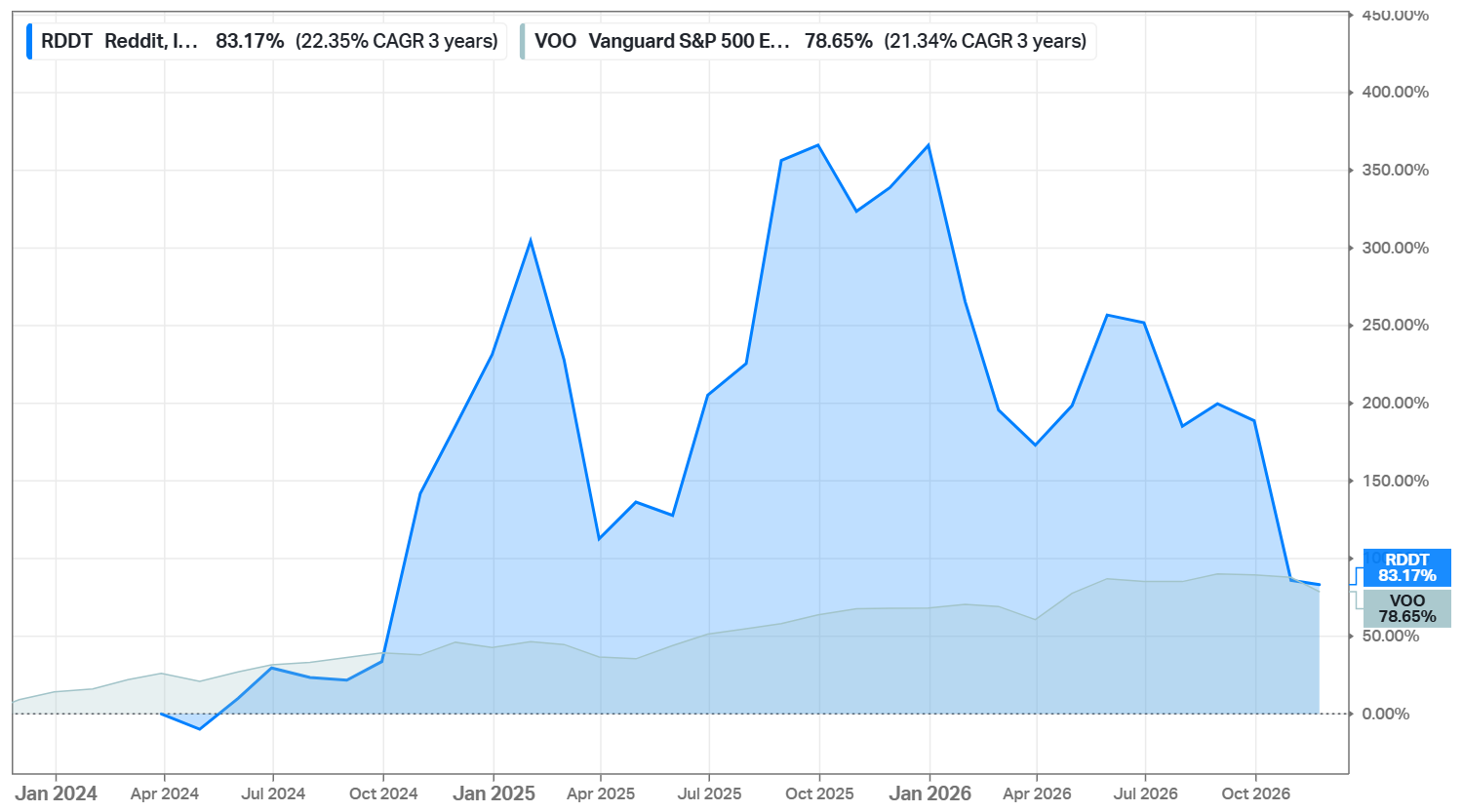
One comparison in my August post was wrong. I wrote that RDDT returned +224% since the IPO, a 47.9% CAGR over 3Y, against +75% for the S&P 500 (VOO). The +224% came from a monthly chart point; the 47.9% CAGR and VOO’s +75% both used a 3Y window, while RDDT had traded for only 2.4 years. From the first close on Mar 21, 2024 ($50.44) to Aug 10, 2026, RDDT returned +215% (~62% a year) and VOO ~51% with dividends (~19% a year). So RDDT was even further ahead than I showed.
Analyst’s note:
From the Mar 21, 2024 close to the Nov 24 close, RDDT returned +79% (~24% a year) and VOO only ~41% (~14% a year), with dividends. The chart shows them almost level (83.17% and 78.65%) because of the same problems: monthly points and a VOO line that starts in late 2023.
The Report
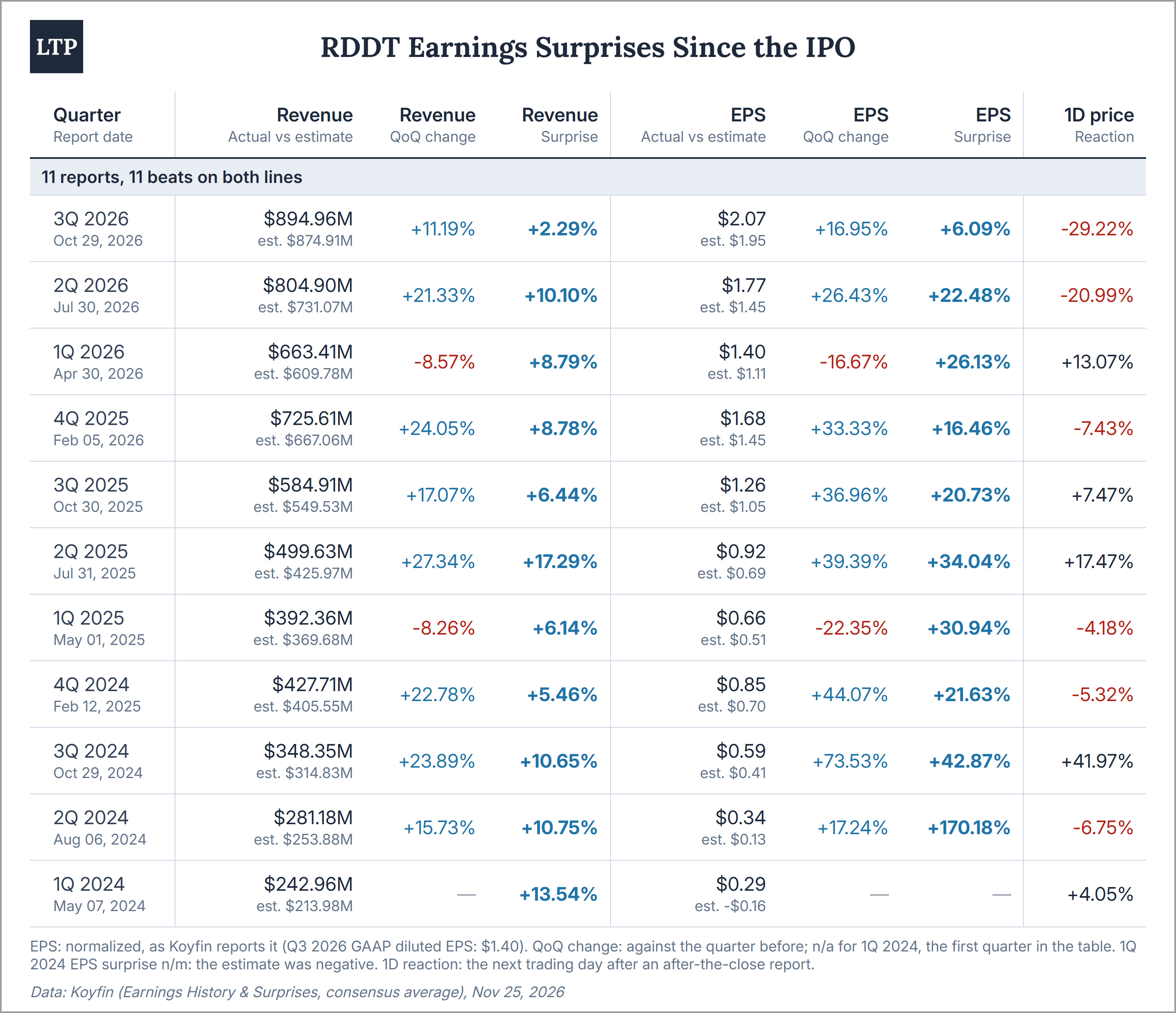
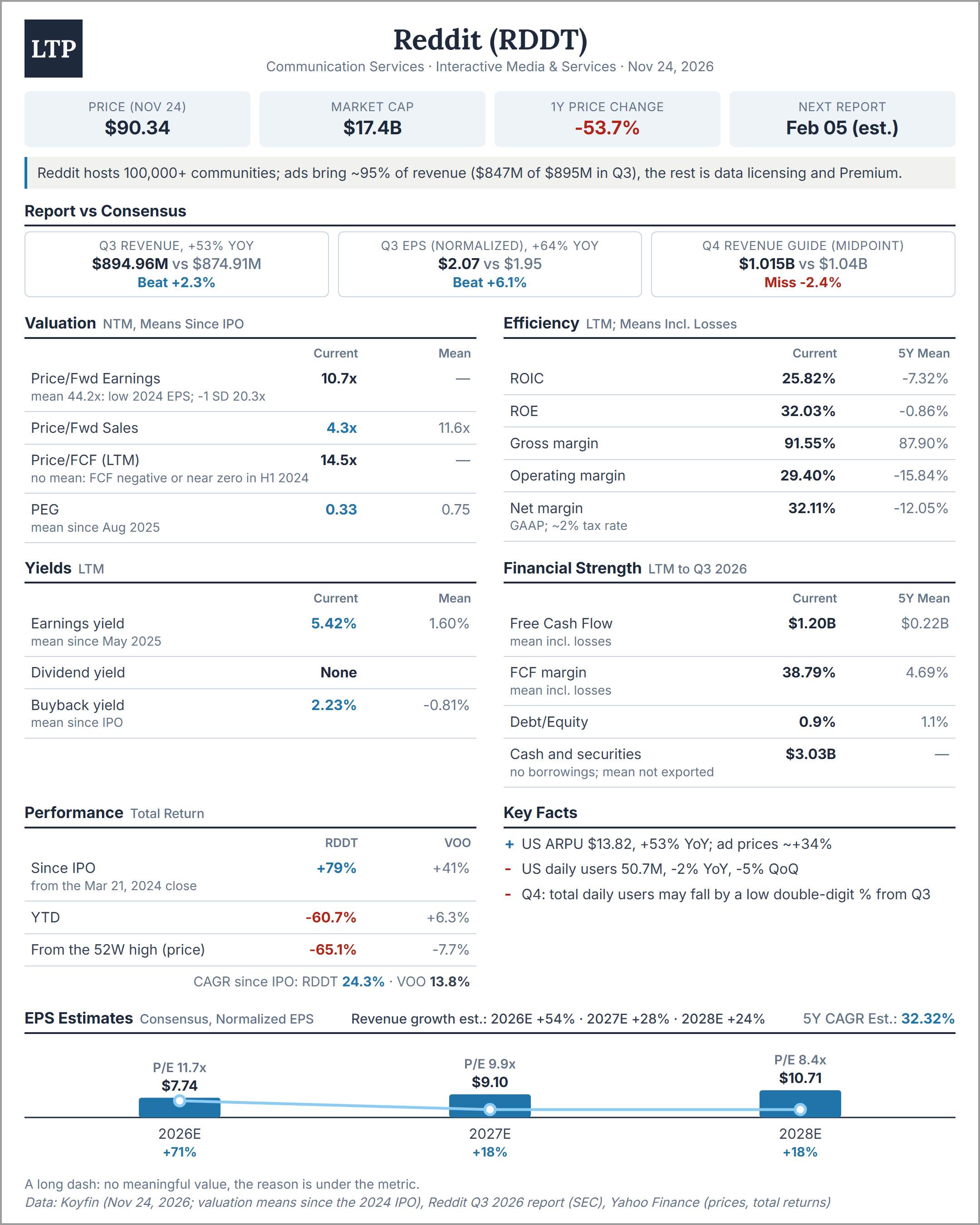
Q3 beat consensus and Reddit’s own guide. According to Koyfin, revenue of $895M beat the $875M consensus by 2.3%, and normalized EPS (Koyfin’s adjusted number, which adds back stock-based compensation (SBC)) of $2.07 beat $1.95 by 6.1%; GAAP diluted EPS was $1.40, +75% YoY. Revenue was also ~3.5% above the midpoint of the company’s own guide of $860-870M. It was the 11th double beat in 11 reports, but the smallest on revenue. Drew Vollero, the CFO, explained the smaller revenue beat, saying demand was concentrated in September: on a couple of days, Reddit couldn't deliver all the ads advertisers had booked.
The Q4 guide was below consensus. The company guides revenue at $1,000-1,030M, +38-42% YoY, against ~$1.04B in Koyfin’s Oct 30 snapshot. The adjusted EBITDA guide implies a ~49% margin, above Q3’s 44.9%; slower growth does not mean a lower margin in Q4.
Ad prices did most of the growing. According to the 10-Q, ad prices increased ~34% and impressions ~15%. In the US, revenue grew 50% while daily users decreased 2%, so revenue per user did all of it ($13.82, +53%). Internationally, daily users grew 24% to 79.6M, but each brings only $2.43 a quarter, against $13.82 in the US. Part of the international user growth was paid for: Reddit raised marketing abroad “in part to compensate for the lost reach”, said Jennifer Wong, the COO.
Analysts cut 2027 and 2028, not this year. According to Koyfin, FY2026 EPS is $7.74, a bit above the $7.67 before the report. FY2027 EPS decreased 6.0% to $9.10, and FY2028 EPS decreased 9.5% to $10.71; both cuts came within 30 days, so the 30-day and 90-day revisions are the same. Revenue estimates decreased less (~3% and ~4%), so margins were cut too. Consensus now sees EPS growth of ~17.6% per year in 2027-2028.

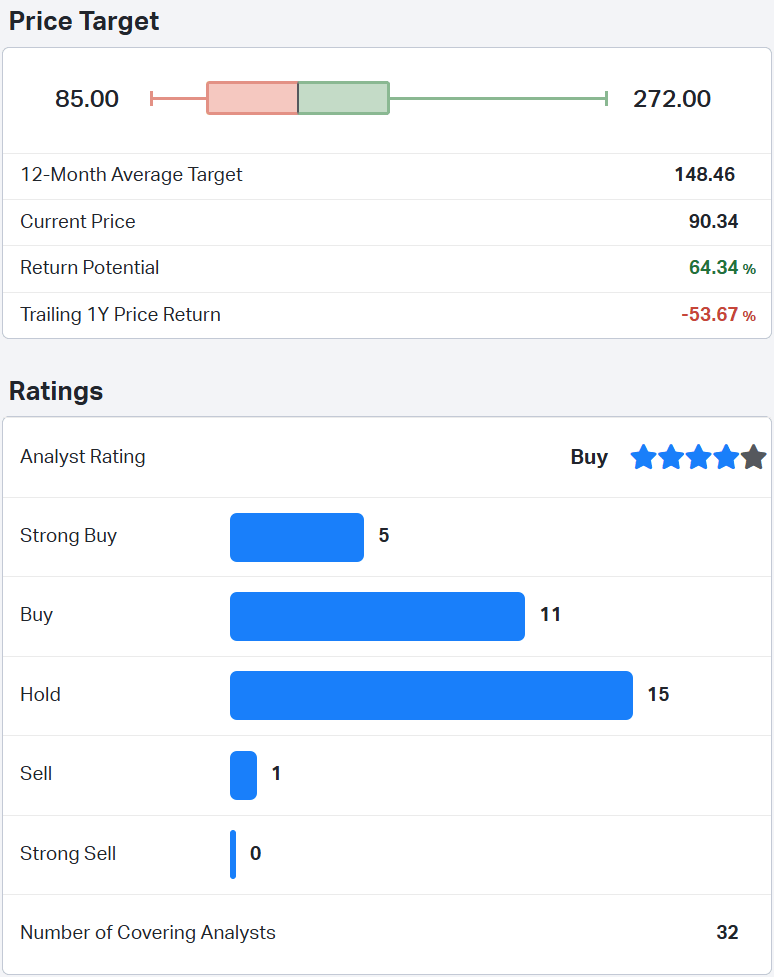
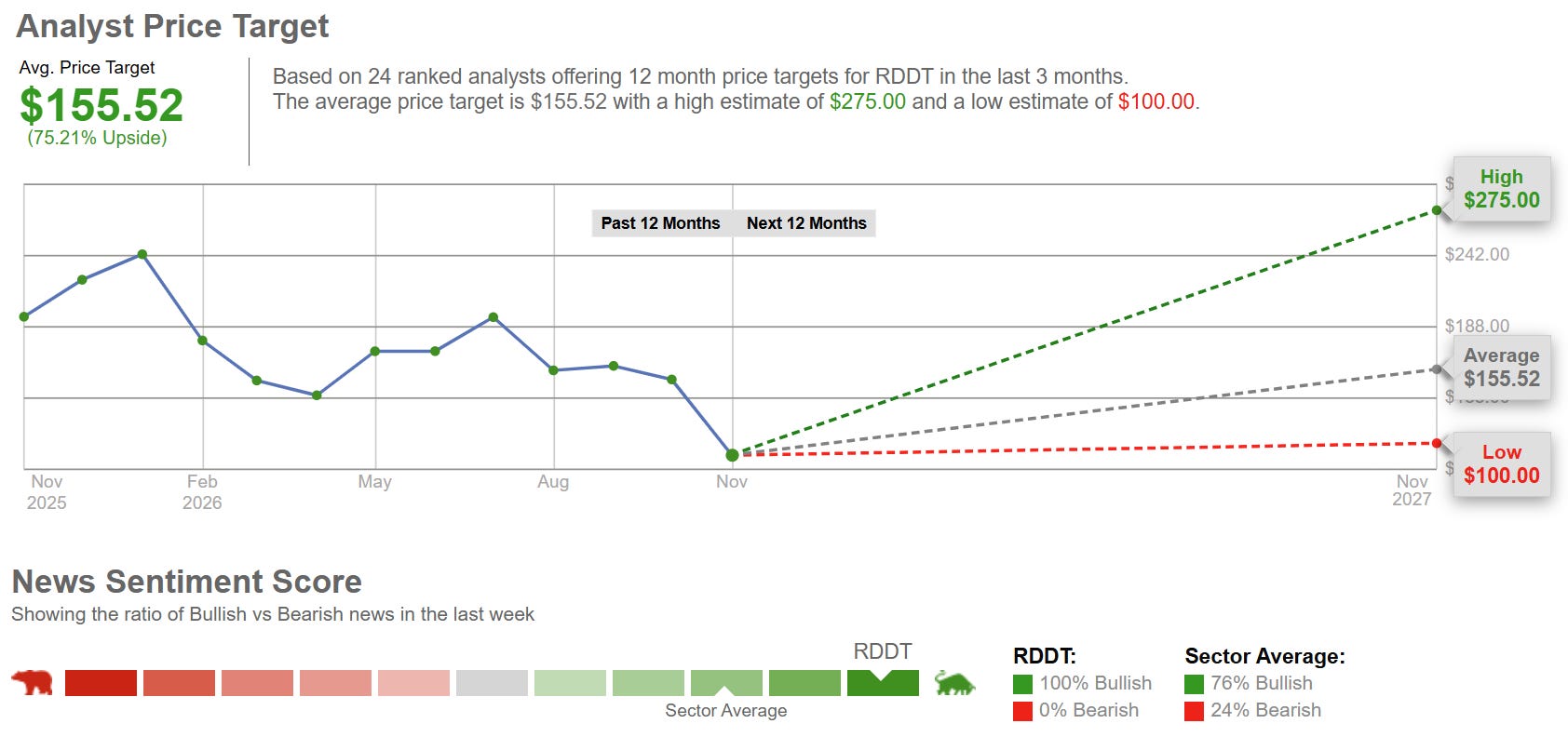
Analysts became more careful. According to Koyfin, 16 of 32 analysts rate RDDT a Buy, against 22 of 34 in August. The average target decreased from ~$216 to ~$148, 64% above the price.
Most of the fall came in one day, but not all of it. On Oct 16, RDDT was still close to its deep-dive price (-1.6%). From Oct 16 to Oct 29, RDDT lost 17% while the S&P 500 rose 0.8%; I found no company news that explains it. On Oct 30, after the user warning and the Q4 guidance, it fell 29.2%, its worst day since the IPO. Since then, it lost another 1.5%, while the S&P 500 lost 5%.
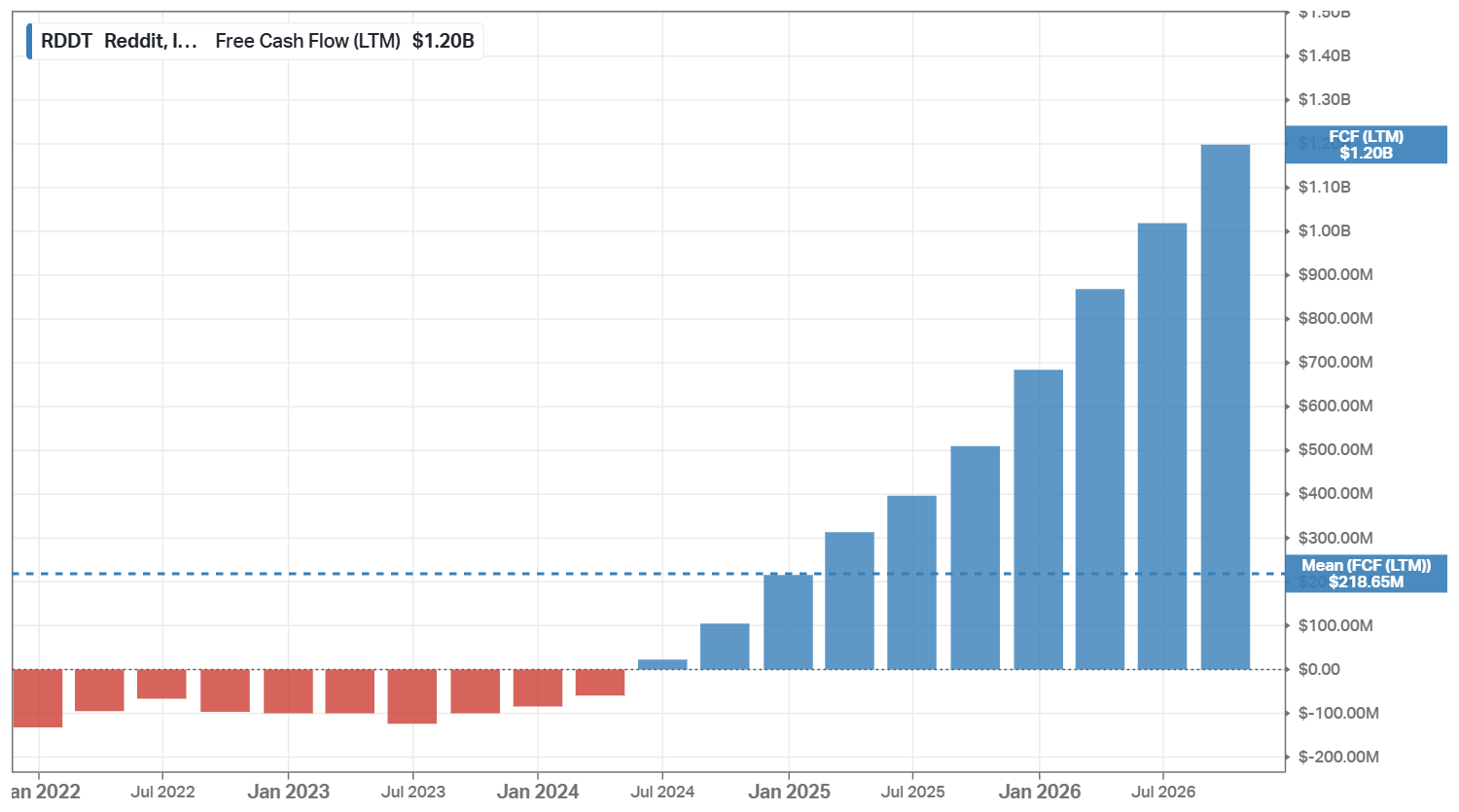
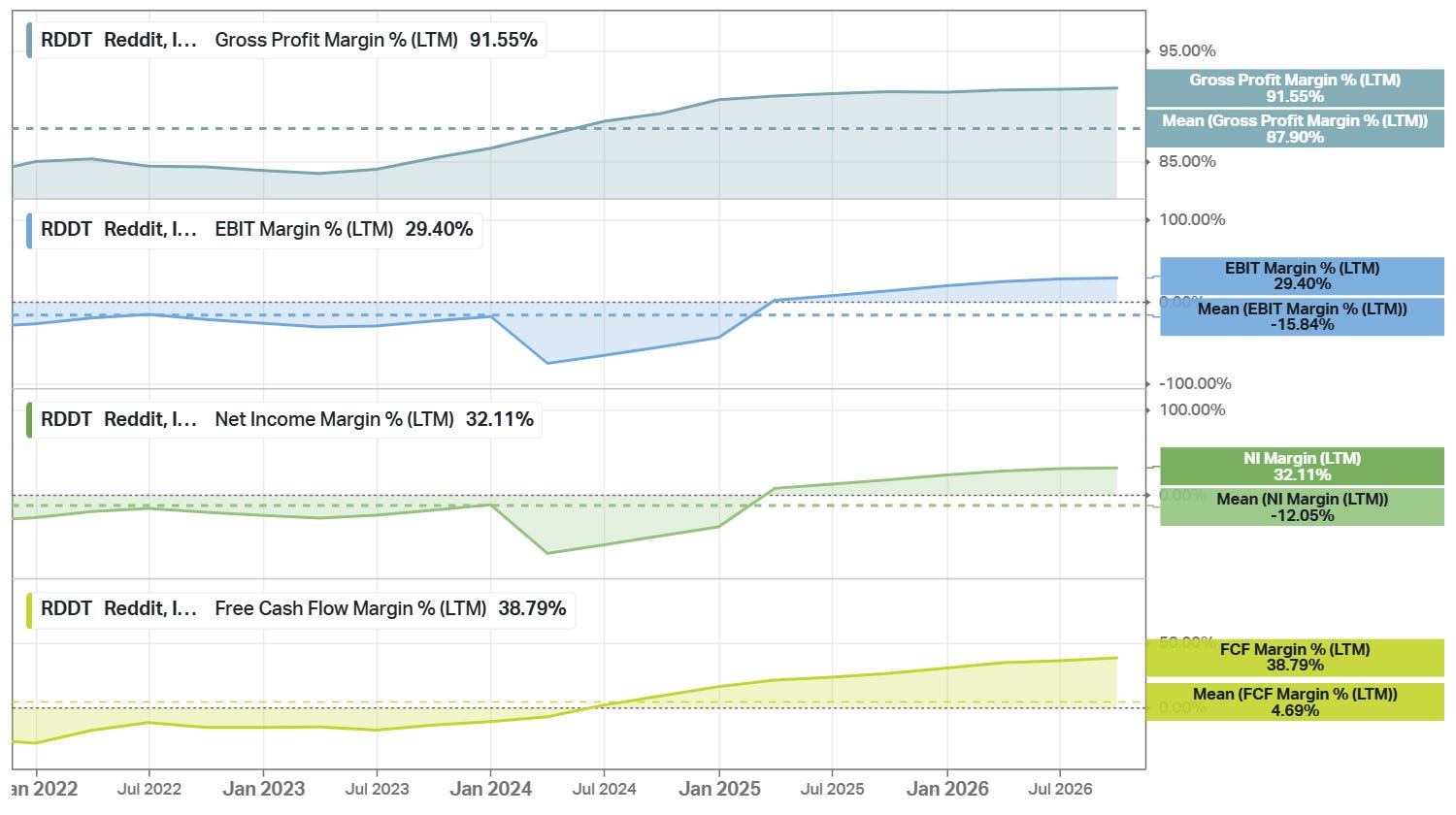
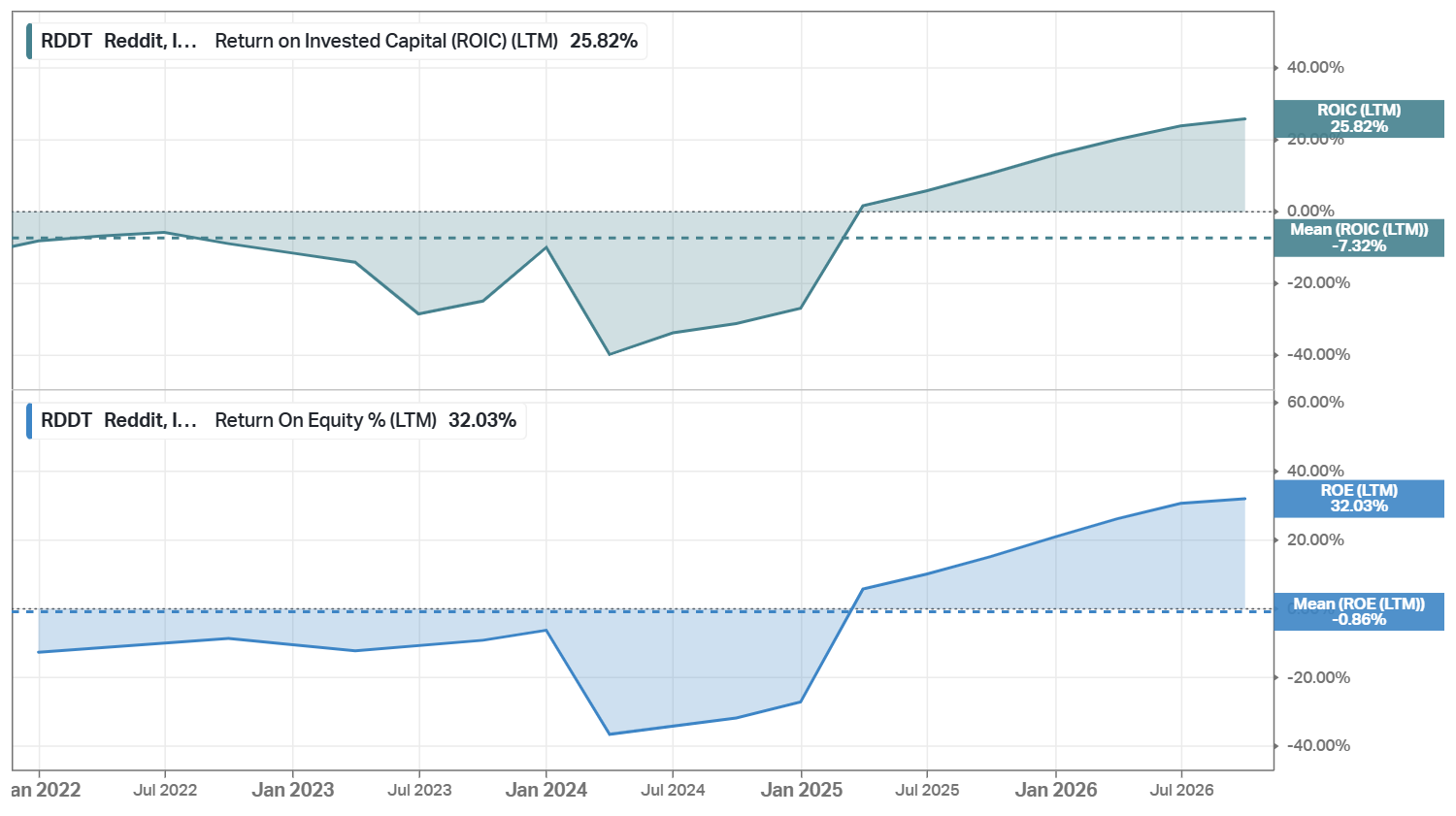
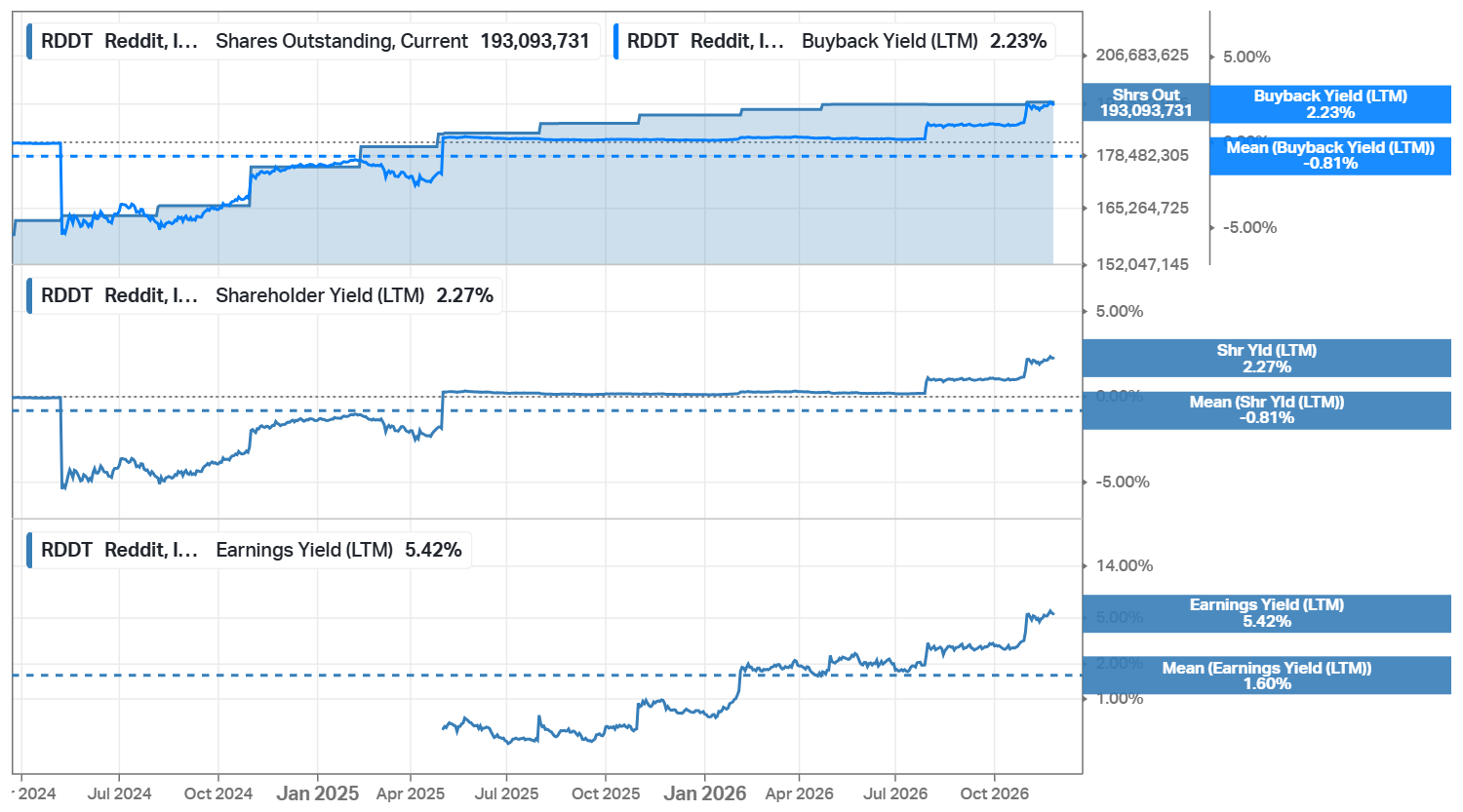
FCF increased 98% YoY. It reached $363M in Q3, a 40.5% margin; LTM FCF is $1.20B, and ROIC is 25.8% (Koyfin). SBC and related taxes took 15% of revenue, up from 13% in Q2 but below 16% a year ago. The fully diluted share count is flat YoY, so buybacks only offset the dilution.
What Changed
Google sends less traffic, and Reddit says it openly. In October, search traffic dropped by more than 1 million referrals a week, according to the shareholder letter; at that rate, total daily users could fall by a low double-digit percentage in Q4 from Q3’s 130M. Steve Huffman, the CEO, says the main hypothesis is Google’s AI Overviews and AI Mode: "The reality is the AI Mode does not drive traffic." He sees it as likely not a passing algorithm change, though the company has no visibility into it.
Reddit is choosing logged-in users over reach. In Q4, in select markets outside the US, it starts testing a login requirement for most of Reddit. After the tests, the 10-Q says it intends to roll out some form of it globally, including the US. Huffman: “This is a test, but we are going to make this transition.” He said over 80% of revenue comes from logged-in users. In the US, logged-out users decreased 4% YoY (9% QoQ) to 27.3M; logged-in users grew 1% YoY. So the company is losing mostly the visitors who bring the least money. Still, the letter says part of the loss reaches logged-in users too. Huffman expects total and logged-in daily users to “more or less converge” over time, so total daily users should decline by design.
Both licensing deals come up for renewal. Unlike the Q2 10-Q, the Q3 one says that the agreements with Reddit’s two main licensing partners are “approaching the end of their respective current terms”. The 10-Q does not name them; my August post identified them as Google and OpenAI. According to Huffman, the company is in active discussions, but the options include not doing a deal.
Losing all licensing could cut operating income by up to ~18%. Other revenue was $48M in Q3 (~5% of the total); most of it should be licensing (the 10-Q calls Premium and Gold revenue not material). At the Q3 pace, that is ~$192M a year, against Q3’s annualized operating income of ~$1.05B; the ~18% assumes licensing has little cost (my assumption). Only $30.5M of multi-year contract revenue, mostly licensing, is booked for 2027, against ~$192M a year now; nothing after. As I see it, Reddit negotiates from a weaker position with Google than when it signed, since Google is also the source of its lost traffic. Still, Huffman says Google is crawling Reddit “as hard as ever”.
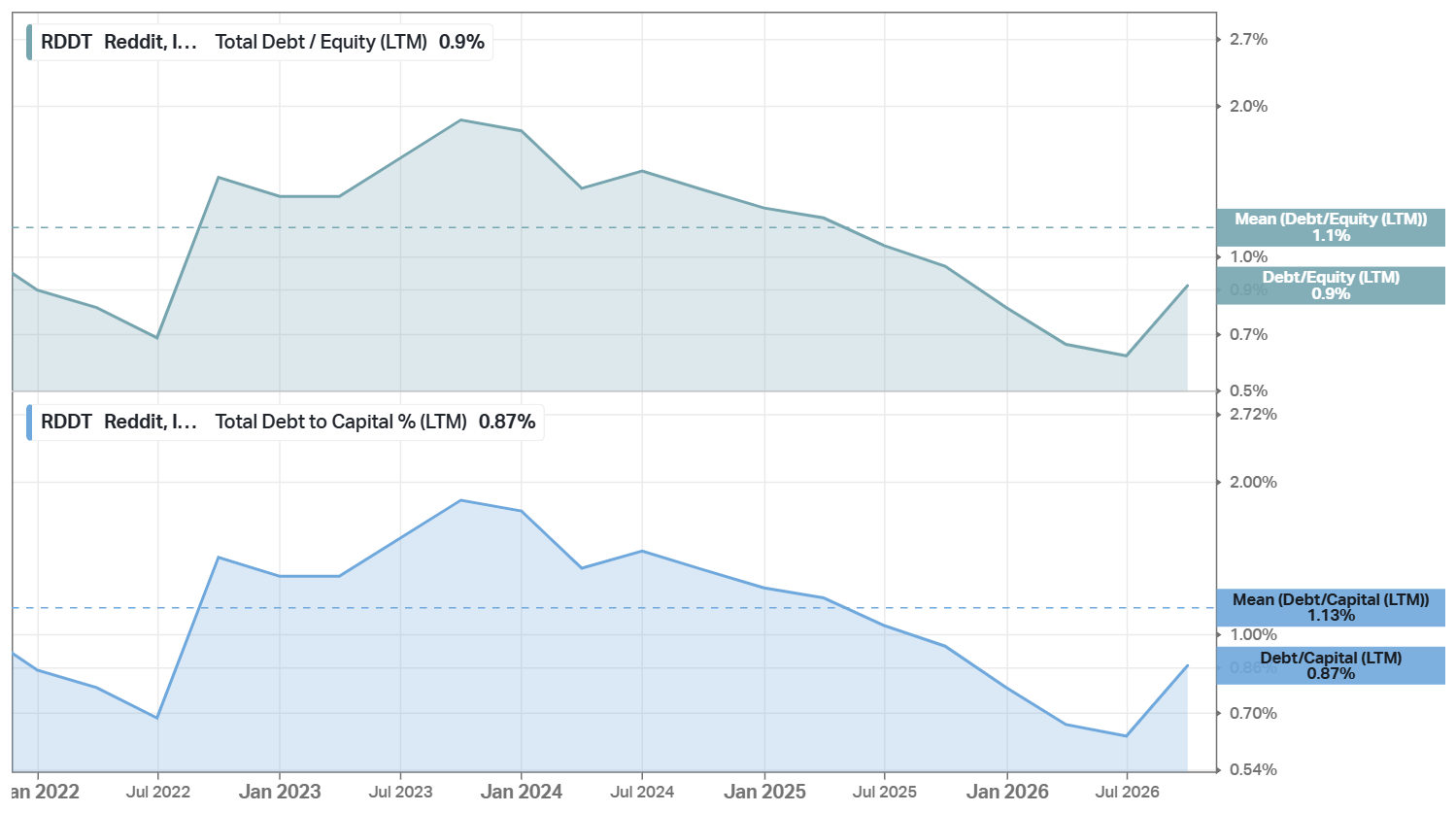
The balance sheet is strong, but the buybacks came at much higher prices. In Q3, the company paid an average of $149.81, 66% above today; $660M remains in the program. Cash and securities of $3.03B (no borrowings; the 0.9% Debt/Equity is leases) are ~17% of the market cap. No insider bought after the fall (insider filings through Nov 18). The COO kept selling under her trading plan; a director sold 10,000 shares at $96-100 in early November.
What the bears get right: revenue growth now depends more on prices than on users. As I see it, logged-out visitors are also a main source of new logged-in users, and Reddit plans to bring some form of login requirement to the US too, where logged-out users make up 54% of daily users. Worldwide, logged-out users bring up to ~20% of revenue (up to ~$0.7B a year at the Q3 pace, up to ~4x licensing). If daily users fall more than the company warned, or keep falling in 2027, growth could fall well below the 28% that consensus expects. My model absorbs only part of this: the 20% cap is above consensus for 2027-2028, so the cushion is the 10x Bear multiple and the 30% margin of safety.
Valuation, Then vs Now
Aug 11 vs now (means since the IPO unless stated):
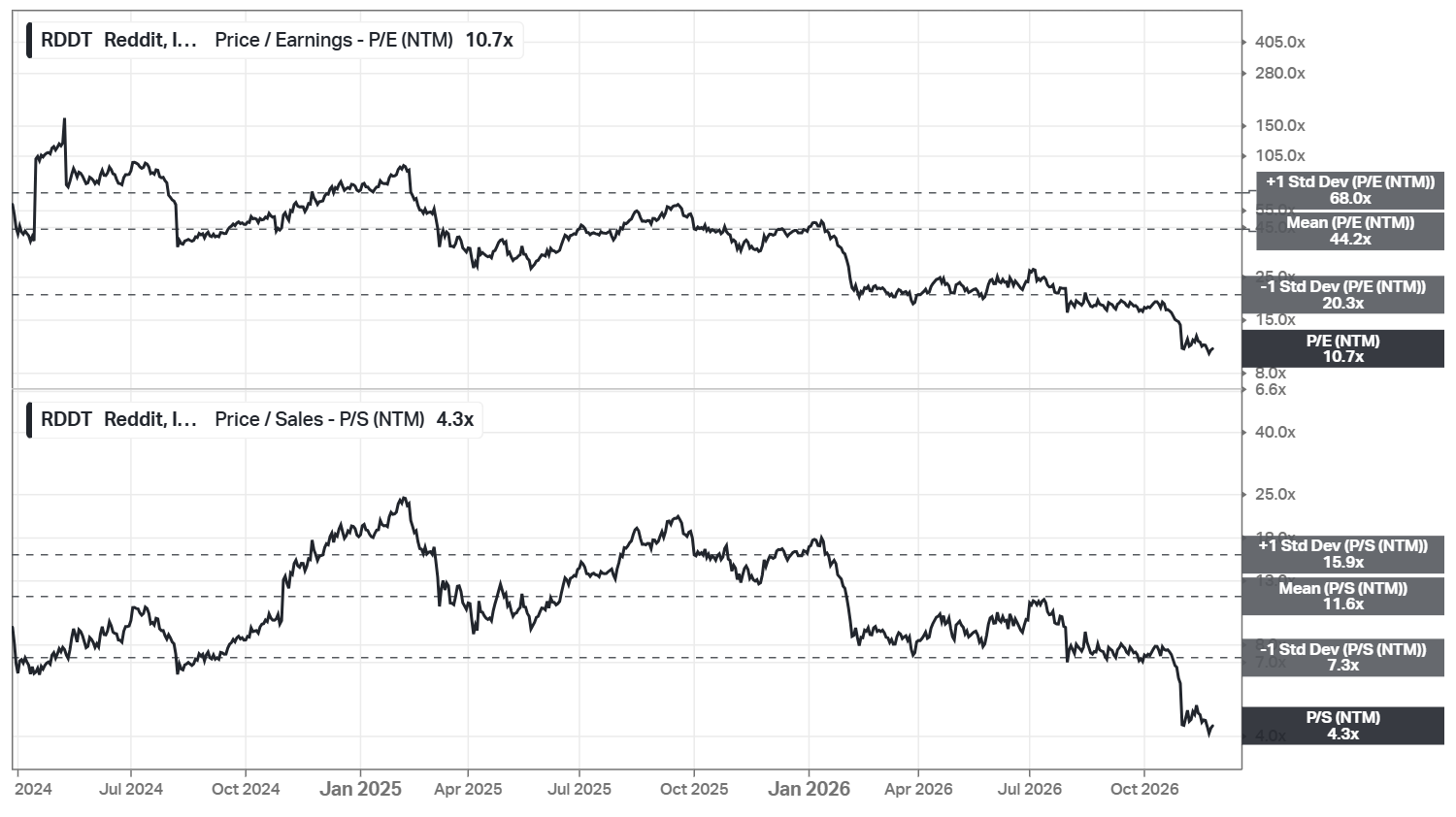
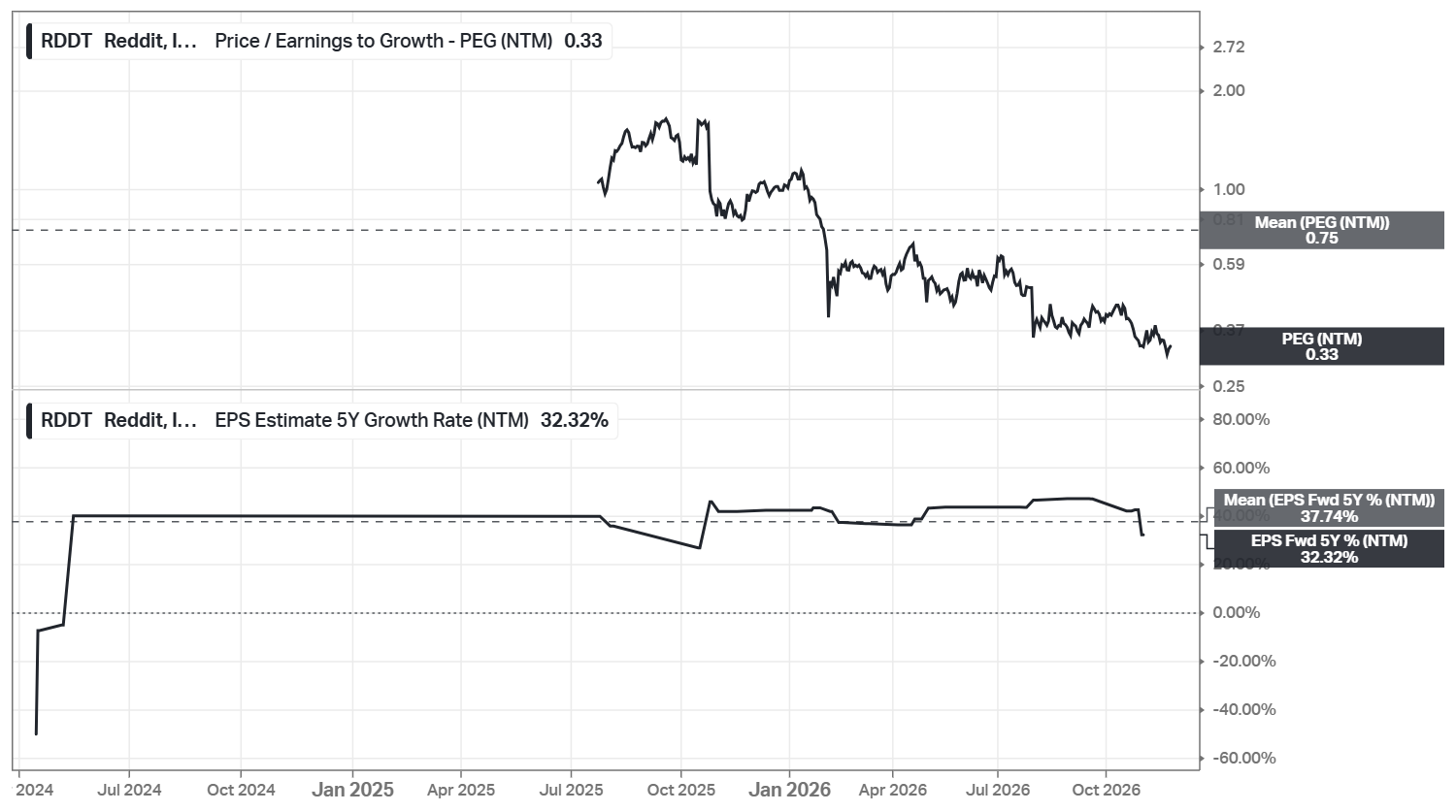
Price/Fwd Earnings: 18.7x vs 10.7x (mean 44.2x; -1 SD 20.3x, was 25.0x)
PEG: 0.40 vs 0.33 (mean 0.75, since Aug 2025)
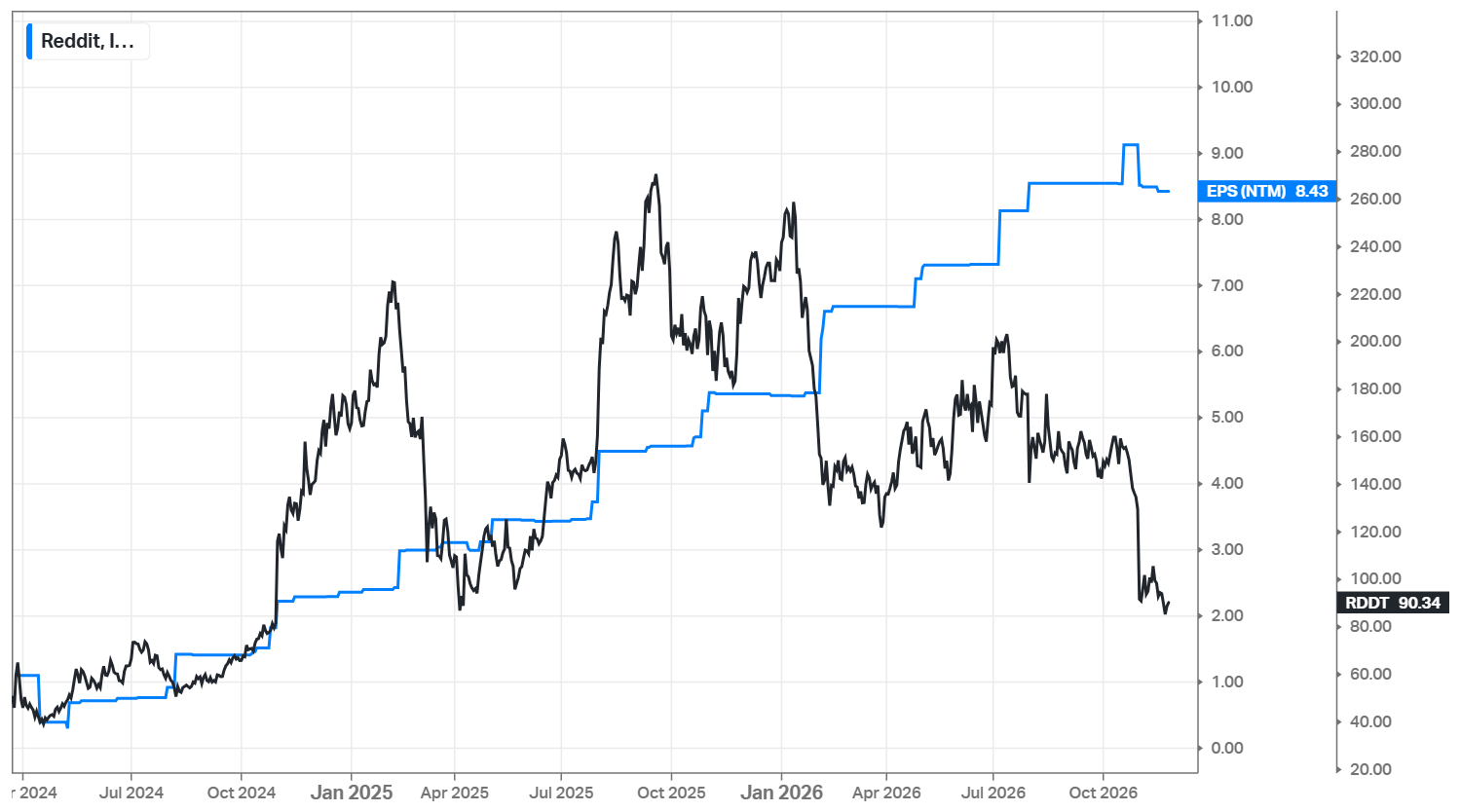
NTM EPS consensus: ~$8.55 vs $8.43
The price fell 43%, while the NTM EPS consensus decreased only ~1.4%. The real cut is larger: the NTM window now includes more of 2027, a year with higher EPS. So the derating came from the multiple. As I see it, the market does not believe the estimates.
Near 10x, RDDT is at its cheapest since the IPO, but not without a reason: the 5Y EPS growth estimate fell from ~47% in August to ~32%. The PEG of 0.33 uses Koyfin’s 5Y rate; on the ~17.6% consensus for 2027-2028, it is ~0.6.
Analyst’s note:
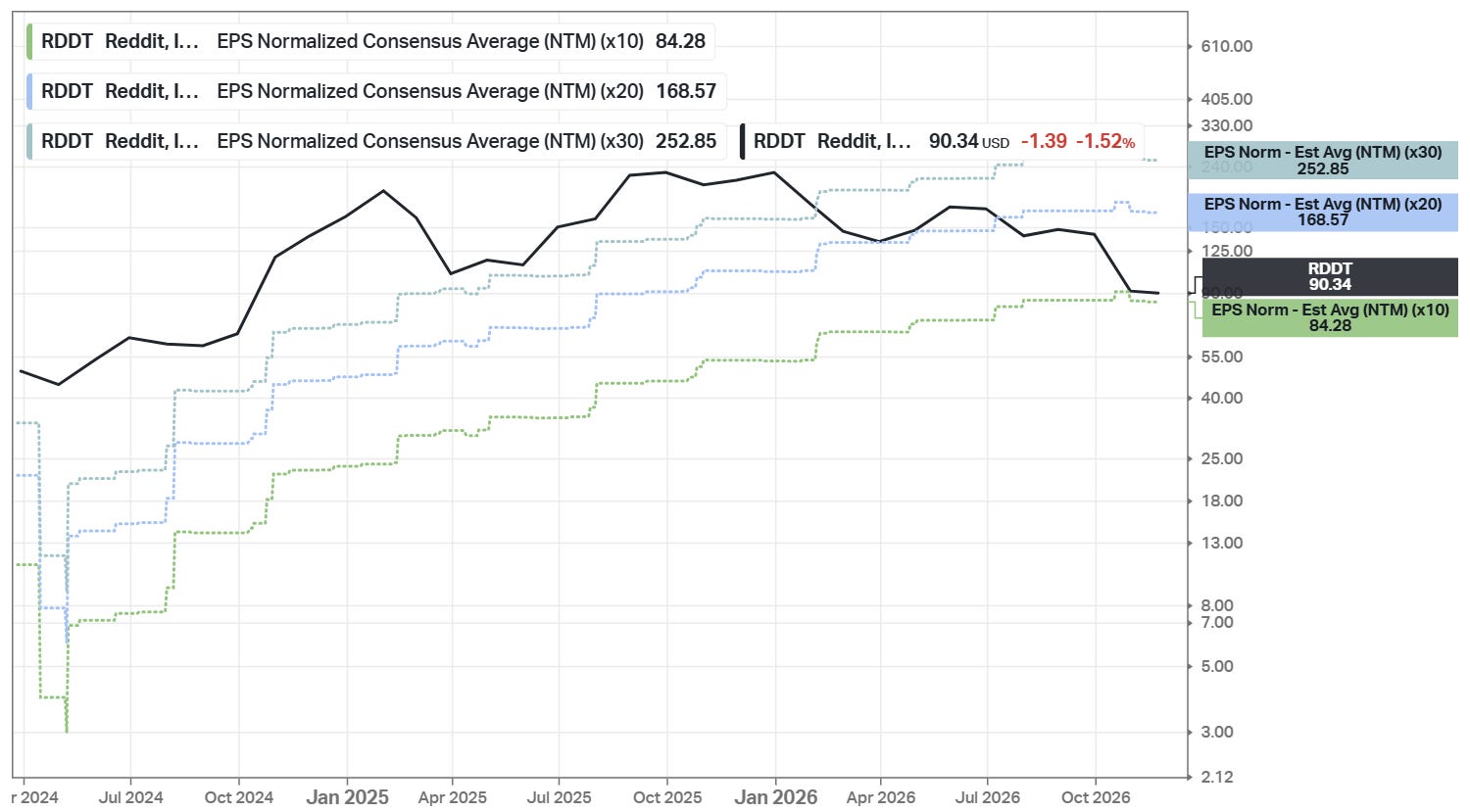
The P/E mean since the IPO is distorted by the small earnings of 2024, so my model uses the -1 SD band. The August NTM EPS (~$8.55) is read from the Koyfin chart of price vs NTM EPS.
One chart frames this whole section. The corridor multiplies the NTM EPS by my exit multiples: 10x (today’s multiple, rounded down), 20x (the -1 SD band, rounded down), and 30x (the ceiling of my Manifest). Today it is ~$84-253, and RDDT is just above its lowest line. The corridor values one year of earnings; my fair prices value 5 years.
Updated Fair Price
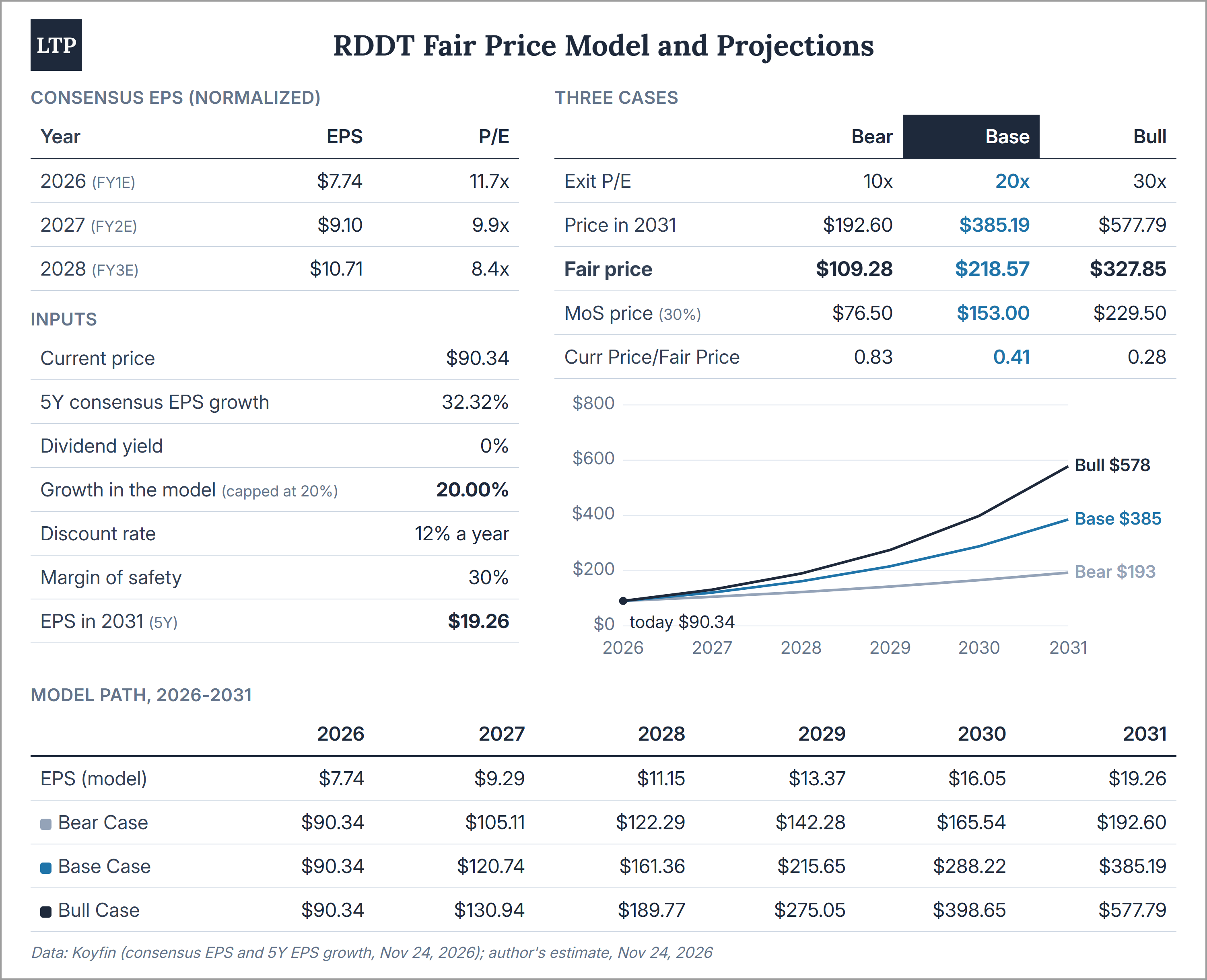
The method is the same as in August. I start from the FY2026 consensus EPS of $7.74 (it was $7.56 in August) and grow it at 20% a year for 5 years to $19.26; the 5Y consensus (32.32%) is higher, so the cap decides. But for the next 2 years, 20% is now above consensus: my path ($9.29 and $11.15) is a bit above the $9.10 and $10.71 that analysts expect. That is why I also test 15% growth this time.
The discount rate is 12%; the margin of safety is 30%. My exit multiples are 10x/20x/30x (they were 20x/25x/30x). Bear: today’s multiple, rounded down (in August, I used 20x, a bit above that day’s 18.7x). Base: the -1 SD band, as in August; it moved from 25.0x to 20.3x, and with the US-user condition broken, I do not go above it. Bull: the 30x ceiling of my Manifest.
Bear Case (exit P/E 10x): fair price $109 (was $213) - MoS price $76
Base Case (exit P/E 20x): fair price $219 (was $267) - MoS price $153
Bull Case (exit P/E 30x): fair price $328 (was $320) - MoS price $229
Almost all of the change comes from the multiples. Starting EPS is 2.4% higher, so the Bull Case, with the same 30x, rises to $328. The Bear Case halved with its exit multiple, and the Base Case lost 18% with the band. If EPS grows only 15% a year, the Base Case fair price is $177 (MoS price $124) and the Bear Case $88, about today’s price.
What does $90.34 assume? If RDDT still trades at 10x in 5 years, EPS has to grow ~15.5% a year for the stock to return my 12% a year, a bit below the ~17.6% consensus for 2027-2028, but it has to last 5 years, not 2. At my 20x Base Case multiple, EPS of only ~$7.96 in 5 years is enough, ~3% above the FY2026 estimate.
Analyst’s note:
Normalized EPS adds back SBC and has almost no income tax in it. Reddit’s Q3 tax rate was ~2%, because old losses and other US tax assets still offset most of its tax. I could not check whether the 2027-2028 consensus assumes a normal rate. At ~24% tax (my assumption), the Base Case MoS price falls to ~$119, and to ~$96 with 15% growth. On GAAP EPS at the same ~24% rate, the Base Case MoS price is ~$84 (~7% below today’s price); with 15% growth, ~$68.
At $90.34, RDDT is 59% below the Base Case and 41% below the Base Case MoS price of $153. My accumulation zone is $76-109; RDDT is inside it.
Verdict
Reddit delivered the money side of my August thesis, not the audience side. Revenue per user, margins, FCF, and cash all improved; US daily users decreased. At $90.34, RDDT is 41% below my Base Case MoS price of $153. On normalized EPS, as in August, even 15% growth and a ~24% tax rate leave the Base Case MoS price (~$96) above the price. On GAAP EPS, after SBC and with the same ~24% tax, the tests fall below the price: ~$84 on my 20% path, ~$68 with 15% growth. My rule uses normalized consensus EPS, so by my rule (buy below the $153 Base Case MoS price), RDDT is a buy; the GAAP tests show how thin the cushion is. It is a weaker buy than in August, though: the price is low mostly because a risk from my August list materialized, not because the market is ignoring a strong quarter. As in August, I see it as a growth position, not a core one. What I watch: logged-in US daily users in the Q4 report in February (23.4M, +1% YoY; once the login requirement reaches the US, the total says less), the login-requirement test, both licensing renewals, and the Q1 2027 guide. If Q4 revenue grows less than 40%, my second condition breaks too. The same holds if the midpoint of Reddit’s Q1 2027 guide, plus a beat as large as Q3’s (~3.5% over the guide), is still below 40%.
Card
This is not a financial or investing recommendation. It is solely for educational purposes.