

TL;DR: Currently, ten leading companies are trading 21–62% below their 52-week highs. Each is also below the -1 SD band of their 5Y forward P/E: Fair Isaac, Intuit, Adyen, Rollins, Hermès, ServiceNow, Zoetis, Booking, Copart, and Intuitive Surgical. Booking and Intuitive Surgical appear to have temporary declines, as their estimates have remained stable over the past 90 days. Zoetis and the mortgage segment of Fair Isaac show signs of more persistent challenges. For the others, the outlook is mixed.
Why This List
A significant decline in a quality business typically has an underlying cause. The market may anticipate changes not yet reflected in historical data, creating a potential value trap where the stock appears inexpensive but the business fundamentals are deteriorating. Alternatively, the market may be reacting to sentiment while the financials remain stable, which can present an opportunity for long-term investors. In some cases, the business remains strong, but the previous valuation was excessive, resulting in a prolonged period of lower stock prices.
This list includes only high-quality companies, each with a consistent record of strong margins; most also deliver high returns on capital. There are three exceptions: ServiceNow’s ROIC is only 6.55%, but it remains on the list due to its growth and cash flow; Fair Isaac and Zoetis have higher debt levels. I excluded cyclicals at their peak (such as chip equipment and energy) and companies whose earnings have not compounded in recent years. Only companies trading at least ~25% below their 52-week high as of November 3 were included. Since then, Booking, Copart, and Intuitive Surgical have rebounded and are now less than 25% below their 52-week highs.
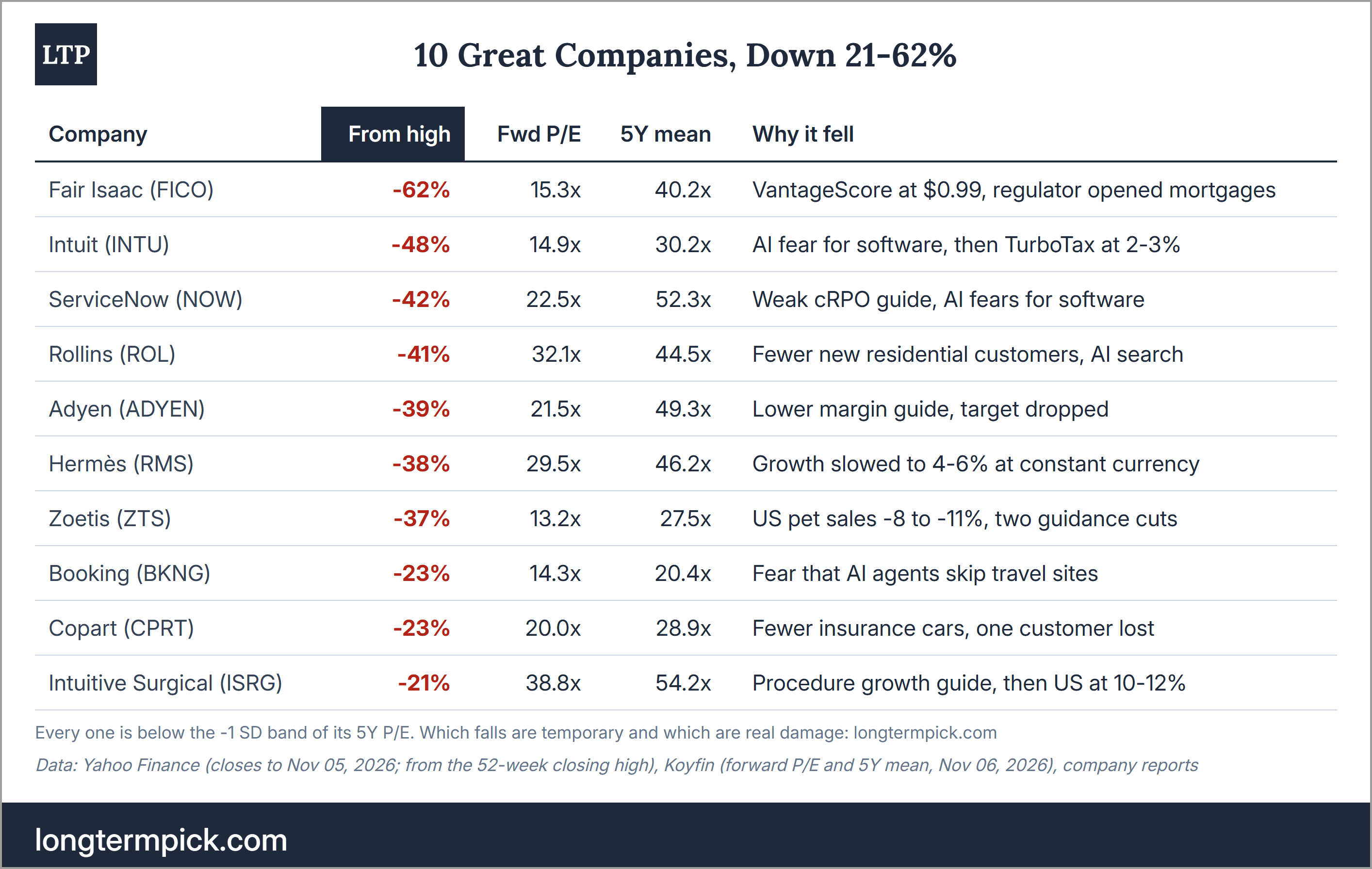
My primary metric here is the consensus EPS over the past 90 days, as a declining share price with stable estimates differs significantly from one accompanied by falling estimates.
Analyst’s note:
Prices are Nov 05, 2026 closes. That day, the S&P 500 fell 4.4% on AI and chip stocks; only ZTS and NOW fell more than 3% from this list. The charts and the multiples are from Koyfin on Nov 06 and use these closes. The revisions are from the Yahoo Finance consensus of Nov 06. Booking, Fair Isaac, and Zoetis reported only days ago, so analysts may still change their numbers. In every valuation chart, the dashed lines are the 5Y mean and ±1 SD (the usual range around the mean). There is no fair price model here, only the question of whether the fall is justified.
Two things limit the comparisons in this post. The 5Y window starts in late 2021, when many of these stocks had very high multiples, so the mean is high for several names. The -1 SD band is a better reference, but it is not a floor. The forward EPS of FICO, ISRG, and NOW excludes stock-based compensation, while INTU, BKNG, and ZTS include it, so a lower P/E does not always mean a cheaper stock. “EPS est. 5Y growth” is the consensus EPS growth for the next 5Y against its own 5Y mean.
1. Fair Isaac (FICO): -62%, a $10 Score Under Attack
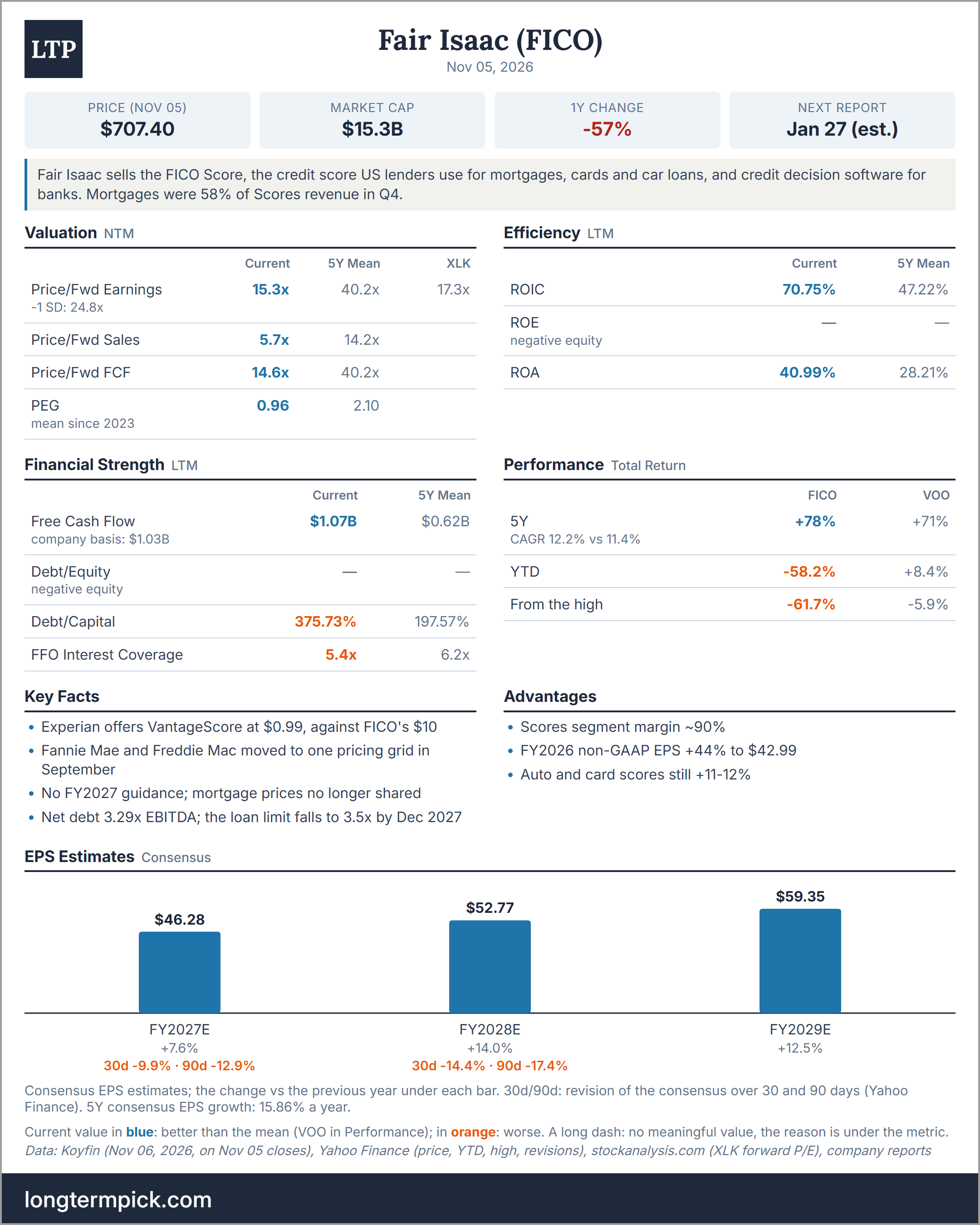
The business kept growing while the stock fell 62%. Fair Isaac sells the FICO Score, the credit score that US lenders use for mortgages, cards, and car loans, and also the software that banks use for credit decisions. In the Q4 FY2026 report (Nov 04), revenue rose 27% YoY to $657.0M, and B2B Scores revenue grew 39%, mostly because the company charged more per mortgage score, even as the number of new mortgages declined. Over FY2026, non-GAAP EPS increased 44% to $42.99; FCF rose from $739M to $1.03B. At the same time, FICO fell from ~$1,845 in December 2025 to ~$707 on Nov 05, 2026. Even after this fall, FICO returned +78% over 5Y against +71% for VOO (the S&P 500 fund).
What happened. On Mar 09, Experian offered VantageScore 4.0, the competitor score from the three credit bureaus, at $0.99 per mortgage score. As a result, FICO fell 24% in 3 days. On Jul 30, it fell another 17% after the Q3 report, even with higher guidance. Mortgage growth slowed, Software grew only 2%, and the direct license program (selling scores directly to mortgage resellers, without the credit bureaus) was still waiting for approval. The path was not straight - FICO was 50% below its high by Apr 10, and only 26% below it before that report.
The second half of the fall is VantageScore in mortgages, in three steps. In early September, the Federal Housing Finance Agency (FHFA) ordered Fannie Mae and Freddie Mac (they buy mortgages from lenders, so lenders follow their rules) to let all lenders use VantageScore. FHFA Director Bill Pulte wrote: “FICO has enjoyed a monopoly. No more.” As a result, FICO fell 16.7% on Sep 04. On Sep 28, FHFA announced that Fannie Mae and Freddie Mac will move to one pricing grid, so a loan scored with VantageScore is now treated the same as one scored with FICO. Rocket Mortgage will make VantageScore its default for these loans by the end of 2026; TransUnion will keep it at $0.99 through December 2028, at no extra cost for lenders who buy a FICO score. As a result, FICO fell 26.5% on Sep 29. In late October, Fair Isaac held its wholesale mortgage price at $10, up from $4.95 in 2025, for a bundle of Classic FICO and FICO 10T, but only for lenders in its new Preferred Program, who buy through resellers that commit to pull FICO on 100% of mortgage applications. FICO increased 39% from Sep 30 to Oct 22, then fell 13.2% on Oct 26, when Pulte said more action was coming.
The Q4 report added a fourth step - no guidance. On the Q4 call, management said: “We are not providing fiscal year 2027 guidance at this time.” The reason is a new way to price mortgage scores, where each customer gets their own deal. CEO Will Lansing went further: “We’re not going to share what the prices are.” In my opinion, this is the most important line of the report. For years, investors could model FICO with one number, the price per mortgage score, but now this number is gone. FICO fell ~6% after hours on Nov 04, to ~$658, but it closed 0.9% higher at $707 on Nov 05, with the S&P 500 down 4.4%.
Estimates are falling, and now there is no guidance to compare them against. Over 90 days, the FY2027 consensus EPS decreased 12.9% to $46.28; the FY2028 number decreased 17.4% to $52.77. FY2027 is only ~8% EPS growth on ~5% revenue growth; fewer shares give most of it - if net income stays flat, fewer shares alone give ~$45.8 (my calculation).
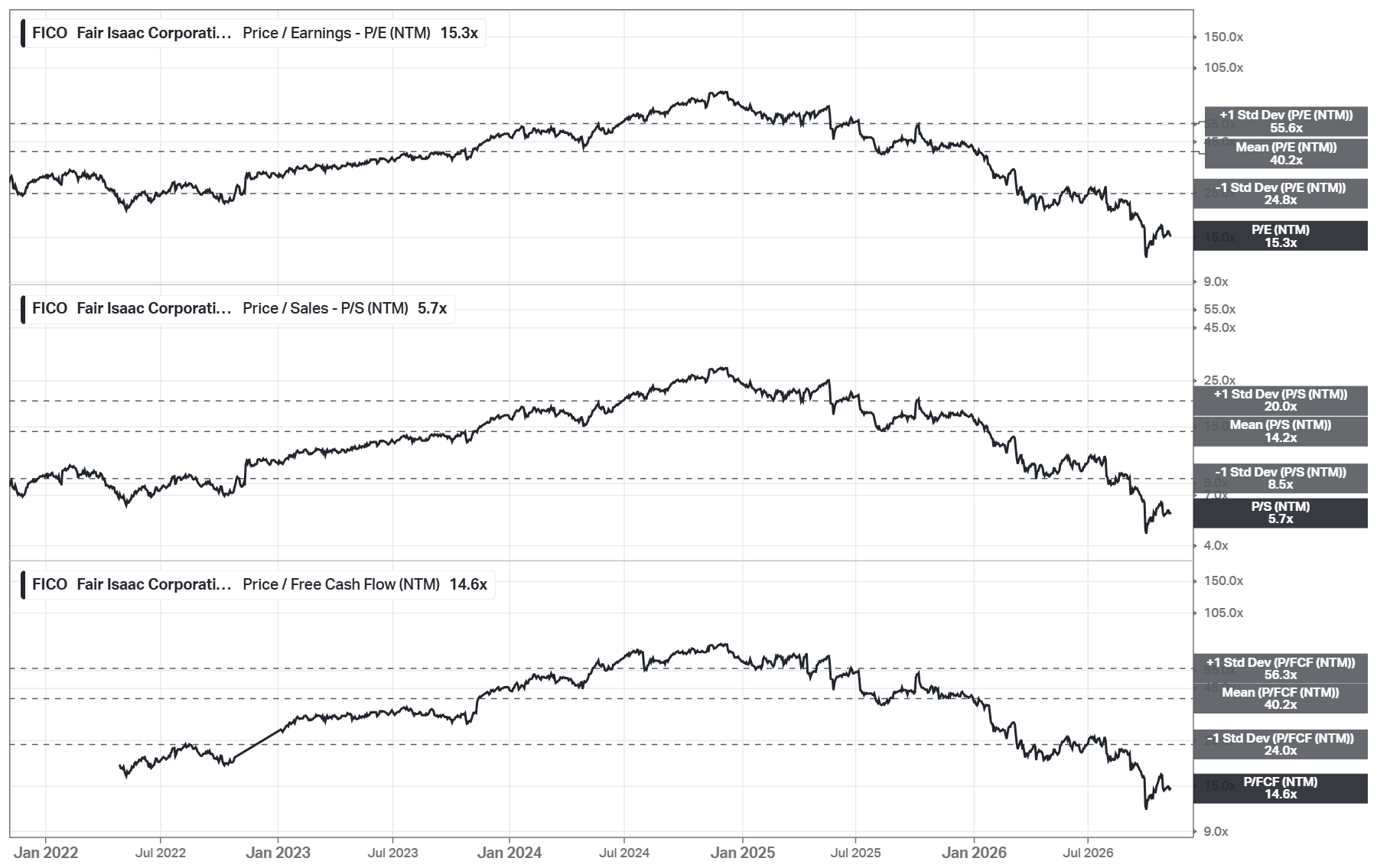
Current vs 5Y mean:
Price/Fwd Earnings: 15.3x vs 40.2x (-1 SD: 24.8x)
Price/Fwd FCF: 14.6x vs 40.2x
PEG: 0.96 vs 2.10 (mean since 2023)
ROIC (LTM): 70.75% vs 47.22%
Analyst’s note:
PEG of 0.96 uses the 15.86% 5Y growth estimate. At ~8% of FY2027, it would be ~2, so I would not call FICO cheap on PEG. This EPS also excludes stock-based compensation. GAAP EPS was $36.32, ~19x at $707. ROIC is above its mean, but the driver for it (mortgage price increases) is now capped.
What the bears get right: mortgages are bigger than they look. They were 58% of Scores’ revenue in Q4, ~37% of total revenue. Scores has a ~90% segment margin against ~28% for Software, so mortgages are roughly half of segment profit (my estimate). Their growth is slowing: +97% in Q3, +72% in Q4, and some volume is moving to home equity lines, which have a lower average price. At ~$960M of annualized mortgage revenue, every 10% of lost price or volume is ~$3.3 in EPS, or ~7% (my calculation). If the average price went back to $4.95, EPS would be ~$30, not $46, and the stock would be at ~24x, not ~15x. This is a stress test, not a forecast.
The balance sheet is the second problem. Fair Isaac bought back $3.03B of stock in FY2026 (3x its FCF) at an average of $1,204 per share. The stock is now ~41% below that. A $1.5B term loan paid for part of it; debt increased from $3.06B to $5.26B in 1 year against $218M of cash. Net debt is ~4.9 years of FCF (my calculation); the limit in my Manifest is roughly 2 years. That is why FICO did not pass this test in Watchlist #002 (and still does not).
The debt now limits what the company can do. Management reports net debt of 3.29x EBITDA; the loan’s leverage limit falls from 4.5x to 4.0x on Dec 31, 2026, and to 3.5x a year later. The company paused buybacks in Q4 to repay debt; Lansing called it “a one or two-quarter thing.” At today’s net debt, EBITDA would have to fall ~18% to reach 4.0x, and ~6% to reach the 3.5x of Dec 2027 (my calculation; the loan’s own definition may differ). Management is already cutting costs - on Oct 01, Fair Isaac cut ~15% of its positions ($27M charge). Q4 also includes a $65M accrual for the proposed settlement of an antitrust class action about Scores.
Why would a lender pay $10 when the competitor costs $0.99? In my view, because the score is a tiny part of mortgage costs, and investors who buy these loans have decades of FICO data. But now the largest lenders have a reason to test the cheaper one. Mortgage volume hasn’t left yet, and that does not prove much. Volumes fell by a high single digit in Q4, and management blames interest rates: “we saw no meaningful loss of volume to competition.” But Fair Isaac is paid per pull, and lenders who compare two scores pull both. The real test comes now - Rocket is about to switch, and Pennymac deployed VantageScore in October. UWM keeps FICO on all credit pulls. FHFA is also “seriously considering” a bi-merge (fewer bureau reports per loan), which could mean fewer paid pulls (my inference).
My opinion: real damage, in the part that makes about half of the profit. So far, the damage is mostly to pricing power, but the first signs are in the numbers. Scores revenue fell 10% QoQ, from $458.9M to $413.8M, against ~-4% a year ago (my calculation), and the average mortgage price fell QoQ. Management attributes this to lower volumes and mix, not competition. Outside mortgages, the report looks fine - auto originations revenue increased 11%, and cards and personal loans 12%. Software increased 19% to $243.2M, after +2% in Q3. At ~15x forward earnings, FICO looks cheap only if ~$46 of EPS holds, and there is no guidance behind that number. I would not call it a temporary fall, because the cause is structural. But the business is not broken - auto and card scores still grow 11-12%, and lenders still pay for FICO.
What to watch: whether FY2027 guidance comes at all, and whether large lenders keep pulling FICO alongside VantageScore.
FICO is one of two cases on this list showing clear structural challenges. Booking represents the clearest case. Zoetis, despite beating expectations and raising guidance on November 5, declined 7.9% in a weak market and remains the company I trust the least. The remaining six companies present mixed outlooks, each contingent on a specific factor discussed below.
