

Paid subscribers got this analysis on Sep 18, when the price was lower. Upgrade your subscription to get the next one early.
TL;DR: Credo (CRDO) sells the connections inside AI clusters: active electrical cables (AECs), optical transceivers and the chips inside them, and retimers. The Q1 FY2027 report was another beat, and the company raised its full-year growth outlook to more than 85%. At the same time, the stock fell 20% the next day and is now 32% below its mid-August price. I see smaller beats, not a weaker business. The rest of the year depends on a new optical business, and stock-based compensation (SBC) is close to 20% of revenue in the Q2 guidance. Verdict: a very profitable company priced as if its growth were temporary. CRDO trades at 24x forward earnings for 50% consensus EPS growth, and the price is above the zone of my model; my full fair price math and the accumulation zone are at the end of this post.
Investment Thesis
Credo reported Q1 FY2027 on Sep 01 with record revenue, a higher full-year growth outlook, and record non-GAAP EPS of $1.20. CRDO fell 20% the next day and 27% in 2 weeks. It is now 42% below its June high, while consensus EPS for the next 12 months is at a record. My idea here is to check whether the report changed the long-term economics of the company or only the shape of this year.
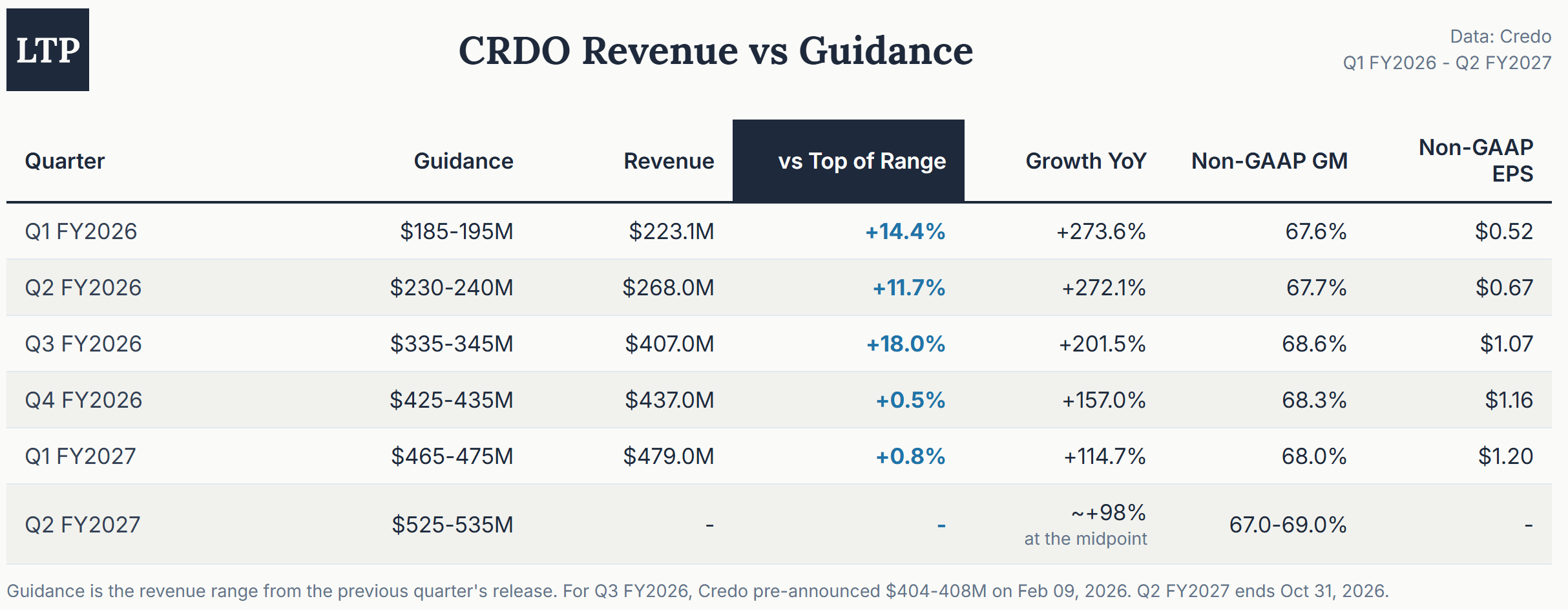
Growth is still very high, but the beats became small. Revenue increased 115% YoY to $479.0M, the seventh quarter in a row of triple-digit growth. In the three quarters before Q4 FY2026, Credo beat the top of its own revenue guidance by 12-18%. In the last two quarters, the beat was below 1%.
The market prices in a much weaker future than analysts expect. The consensus 5Y EPS growth estimate is 50.0%, and CRDO trades at 24.1x forward earnings, a PEG ratio of 0.48. At a 12% required return and a 22x exit multiple, today’s price needs only ~17% annual EPS growth.
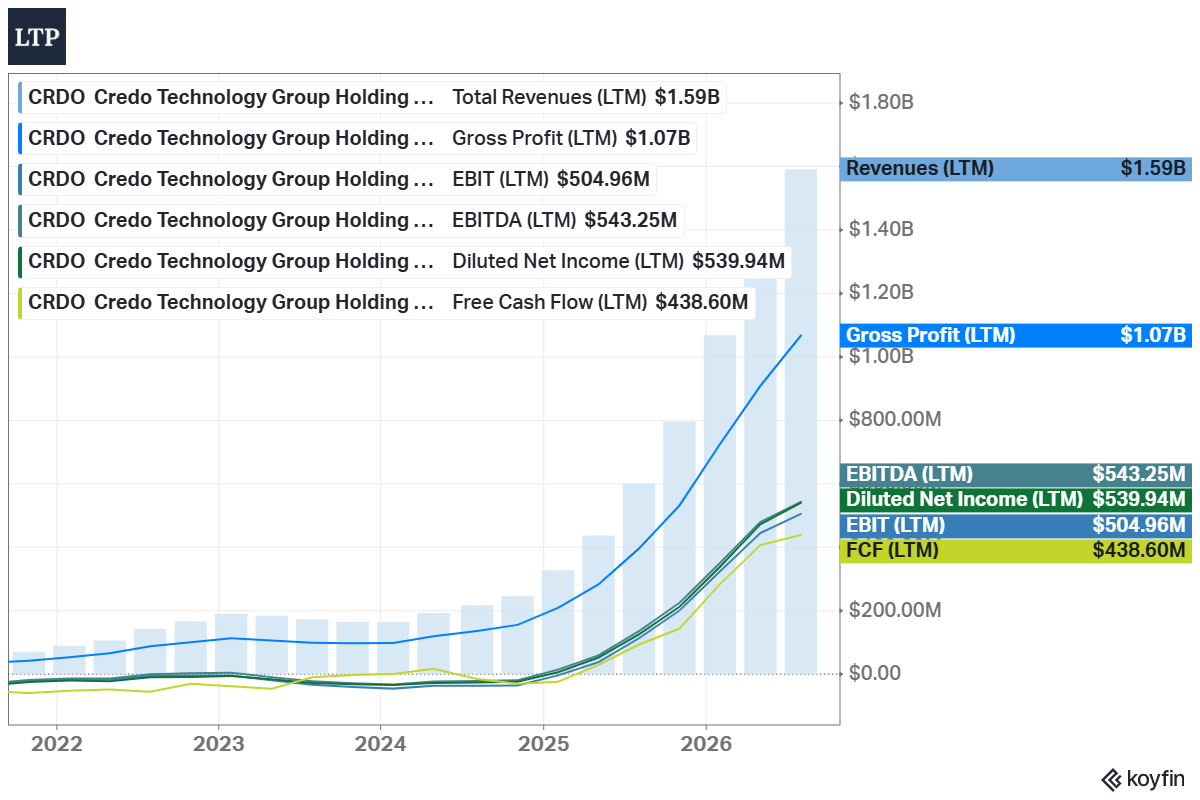
The business is already very profitable. LTM gross margin is 67.07%, net margin 33.83%, and ROIC 20.8%. FCF over the last 12 months is $439M. Credo has no borrowings and $764M of cash and short-term investments.
The multiple is near the bottom of its range. CRDO trades at 24.1x forward earnings, 47% above its 16.4x -1 standard deviation band. The 88.5x mean since the IPO comes from the loss-making years, so I do not use it. And this despite the fact that analysts expect record EPS for the next 12 months.
The bear case: two customers bring 71% of revenue, the second half depends on optical products that have just started to ship, SBC is ~20% of revenue in the Q2 guidance, and the diluted share count increased 5% in 1 year. My model takes this into account by capping future growth at 20%, far below consensus, and by using the 17x -1 standard deviation band as the Bear Case exit. With these limits, the price of $176 is 16% above my Bear Case fair price ($151) and 10% below the Base Case ($196).
Analyst’s note:
EPS in this post is non-GAAP, since the estimates are built on it. The difference is large. In Q1, GAAP EPS was $0.67 against $1.20 non-GAAP, mostly because of SBC, acquisition costs, and the amortization of acquired intangibles. The 71% is the share of the two largest contracting customers in the 10-Q. By end customer, the top four brought 84% of revenue.
Company Overview
Next Earnings Date: Dec 02, 2026 (estimated)
Market Cap: $33.06B
Sector: Information Technology | Industry: Semiconductors
Type: Large Growth
Short Interest: 3.3%
Credo Technology Group was founded in 2008 in San Jose, California, and it is incorporated in the Cayman Islands. It started with serializer/deserializer (SerDes) technology - the circuits that move data between chips at high speed. Its engineers began to work on active electrical cables in 2017, and production of the first HiWire AECs started in 2019. An AEC is a copper cable with Credo chips at both ends, which clean and boost the signal. Credo created this product category, and AECs are still its largest business. The IPO was in January 2022 at $10 per share. Bill Brennan has been CEO for 13 years, and the two founders, Lawrence Cheng (CTO) and Job Lam (COO), are still in management and on the board.
The product range has four groups. AECs connect GPUs and servers with the first switch at distances of up to 7 meters. The optical business includes digital signal processors (DSPs) for optical transceivers, silicon photonics photonic integrated circuits (PICs) from the DustPhotonics acquisition, and ZeroFlap optical transceivers that Credo builds itself. Retimers (Screaming Eagle, Blue Heron, and Toucan) keep the signal clean inside servers and in scale-up networks. The rest is SerDes IP licensing and chiplets. Most products work with PILOT, Credo’s diagnostics software. The company is fabless - TSMC (TSM) makes its chips, and Amkor (AMKR) and ASE (ASX) package and test them. 616 of its 807 employees are engineers, according to the 10-K.
Credo sells to hyperscalers and neoclouds directly and through cable and optical module makers. By shipment destination (Q1 10-Q), 53% of Q1 revenue went to the US, 19% to Hong Kong, and 16% to Malaysia. Mainland China decreased from 23% of revenue a year ago to 0.2%.
Market Overview
The optical market is growing faster than almost any other part of the data center. According to LightCounting (January 2026), sales of Ethernet optical transceivers and co-packaged optics (CPO) for AI clusters reached $16.5B in 2025 and should reach $26B in 2026, +60% in both years. In April 2026, it forecast 65% growth for all Ethernet transceivers in 2026, after +93% in 2024. In March 2026, it wrote that there is “a reasonable chance” for AI cluster optics to reach $100B per year by 2030. To compare, Credo’s optical target of more than $600M for FY2027 is less than 3% of the 2026 market.
Copper still makes most of the connections, and AECs extend its reach. According to Brennan, copper is still more than 95% of the connections in a data center, the same share as 12 years ago. AECs cover the short end of the pluggable market, up to 7 meters. According to Brennan, the only switch between the two media so far went the other way - copper replaced optics at lengths of up to 7 meters, first of all because it is more reliable, and also because it uses less power. Credo does not report AEC revenue separately, but management says it more than doubled in FY2025 and more than tripled in FY2026. I did not find a reliable, recent third-party estimate of the AEC market. The published ones are far below Credo’s own AEC sales (AECs brought over $230M of extra revenue in Q1 alone), so I do not use them.
The buyers are few. LightCounting estimates that four cloud companies are responsible for more than 50% of AI spending on optical transceivers: Amazon (AMZN), Google (GOOGL), Meta (META), and Microsoft (MSFT). In its January report, it also expects optics to be 3.1% of the capex of the top 5 cloud companies in 2026, up from 2.7% in 2025. Credo has the same structure on a smaller scale, with two customers at 71% of revenue.
The risk is the timing, not the size. In its newest forecast (April 2026), LightCounting writes that demand exceeds supply by 30%, and that the shortages should go away by the end of 2026. It also warns that transceiver sales usually drop once the shortages ease, even while capex still grows: "This will happen again in the current cycle, but we just don't know when." In March, it pointed to a possible flat or negative year in 2027-2028. Credo plans its fastest growth for exactly this period: ~20% QoQ in Q3 (November-January) and ~30% in Q4 (February-April). In my view, this is the most important market question for CRDO today. A pause in orders across the industry would hurt a company whose guidance needs acceleration.
Economic Moat
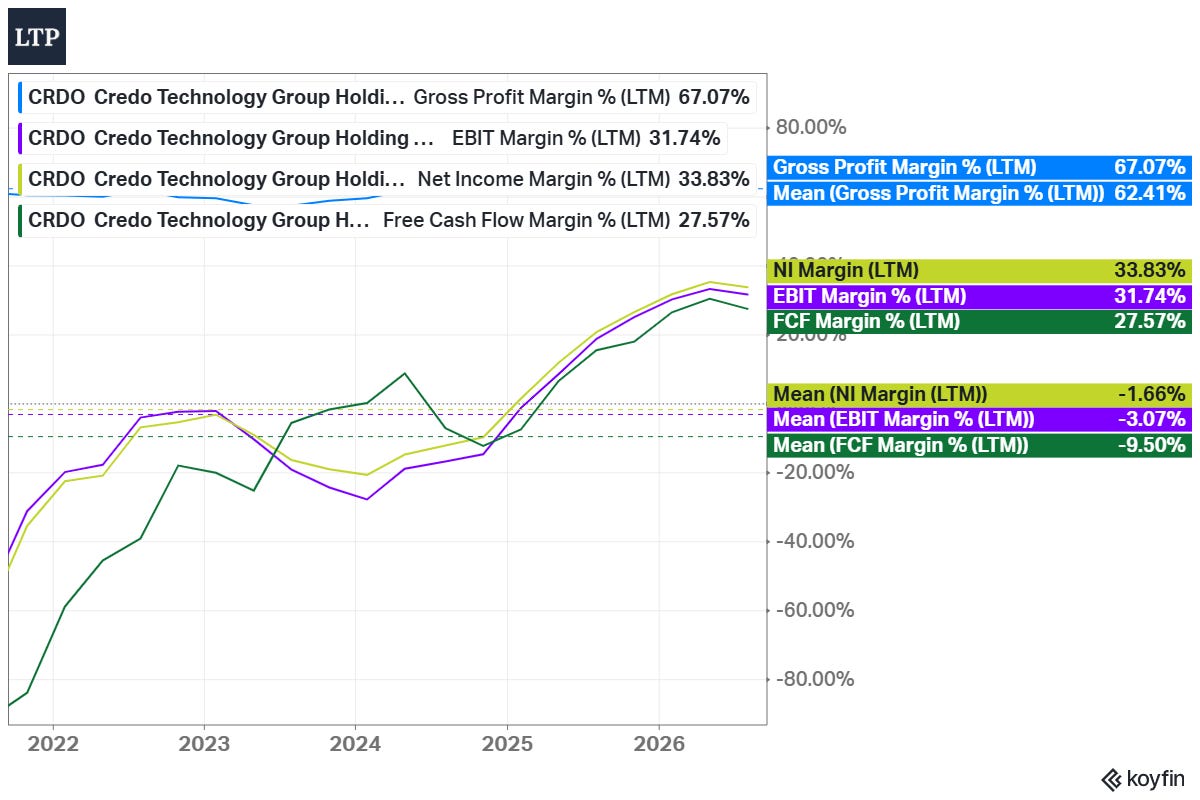
Every LTM margin is far above its 5Y mean. Gross margin is 67.07% (mean: 62.41%), EBIT margin 31.74% (-3.07%), net margin 33.83% (-1.66%), and FCF margin 27.57% (-9.5%). The means include the loss-making years before FY2025, so the more useful number is the trend. The non-GAAP gross margin stayed between 67.6% and 68.6% for five quarters, while quarterly revenue more than doubled. Management guides FY2027 at the same level as FY2026 (68.1%).
Let’s see where this margin comes from. Part of it is intellectual property. Credo owns 86 issued US patents and 52 in mainland China. In March 2025, it filed a complaint with the US International Trade Commission (ITC) against Amphenol (APH), Molex, TE Connectivity (TEL), and Volex over its AEC patents. By March 2026, all four cases were settled with license or cross-license agreements, and Siemon and 3M (MMM) also signed licenses for Credo’s AEC patents. The terms are confidential, so I cannot say what these licenses are worth. What I like: four large cable makers chose a license over a long fight.
The system approach matters even more. Credo designs the SerDes, the chip, the firmware, and the cable, manages the supply chain, and tests its cables with the customer's own switches and network cards before it ships them. Management calls this "probably our biggest competitive moat" and says the company never fails a customer qualification. I cannot verify the second claim. At the same time, it explains why hyperscalers stay: once a cable is qualified for a cluster, a second supplier has to pass the same qualification again. Next, cost. According to the 10-K, Credo's SerDes reaches similar performance to competitors on an older and cheaper chip process.
The weak point is the customer's power. Two contracting customers brought 71% of Q1 revenue, and the remaining performance obligations were only $4.2M. According to the 10-K, Credo does not have long-term purchase commitments from its customers, and they can cancel or delay orders.
In my view, Credo has a narrow moat. The returns are high, and the patents held up, but the high profits are only 2 years old, and a customer can move volume to a second supplier after a new qualification.
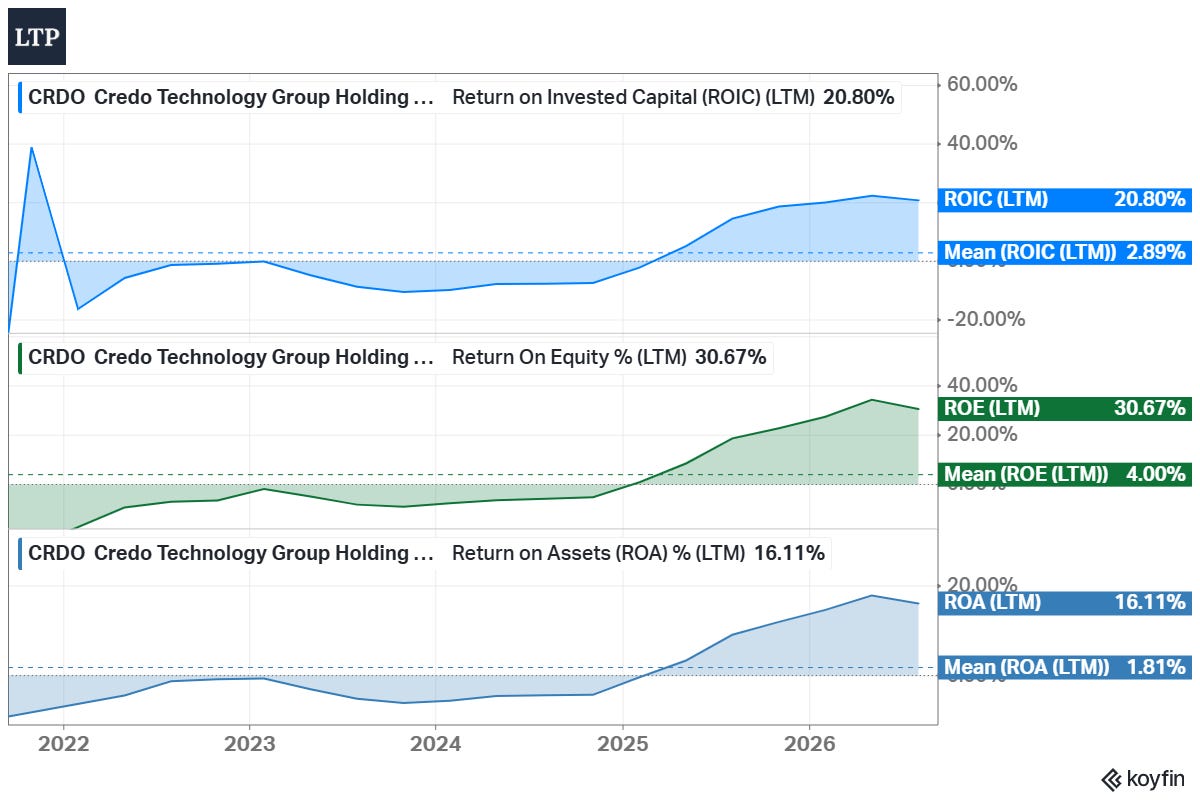
The returns on capital support the moat, but the history is short. ROIC is 20.8% (5Y mean: 2.89%), ROE is 30.67% (4.0%), and ROA is 16.11% (1.81%). All three were negative or close to zero until 2025. ROIC decreased in the last quarter. GAAP operating income decreased 23% QoQ because of SBC and the amortization of acquired intangibles, and the DustPhotonics deal added $1.24B of goodwill and intangibles.
Business Strategy
Own the whole link. Credo builds its own SerDes, DSPs, and, since the DustPhotonics deal, silicon photonics PICs. On top of that, it designs complete cables and transceivers. Management says Credo is the only vertically integrated player in optical transceivers and expects this to give it an advantage on both the cost of goods and the price. Competitors split the same stack between partners. For example, Marvell (MRVL) sells AEC DSPs to cable makers, and in December 2025, it launched a Golden Cable program that gives them reference designs and software.
Sell reliability, not only bandwidth. In an AI cluster, one unstable link (a "link flap") can force a reset of the whole cluster. According to management, customers have reported losing 10-20% of GPU utilization because of it. Credo developed ZeroFlap with input from xAI and Oracle (ORCL). According to Bill Brennan, xAI can now bring a cluster up in 5 days instead of 6-8 weeks with ZeroFlap AECs, and its uptime has reached 99.9%. ZeroFlap optical transceivers do the same for longer links. They measure the health of every link in real time and take an unstable link down before it breaks the cluster. The company says it is not targeting the commodity IEEE 1.6T transceiver market, but the parts of the network where reliability justifies a higher price.
Optics as the second business. Management expects more than $600M of optical revenue in FY2027. ZeroFlap optics, silicon photonics PICs, and optical DSPs are each expected to bring more than $100M. The optical DSP business had record revenue in Q1, and the first PIC revenue came in the same quarter. The DustPhotonics team already has two design wins with major customers, with ramps late in FY2027 or in FY2028. By the end of FY2027, Credo plans to produce hundreds of thousands of optical units per month, and then double or triple that rate by the end of FY2028.
New products for FY2028. Active LED cables (ALCs) use micro-LEDs instead of lasers to reach 30 meters with the reliability of copper, and they are 75% smaller in volume than 7-meter AECs. OmniConnect gearboxes connect processors with LPDDR memory to solve the memory bottleneck in inference. Management estimates the Credo content at thousands of dollars per GPU. Both products should bring their first revenue in FY2028. Credo also joined the Open CPX MSA and has design wins for near-package optics (NPO) in scale-up networks, with ramps starting in FY2028.
Buy teams, not revenue. In 12 months, Credo made three acquisitions: Hyperlume (micro-LED technology, $92.0M, September 2025), CoMira (link layer and security IP, $35.1M, February 2026), and DustPhotonics (silicon photonics, $1.25B, May 2026). The 10-Q calls their effect on the results not material. As a result, the 115% growth in Q1 is almost entirely organic, and over 90% of the YoY increase came from higher AEC volumes.
Capital Allocation
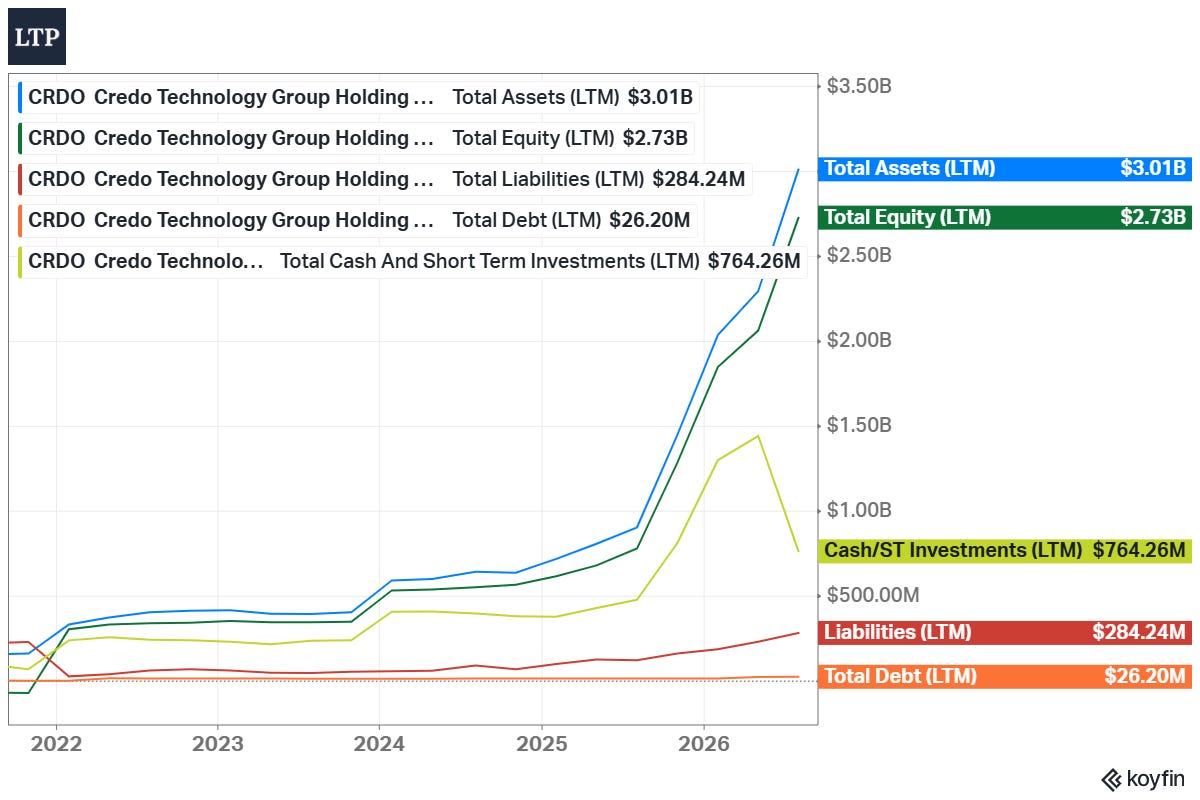
The DustPhotonics deal halved the cash in one quarter. Cash and short-term investments fell to $764M from $1.44B in May. Credo paid $770M in cash, $169M in shares, and booked $310M of contingent consideration that depends on future milestones. As a result, goodwill and intangibles increased to $1.37B, which is 50% of the $2.73B equity. In my view, the price is high for a team with no material revenue yet, but it is 4% of the market cap, and ~38% of it is paid in shares or only if targets are met.
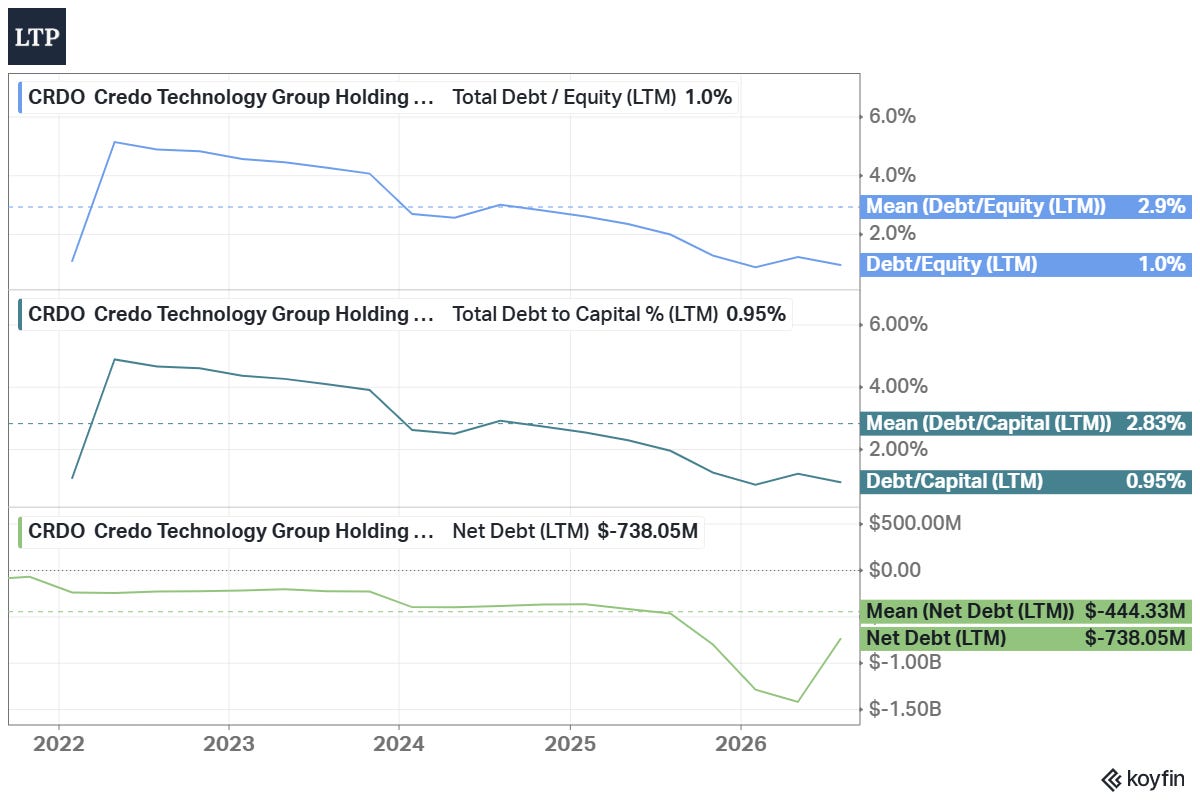
The balance sheet is still very strong. Total assets are $3.01B against $284M of liabilities. Credo has no borrowings, and the $26M of debt in Koyfin is operating lease liabilities. Debt/Equity is 1.0% against a 2.9% 5Y mean, and net cash is $738M.
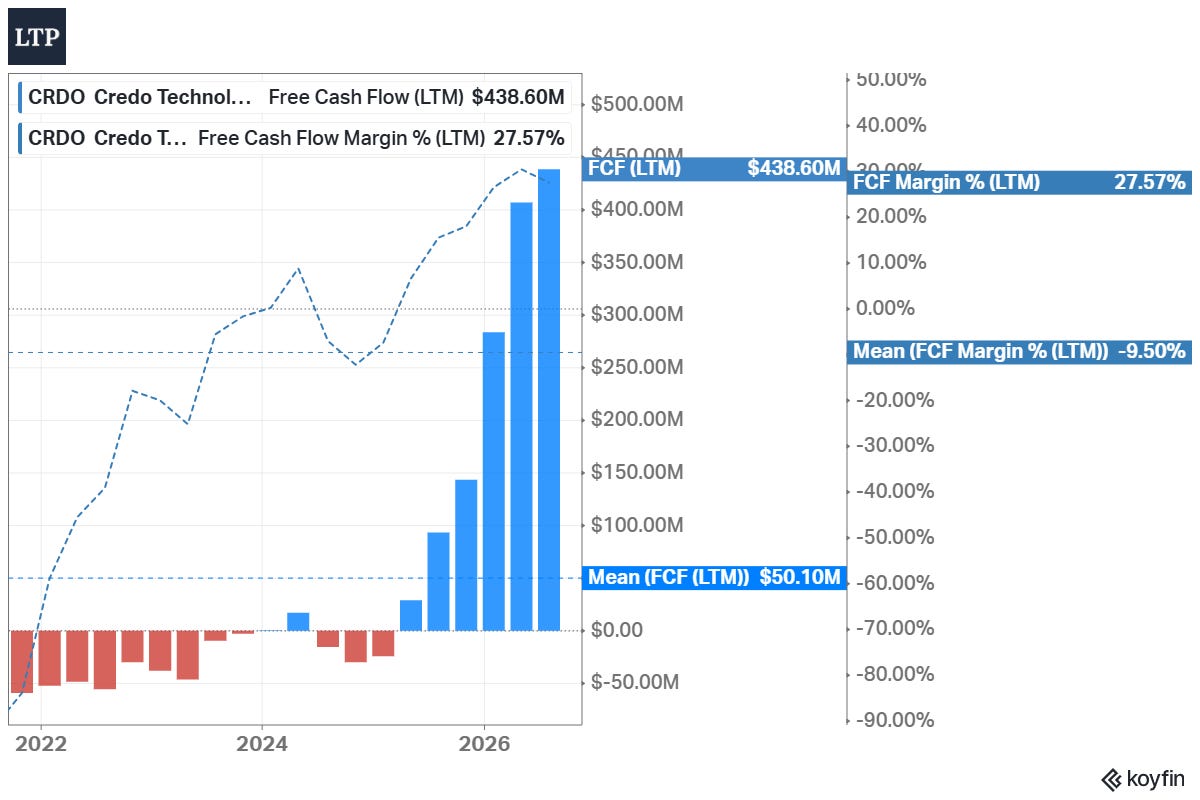
FCF reached $439M over the last 12 months, a 27.57% margin, against a $50.1M 5Y mean. Capex is $62M, 3.9% of revenue. The weak spot is Q1. Operating cash flow was only $90.2M against $129.4M of net income, since working capital used $151.3M. Receivables increased $54.5M, and inventory increased $61.5M "to support unfulfilled backlog and related new product ramps". Another $25.3M went to refundable deposits that reserve manufacturing capacity. Inventory is now $313.1M, which is ~168 days of Q1 cost of revenue by my calculation.
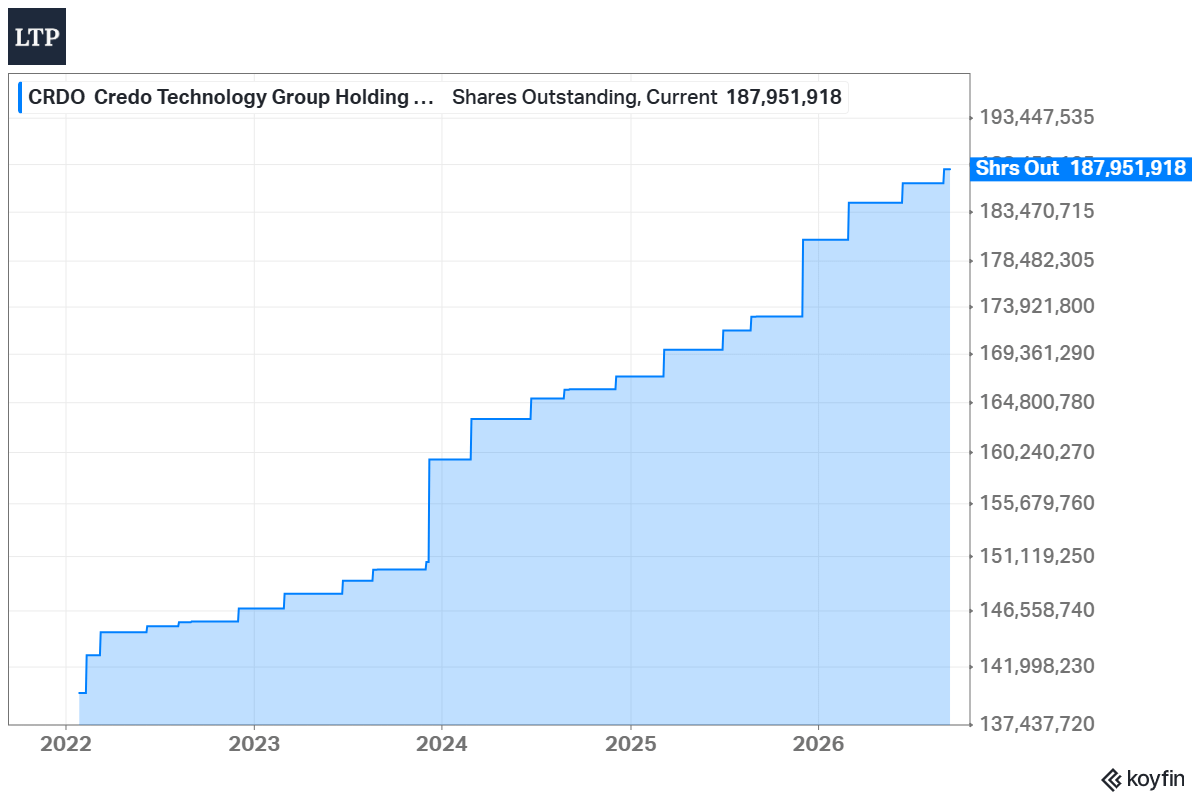
The share count increases every year. Diluted shares increased 5.3% YoY to 194.4M, and management expects ~200M in Q2. The two largest increases were equity sales: a public offering of 8.94M new shares at $17.50 in December 2023, and an at-the-market (ATM) program that sold 4.8M shares for $736M of net proceeds from October 2025 to January 2026. Credo pays no dividend and does not buy back shares.
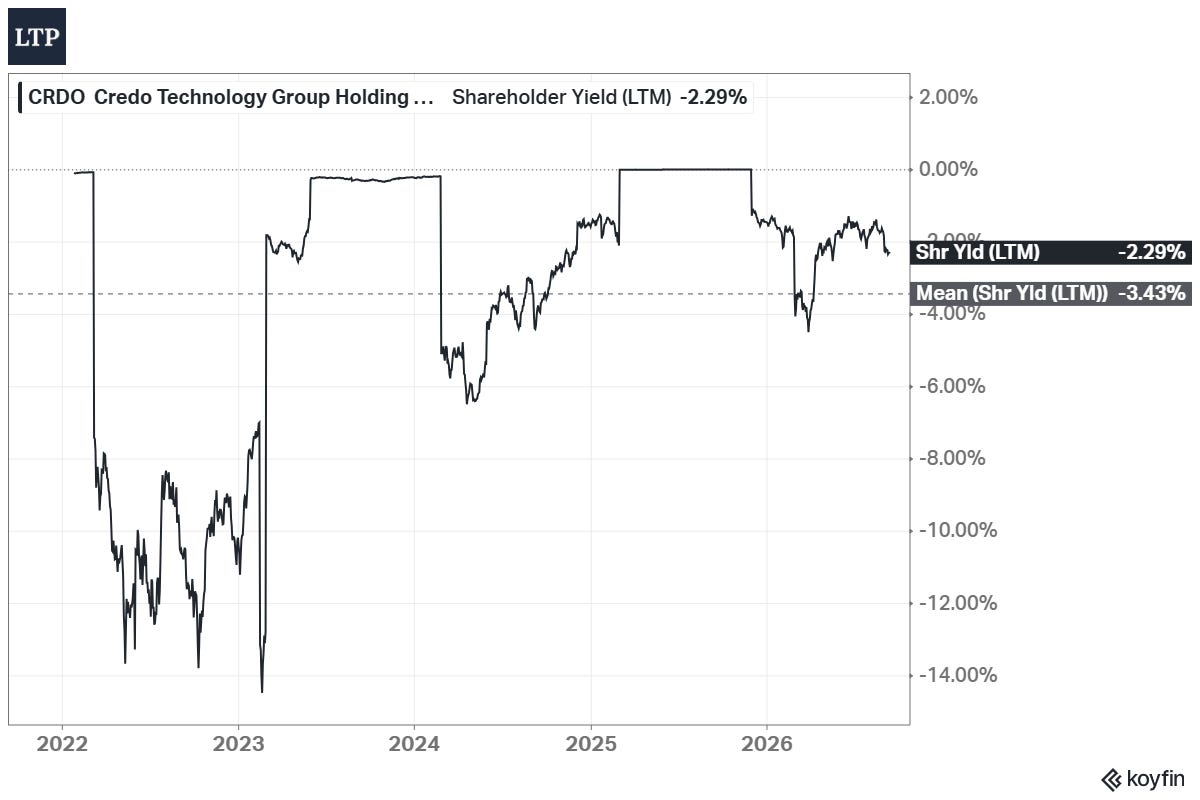
As a result, shareholder yield is -2.29% against a -3.43% 5Y mean. The negative number is the dilution.
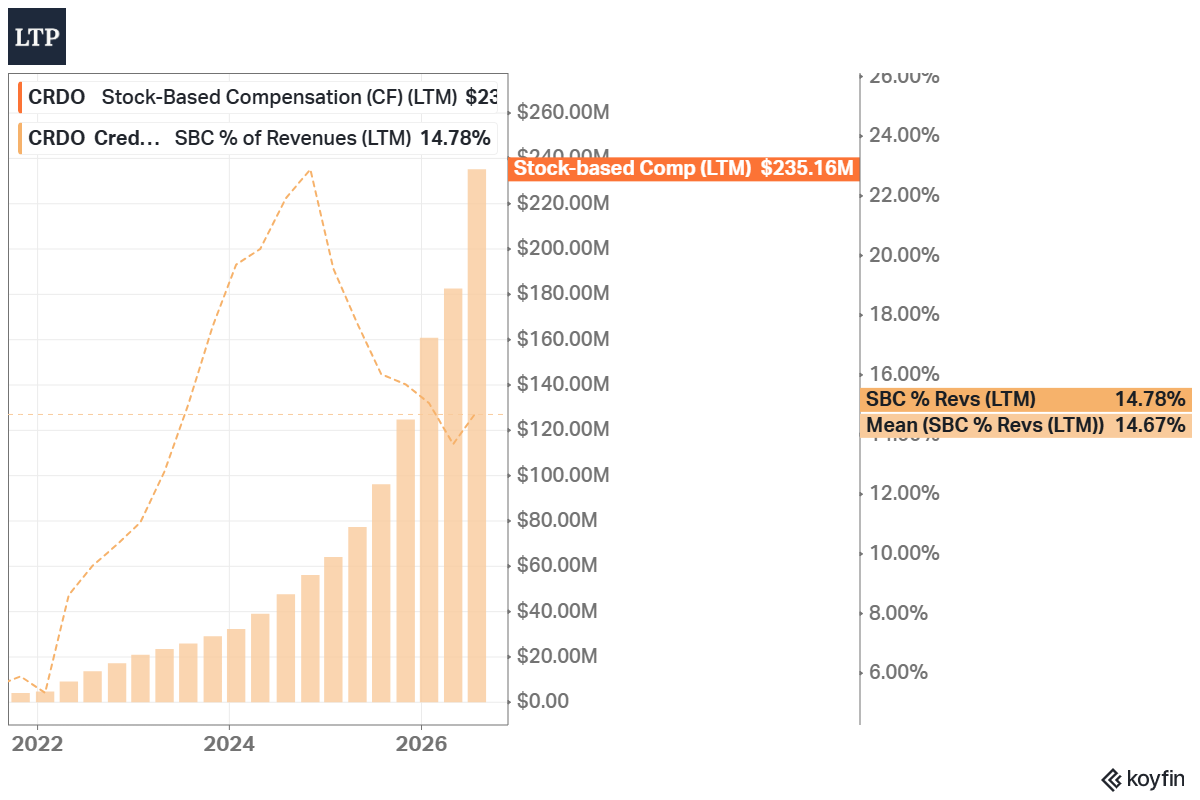
SBC is the main cost that the non-GAAP numbers hide. LTM SBC is $235M, 14.78% of revenue, against a 14.67% 5Y mean. In Q1, SBC increased 148% YoY to $88.0M, and the Q2 guidance implies ~$104M, ~20% of revenue. In Q1 alone, Credo granted 2.1M restricted stock units (RSUs) and 1.9M performance units (PSUs). The PSUs include a special award for the CEO - up to 1.44M shares in six tranches, which require trailing revenue of $2.5-7.5B and a stock price of $244.70-489.40 before June 2031. What I like: both hurdles have to be met (with one exception for the first two tranches), and the first revenue hurdle is already the FY2027 consensus. LTM SBC equals 54% of FCF, so FCF after SBC is only $203M.
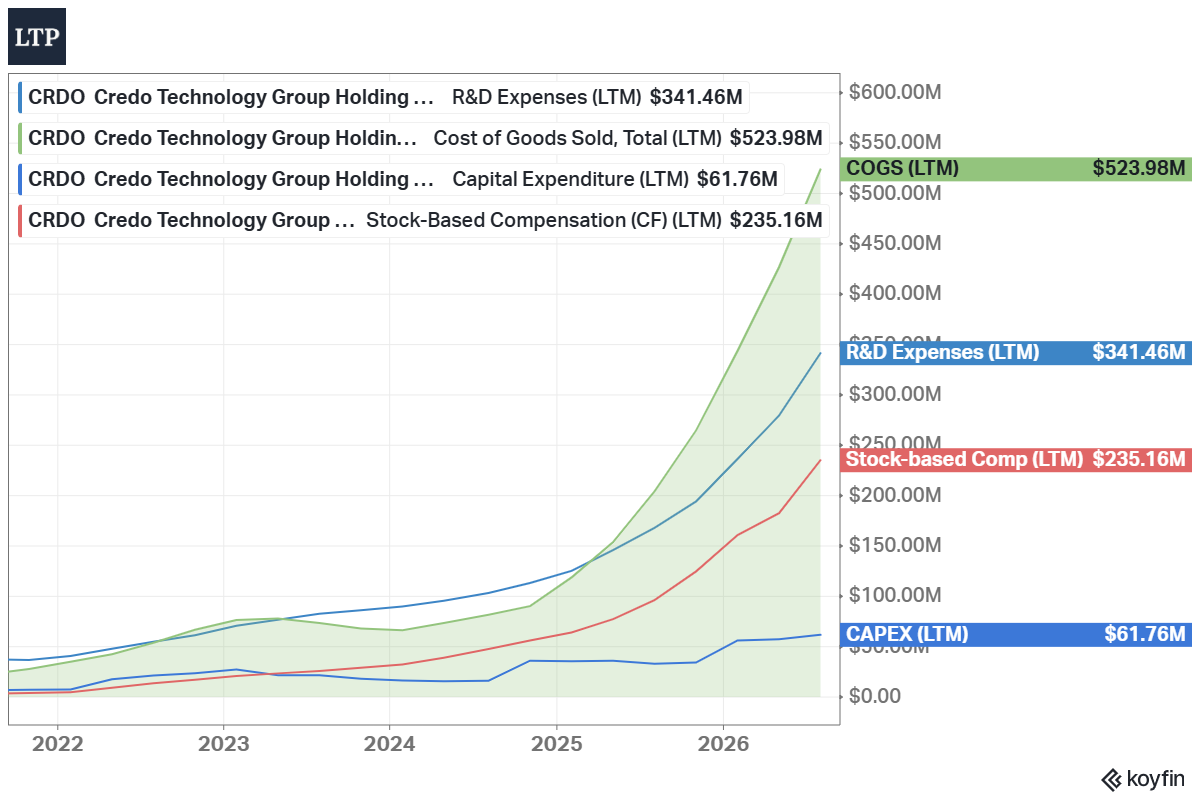
Operating costs grow slower than revenue, but faster than planned. Over the last 12 months, cost of revenue was $524M, R&D $341M, and SG&A $221M. In Q1, non-GAAP operating expenses were $95.2M, above the $86-90M guidance, since R&D for new products increased. Management expects non-GAAP operating expenses to grow ~55% in FY2027, against more than 85% revenue growth.
As I see it, Credo allocates capital in an aggressive but focused way. All the cash goes into R&D, inventory, and technology teams, and shareholders pay for it with dilution instead of receiving a return.

Advantages
The fastest growth in the group at one of the lowest multiples. LTM revenue grew 165%, faster than Broadcom (AVGO), Marvell, and Astera Labs (ALAB). At the same time, CRDO trades at 24.1x forward earnings, against 44.8x for Marvell and 54.0x for Astera Labs.
The inventor of the AEC category. Credo started production of AECs in 2019, and Microsoft was its first AEC customer. In 2025-2026, four cable makers settled Credo’s patent cases with licenses or cross-licenses, and two more companies licensed the patents.
Stable margins during a very fast ramp. The non-GAAP gross margin was 67.6-68.6% in each of the last five quarters, while quarterly revenue increased from $223M to $479M. Management guides the same margin level for FY2027, even with the optical ramp.
A net cash balance sheet after a large deal. Credo paid $770M in cash for DustPhotonics and still has $764M of cash and short-term investments, no borrowings, and a 1.0% Debt/Equity ratio.
More products for the same customers. Credo works with 5 hyperscalers and a growing number of neoclouds. Optics should bring more than $600M in FY2027, and ALCs, OmniConnect, and near-package optics add new revenue from FY2028.
Disadvantages
Customer concentration. Two contracting customers brought 71% of Q1 revenue, and the top four end customers brought 84%. The remaining performance obligations are only $4.2M, and customers have no long-term purchase commitments. The CEO himself describes the hyperscalers as “surging and then pausing”.
The second half depends on products that have just started to ship. The CFO expects ~20% sequential growth in Q3 and ~30% in Q4. The first PIC revenue came only in Q1, and the first 1.6T DSP revenue is expected later this fiscal year. If the optical ramp slips by one or two quarters, the FY2027 growth outlook is too high.
Heavy SBC and dilution. SBC is 14.78% of LTM revenue and ~20% in the Q2 guidance. The diluted share count increased 5.3% in 1 year. In Q1, GAAP EPS was only 56% of non-GAAP EPS.
AECs become easier to copy. Marvell introduced a 1.6T DSP for AECs in 2024 and started a program with reference designs for cable makers in December 2025. Astera Labs sells smart cable modules for AECs, and the four cable makers from the patent cases now have licenses. Brennan says new entrants show that the market is large. In my view, more suppliers are the main threat to the 68% gross margin.
Weaker cash conversion and a large inventory. Q1 operating cash flow was 70% of net income, and inventory increased 25% QoQ to $313M. Goodwill and intangibles are now $1.37B, so a failed optical ramp would also be an accounting problem.
What the bears get right: the beats became small exactly when the plan became more ambitious. Revenue in Q4 FY2026 and Q1 FY2027 came in only 0.5% and 0.8% above the top of the guidance, after 12-18% in the three quarters before. Even the top of the Q2 guidance ($535M) is +99.6% YoY, so the streak of triple-digit growth ends unless Credo beats it by more than $1M. The CFO's path for Q3 is only ~56% YoY, since Q3 FY2026 was a very strong quarter. A pause at a large customer already happened once. In February 2023, Credo's largest customer reduced its demand forecast; the company cut its quarterly revenue guidance to $30-32M (consensus was above $45M), and CRDO fell 47% in one day. FY2024 revenue then increased only 4.8%. The biggest risk, as I see it, is a repeat of 2023 at one of the two largest customers while the optical business is still small. My fair price does not include this risk, so it has to be handled with the size of a position.
Competitors
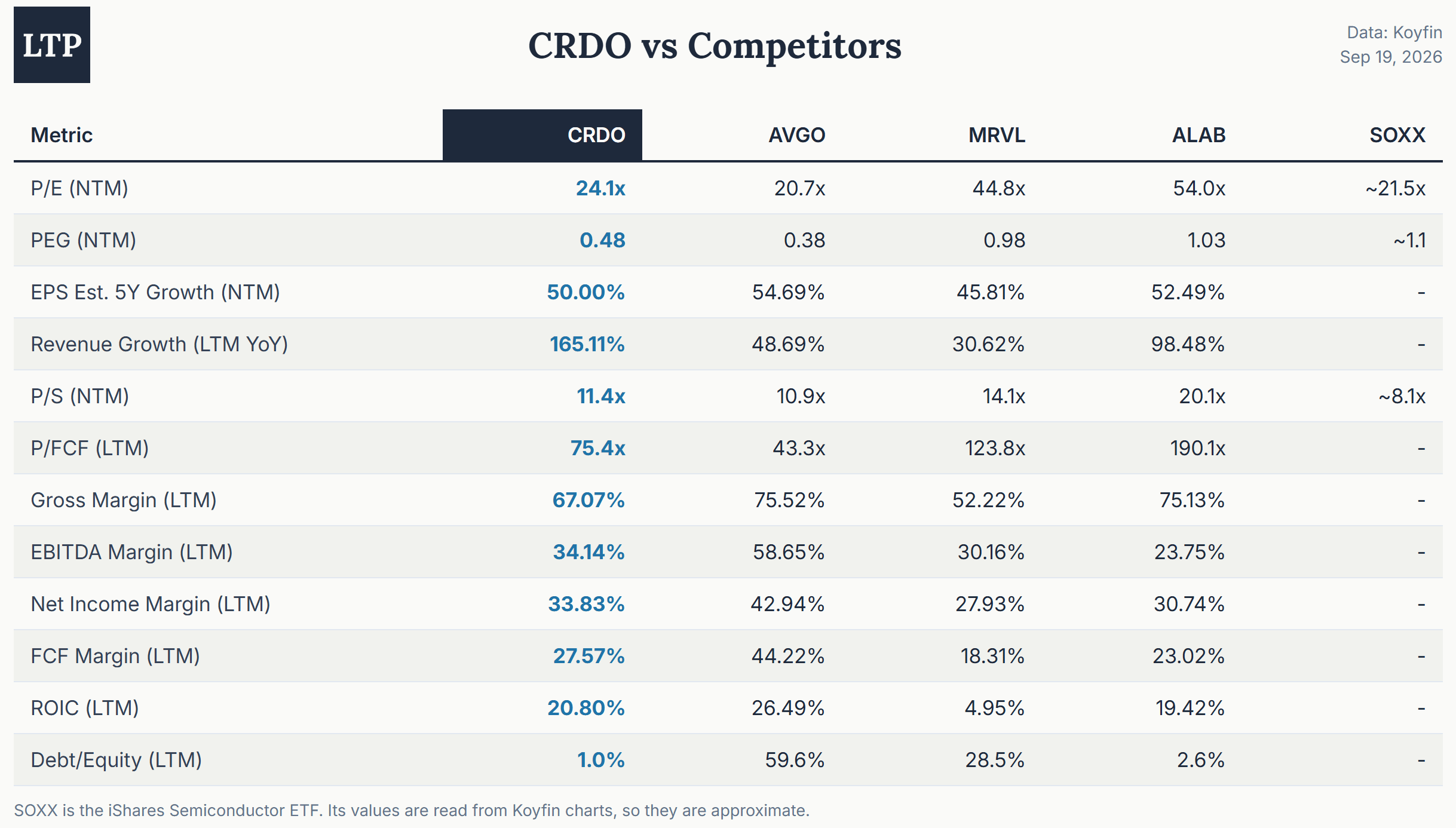
I compare Credo with 3 semiconductor companies and the sector ETF. In the 10-K, Credo names Broadcom, Marvell, and Astera Labs as its principal competitors, together with “various cable and optical transceiver suppliers”. Broadcom makes DSPs, SerDes, and custom AI chips for hyperscalers, and it also sells infrastructure software. Marvell sells optical DSPs and DSPs for AECs. Astera Labs makes retimers and switches for scale-up networks. In AECs, Marvell and Astera Labs sell chips and modules to cable makers, while Credo sells the complete cable. The cable makers from the patent cases are competitors too, but they sell many other products, so their multiples say little about AECs. The iShares Semiconductor ETF (SOXX) shows the level of the whole sector.
CRDO is not the cheapest name here, and Broadcom is the real alternative. The forward P/E is 20.7x for Broadcom, 24.1x for Credo, 44.8x for Marvell, and 54.0x for Astera Labs. SOXX trades at ~21.5x. Consensus 5Y EPS growth is 54.69% for Broadcom, 52.49% for Astera Labs, 50.0% for Credo, and 45.81% for Marvell. As a result, the PEG ratio is 0.38 for AVGO and 0.48 for CRDO, against 0.98-1.03 for MRVL and ALAB, and ~1.1 for SOXX. The strong point of Credo is LTM revenue growth: 165.11%, against 98.48% for Astera Labs and 30.62-48.69% for the other two.
On returns and margins, Credo is second after Broadcom. ROIC is 26.49% for Broadcom, 20.8% for Credo, 19.42% for Astera Labs, and 4.95% for Marvell. Broadcom also has the highest gross margin (75.52%), net margin (42.94%), and FCF margin (44.22%). Credo is second in net and FCF margin. On the balance sheet, Credo is the strongest, with a 1.0% Debt/Equity ratio, against 59.6% for Broadcom.
In my view, the next-best alternative is Broadcom. It has a lower P/E, a lower PEG ratio, higher margins, and a higher ROIC. The difference is the exposure. Broadcom is a much larger and more diversified company, with custom chips, networking, and software, and it has much more debt. Credo is a pure play on AI connectivity, with the fastest revenue growth in the group, net cash, and a much higher customer concentration. For me, CRDO makes sense only as a bet on this specific market, not as a cheaper Broadcom. On valuation alone, Broadcom wins.
Past
Q1 FY2027 results (quarter ended August 1, USD, YoY):
Revenue: $479.0M, +115% (+10% QoQ), above the top of the $465-475M guidance
Non-GAAP EPS +131% to $1.20; GAAP EPS +97% to $0.67
Non-GAAP gross margin 68.0% (67.6% a year ago); non-GAAP operating margin 48.2% (43.1%)
Non-GAAP operating expenses +75% to $95.2M, above the $86-90M guidance
Operating cash flow $90.2M and FCF $82.9M; inventory +$62M QoQ to $313.1M
LTM: revenue $1.59B, net income $538M, FCF $439M, and ROIC 20.8%
Why did CRDO fall 42% from Aug 14 to Sep 15? The stock was already 27% below its August high when the report came out. Here are the reasons, starting with the most important one:
The reaction to the report. CRDO fell 8.65% on Sep 01, before the release, and 20.04% on Sep 02, while SOXX increased 0.23% that day.
Small beats. Revenue was $4M (0.8%) above the top of the guidance and 0.7-1.2% above the consensus (Zacks and TipRanks). EPS of $1.20 beat the $1.17 consensus by 2.6%. In the first three quarters of FY2026, the beats were much larger, so the market read it as a slowdown.
The GAAP gross margin. It decreased from 68.2% to 64.5%, and the Q2 guidance is 62.9-64.9%. Some analysts saw pricing pressure in it. The main reason is accounting: $11.0M of amortization of the DustPhotonics intangibles and $5.7M of SBC in cost of revenue. The non-GAAP margin was 68.0%, at the midpoint of the guidance.
Operating expenses. Non-GAAP operating expenses were $95.2M, above the $86-90M guidance, and GAAP operating expenses more than doubled YoY.
The sector. On Aug 18 and Sep 14, CRDO fell 13.03% and 7.89%, while SOXX fell 4.96% and 5.63%. Coherent (COHR) fell ~13% on both days, and Astera Labs fell 11.74% on Sep 14. From Aug 14 to Sep 15, SOXX lost 9%, and Astera Labs lost 21%.
Still, the numbers in the report were strong. The Q2 guidance midpoint ($530M) is 5% above the Zacks consensus before the report ($502.69M), and the company raised its full-year growth outlook. In my view, the reaction is only partly justified. The worry about the second half is fair, since it depends on new optical products. The worry about the gross margin is not, since the non-GAAP margin did not change.
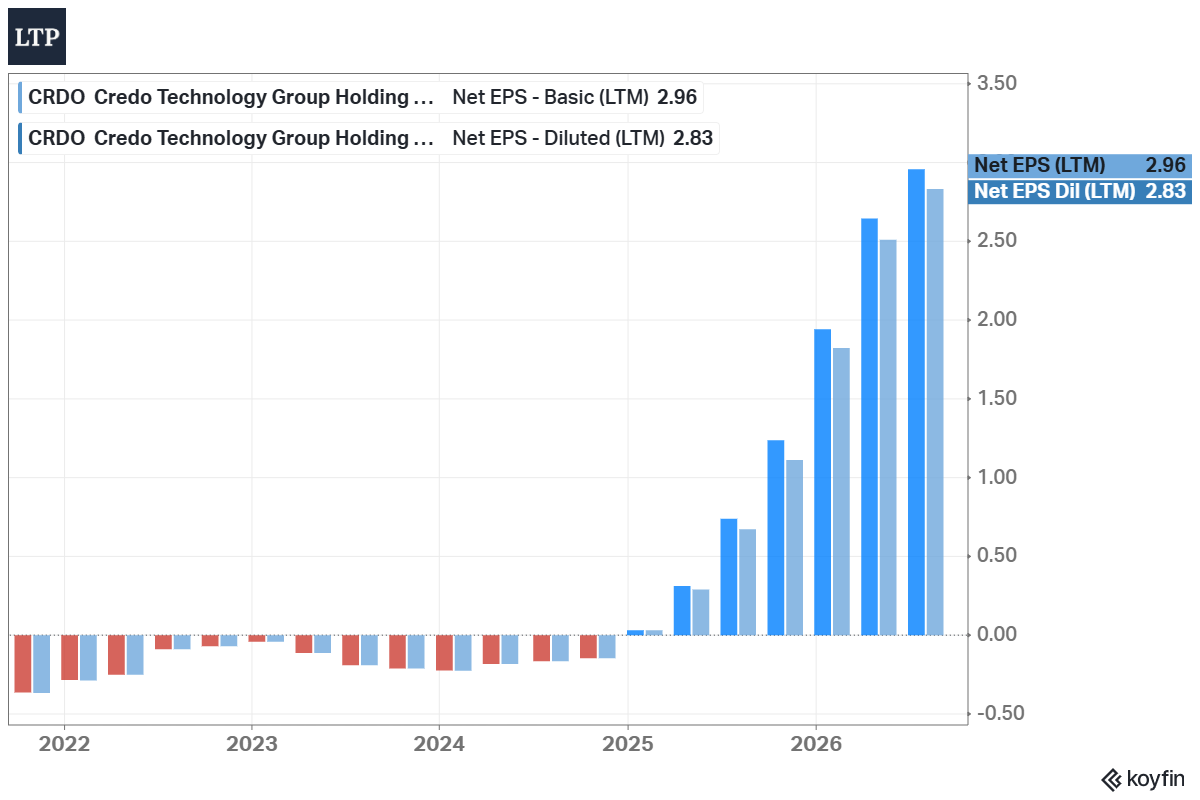
Over a longer period, the record is uneven. Revenue increased from $58.7M in FY2021 to $1.34B in FY2026, and the 3Y revenue CAGR is 93.5%. The path was not smooth. FY2023 revenue ($184.2M) missed the company’s own target of “at least $200 million”, and in FY2024, revenue increased only 4.8% after the largest customer reduced its demand forecast. Credo had GAAP net losses from FY2021 to FY2024 and returned to profit in FY2025 ($52.2M). In FY2026, net income reached $472.3M, and GAAP EPS reached $2.51.
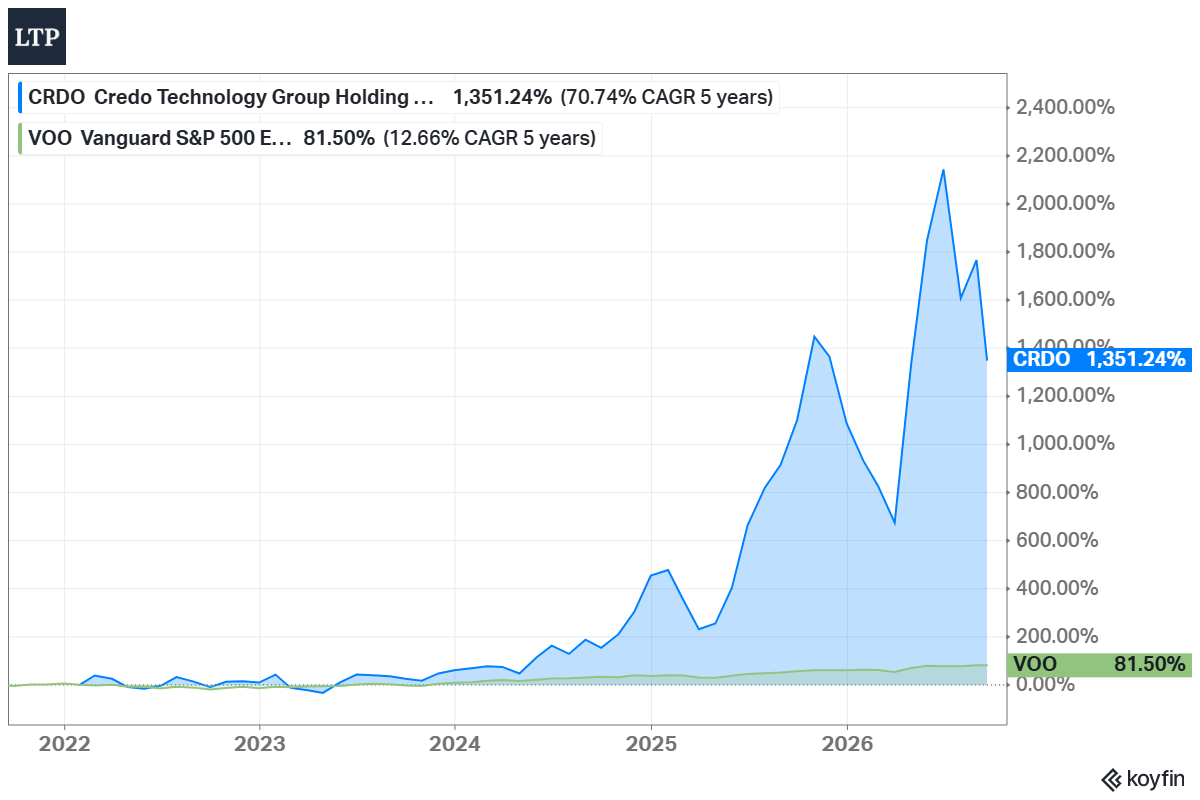
The stock was an excellent investment, but not a calm one. Since its first trading day on Jan 27, 2022, CRDO returned 1,410%, or 79.5% per year, against 14.66% per year for the S&P 500 (VOO). Right now, it is 42% below its June high, and earlier this year, it increased 245% from its March low in less than 3 months. Beta is 3.23.
Analyst’s note:
Koyfin shows a 70.74% CAGR “over 5 years” for CRDO, but the stock has traded for 4.6 years, and the chart starts from the first month-end close ($12.12). I calculated the returns from the daily closes instead: $11.65 on Jan 27, 2022 and $175.89 on Sep 18, 2026, with dividends reinvested for VOO.
Future
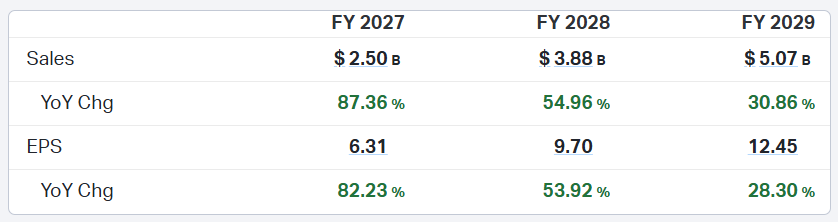
Consensus revenue: FY2027 $2.50B (+87.36%), FY2028 $3.88B (+54.96%), FY2029 $5.07B (+30.86%) - the growth is expected to slow every year
Consensus EPS: $6.31 -> $9.70 -> $12.45 (FY2027-FY2029); FY2027 EPS is 82% above the FY2026 non-GAAP EPS of $3.46
5Y forward EPS growth estimate: 50.0%, against a 33.56% mean since 2022 and a 59.83% +1 standard deviation band. To compare, non-GAAP EPS was $0.70 in FY2025 and $3.46 in FY2026
Analysts: 18 of 19 rate the stock Buy or Strong Buy (4 Strong Buy, 14 Buy, and 1 Hold), average target $282.47, +60.59% from here (the range is $185.00-350.00)
Company guidance: FY2027 revenue growth of more than 85% (raised from more than 80% in June), optical revenue of more than $600M, a non-GAAP gross margin broadly consistent with FY2026, ~55% growth in non-GAAP operating expenses, and a non-GAAP net margin of ~50%; Q2 revenue $525-535M, a non-GAAP gross margin of 67-69%, and non-GAAP operating expenses of $100-105M
What must go right. The CFO described the path at the Goldman Sachs conference on Sep 10: ~11% sequential growth in Q2, ~20% in Q3, and ~30% in Q4. That gives ~$2.47B of FY2027 revenue and a $1B quarter "within our sights" in early FY2028. In my view, the plan is realistic if three things happen: the optical products ramp on time, the AEC business keeps growing with the move to 1.6T, and the gross margin stays near 68% while optics becomes a larger part of revenue. The first one is the least certain. My model needs only 20% annual EPS growth over 5 years. That is why the stock does not need the full plan. It needs the business to keep growing after FY2027. The next checkpoints are the ALC demonstration at the Open Compute Project (OCP) summit in October and the Q2 report in early December.
Current Valuation
Current vs mean since IPO:
Price/Fwd Earnings: 24.1x vs 88.5x
Price/Fwd Sales: 11.4x vs 14.2x
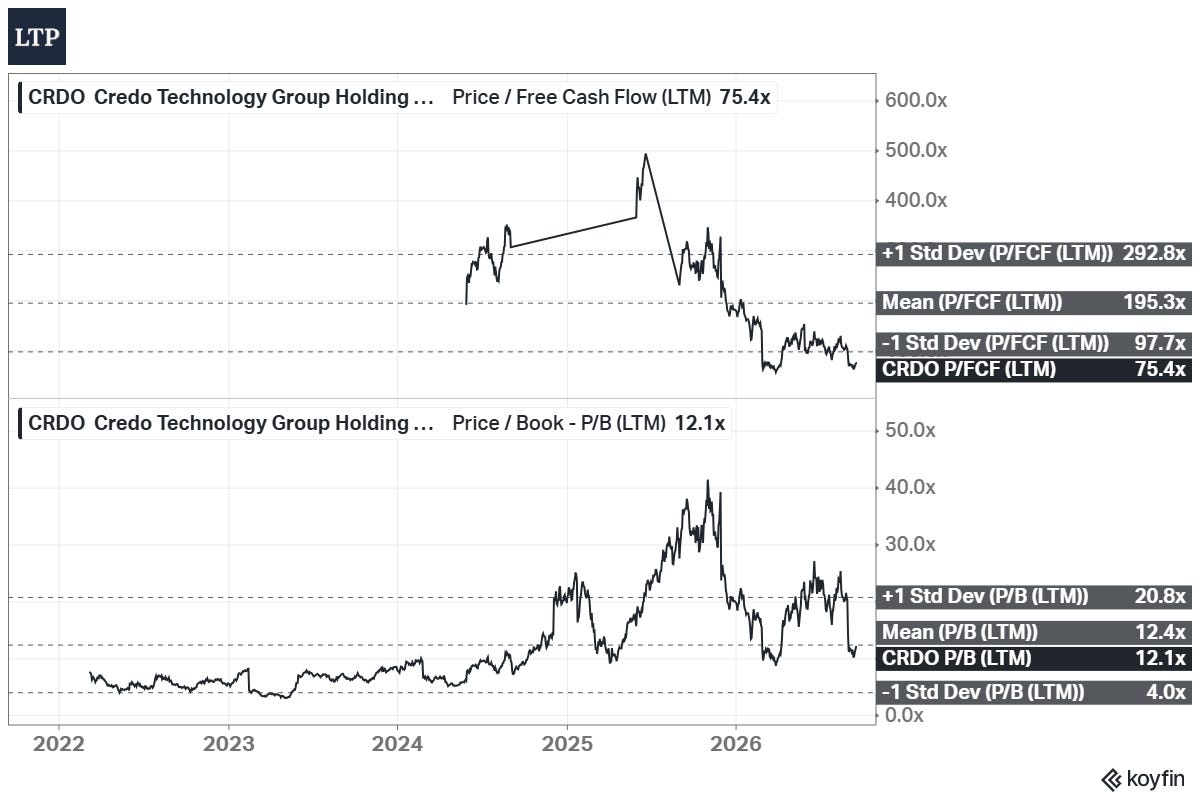
Price/FCF: 75.4x vs 195.3x
Price/Book: 12.1x vs 12.4x
PEG: 0.48 vs 2.88
Forward Earnings Yield: 3.6%
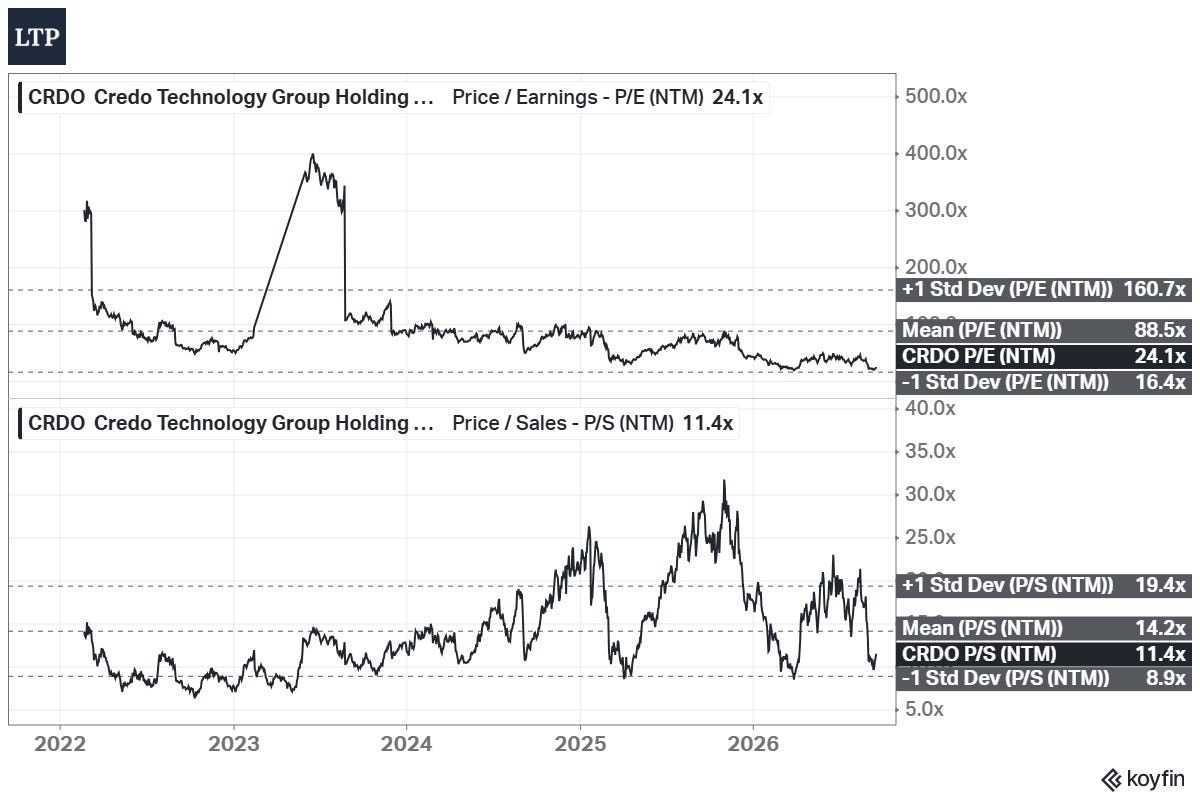
All five multiples are below their means since the IPO, but these means are not a good anchor. The forward P/E is 24.1x against a 16.4x -1 standard deviation band, and Price/Sales is 11.4x against an 8.9x band. On GAAP earnings, CRDO trades at 62.2x LTM EPS, and the FCF yield is only 1.33%. To compare, SOXX trades at ~21.5x forward earnings. In my view, CRDO is priced slightly above an average semiconductor company, although its PEG ratio is 2.3x lower (0.48 vs ~1.1).
Analyst’s note:
The means start in 2022, when Credo had no profit, so the forward P/E reached almost 400x in 2023, and the 88.5x mean is not usable. Price/FCF has data only from mid-2024, when FCF became positive. Also, Koyfin’s 24.1x uses next-12-months EPS ($7.30), which includes part of FY2028. On FY2027 EPS of $6.31, the P/E is 27.9x. The exit multiples in my model start from the -1 standard deviation band, not from the mean.
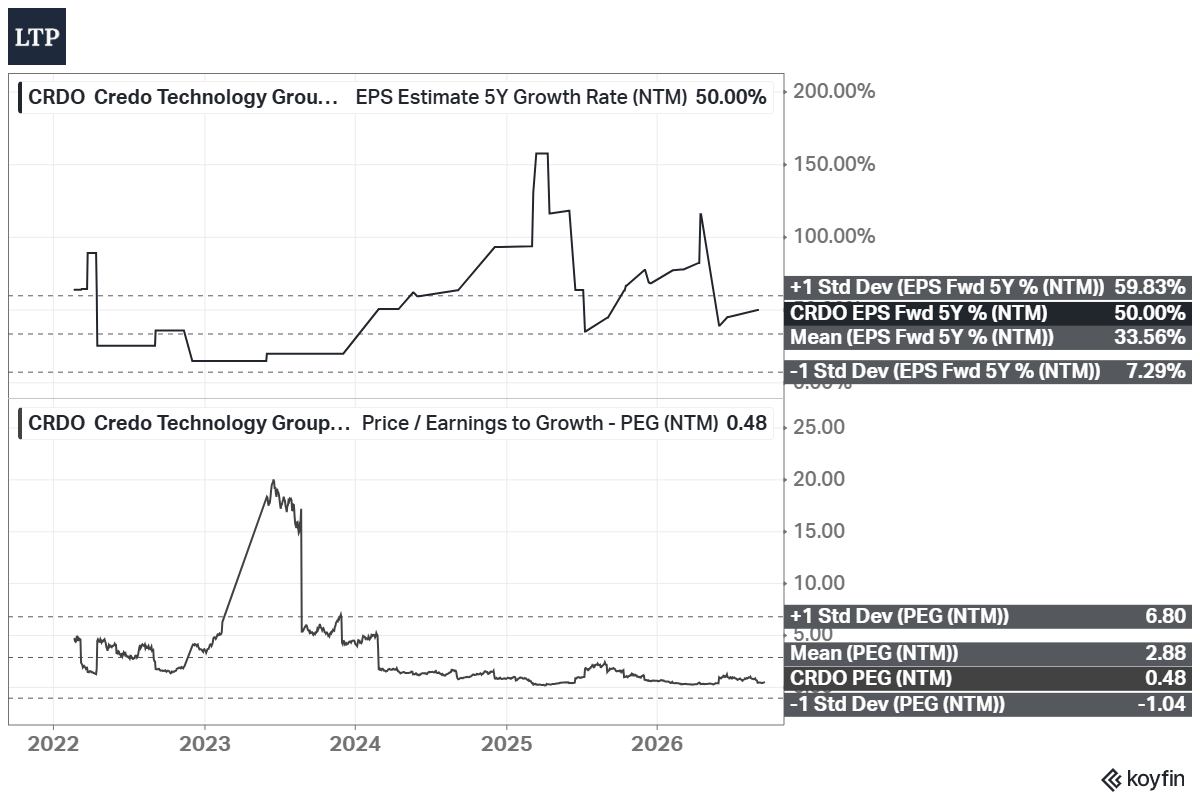
The growth estimate is above its mean, and the PEG is near its lowest level. The 5Y EPS growth estimate is 50.0% against a 33.56% mean, and the PEG ratio is 0.48 against a 2.88 mean. The mean PEG is also distorted by 2023, but even SOXX has a PEG of ~1.1, which is 2.3x higher.
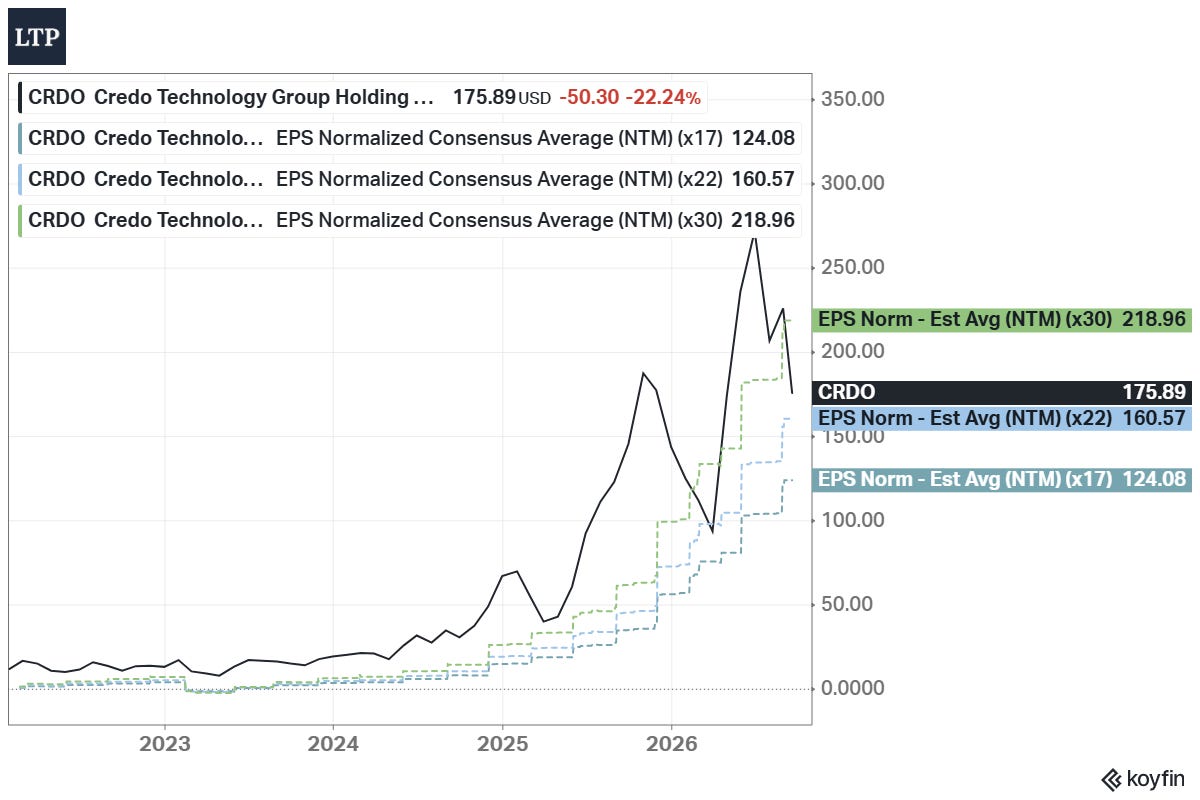
What does the price already assume? If I require 12% per year, CRDO needs ~24% annual EPS growth for 5 years when the multiple decreases to 17x. At a 22x exit, ~17% is enough, and at 30x, ~10%. Consensus expects ~53% per year from FY2026 to FY2029. A reverse DCF shows that the current price implies 41.4% annual revenue growth for 5 years, while consensus expects ~56% per year until FY2029.
One chart frames this whole section. Its three dashed lines are the consensus forward EPS multiplied by my exit multiples (17x, 22x, and 30x), and the black line is the price.
Fair Price
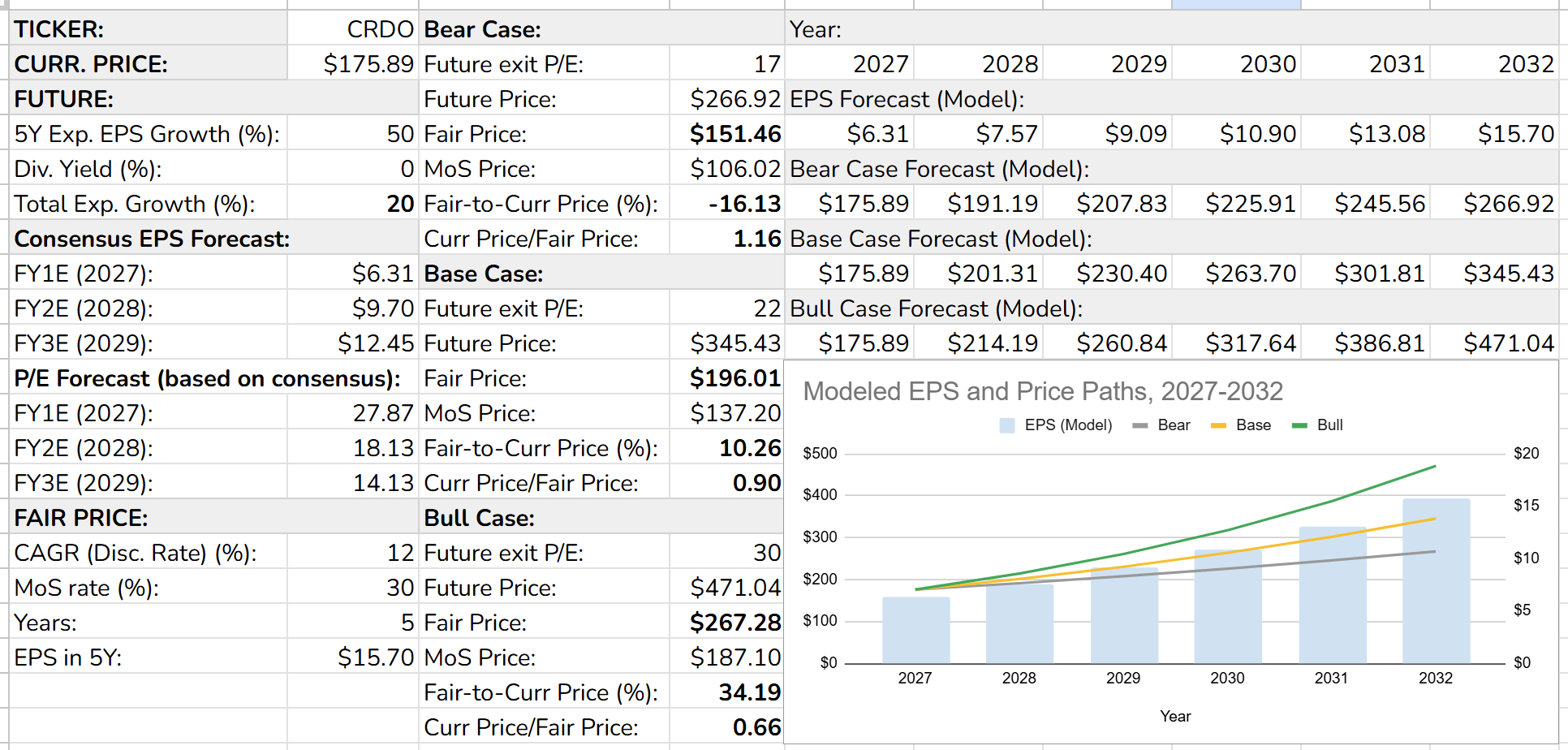
The model starts from the FY2027 consensus EPS of $6.31 and grows it for 5 years. Consensus expects 50.0% per year, which is 2.5x my 20% cap, so the model uses 20%. Credo pays no dividend. As a result, EPS reaches $15.70 in FY2032, while consensus already expects $12.45 in FY2029.
The discount rate is 12%; the margin of safety is 30%. The exit multiples are 17x, 22x, and 30x. 17x is the -1 standard deviation band (16.4x today), so this case assumes that CRDO stays at the bottom of its range for 5 years. At the 20% cap, 17x is a PEG of 0.85. 22x is where CRDO traded right after the September 1 report, a PEG of 1.1. 30x is the ceiling of my method, a PEG of 1.5 at the 20% cap.
Bear Case (exit P/E 17x): fair price $151 - MoS price $106
Base Case (exit P/E 22x): fair price $196 - MoS price $137
Bull Case (exit P/E 30x): fair price $267 - MoS price $187
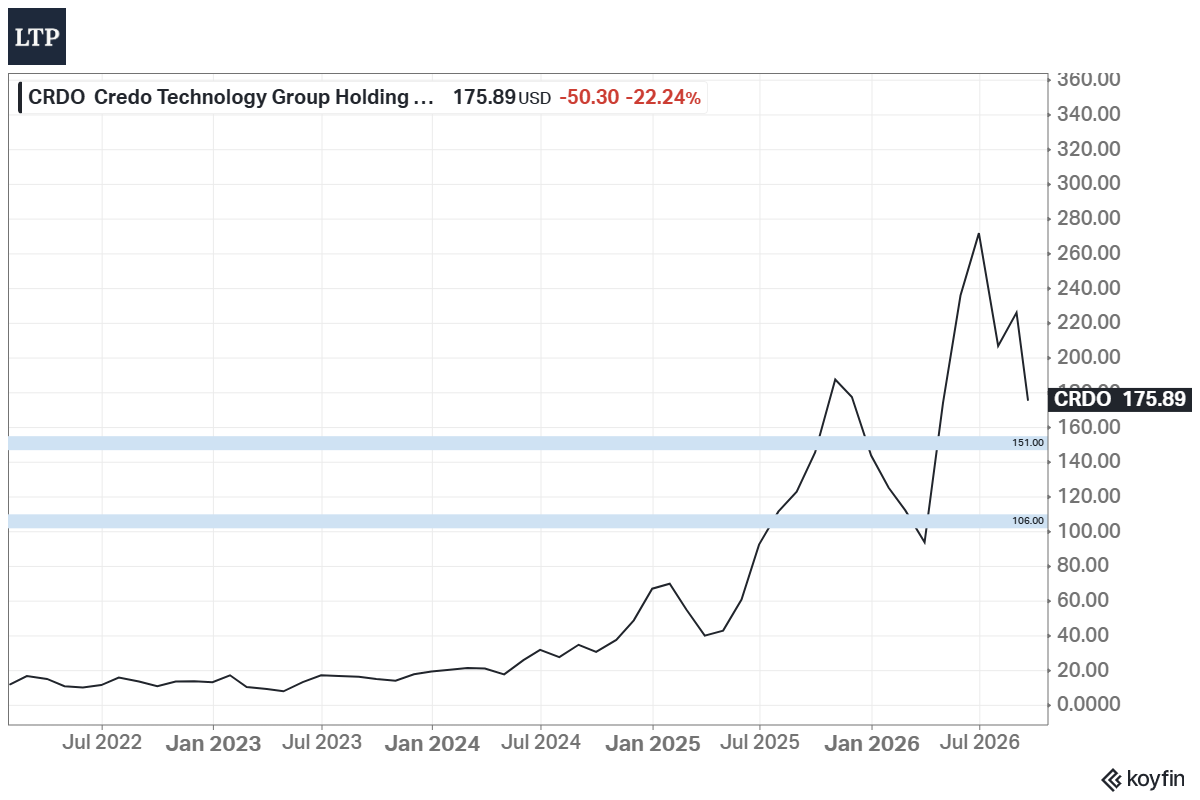
At $176, CRDO trades 10% below the Base Case. It is also 16% above the Bear Case fair price. My accumulation zone is $106-151, so the price is above it. Growth is the input that moves the result most. If EPS grows 15% per year, not 20%, the fair prices fall to $122/$158/$216, and CRDO is 44% above the Bear Case. At the same time, 15% would already mean a very sharp slowdown from the ~53% that consensus expects until FY2029. Worth noting that the average street target ($282) is above my Bull Case ($267), so my corridor is more conservative than the street.
Due Diligence
Profitability (12 of 15):
Positive Gross Profit: $1.07B
Positive Operating Income: $505M
Positive Net Income: $538M
Positive FCF: $439M
Gross margin >= 40%: Yes (67.07%)
Net margin >= 10%: Yes (33.83%)
FCF margin >= 10%: Yes (27.57%)
Management (ROIC, ROE, ROA) >= 10%: Yes (20.8%/30.67%/16.11%)
Strong 3Y Revenue Growth: Yes (~94% per year)
Revenue Growth Forecast: Yes (~56% per year over the next 3 years)
ROE is increasing: negative in FY2024 -> 30.67%
ROIC is increasing: negative in FY2024 -> 20.8%
Revenue surprises since the IPO in a row: No (in line in Q3 FY2023 and Q4 FY2024)
EPS surprises since the IPO in a row: No (a miss in Q2 FY2023)
EPS growth YoY 5Y in a row: No (losses until FY2024)
Financial Strength (5 of 6):
Total assets ($3.01B) exceed total liabilities ($284M) by 10.6x
Negative Net Debt: Yes ($738M of net cash, with cash and short-term investments of $764M against $26M of lease liabilities)
Low Debt/Equity: 1.0% (5Y mean: 2.9%)
Debt/Capital: 0.95% (5Y mean: 2.83%)
Interest coverage (FFO): Yes (no borrowings)
Piotroski F-Score: 6 of 9 (not passed: operating cash flow below net income, lower current ratio YoY, and more shares outstanding)
Valuation and Advantage (3 of 4):
Valuation < mean since IPO: Yes
Valuation < the industry: No (P/Fwd E 24.1x vs SOXX at ~21.5x and AVGO at 20.7x)
Does it have a moat: Yes (narrow)
Outperformed the S&P 500 since the IPO: Yes (79.5% vs 14.7% CAGR)
Shares (1 of 3):
Insider ownership >= 5%: Yes (9.06%)
Fewer shares outstanding YoY: No (194M vs 185M diluted)
Insider buys in the last 6M: No ($178M of sales, mostly under 10b5-1 plans)
Price (3 of 4):
1Y price forecast > 10%: +60.59%
Next 5Y EPS growth estimate (CAGR) > 10%: Yes (50.0%)
DCF Value: ~$102 (base case: revenue growth 28.2% - below consensus, 10.1% discount rate); overvalued by ~42%
Short Interest < 5%: Yes (3.3%)
Verdict
CRDO belongs in a long-term portfolio as a small, high-risk growth position, not as a core holding. Credo created the AEC category and turned it into a very profitable business, with a 67% gross margin, a 21% ROIC, net cash, and revenue that grew 115% in the last quarter. CRDO trades at 24.1x forward earnings and a PEG of 0.48, not far from its -1 standard deviation band and slightly above the whole semiconductor sector, although analysts expect 50% annual EPS growth. I cap growth at 20% in my model and use exit multiples of 17x/22x/30x. My fair prices range from $151 to $267, with an accumulation zone of $106-151. At $176, CRDO is 16% above the top of that zone. For me, the realistic bear case is not the end of AI spending but a pause at one of the two largest customers while the optical ramp is late, as in 2023, when the stock fell 47% in one day. For this reason, the position should stay small. Accumulate gradually inside the zone with a multi-year horizon, and judge the thesis on optical revenue in the second half and the non-GAAP gross margin, not the share price.
One-Pager
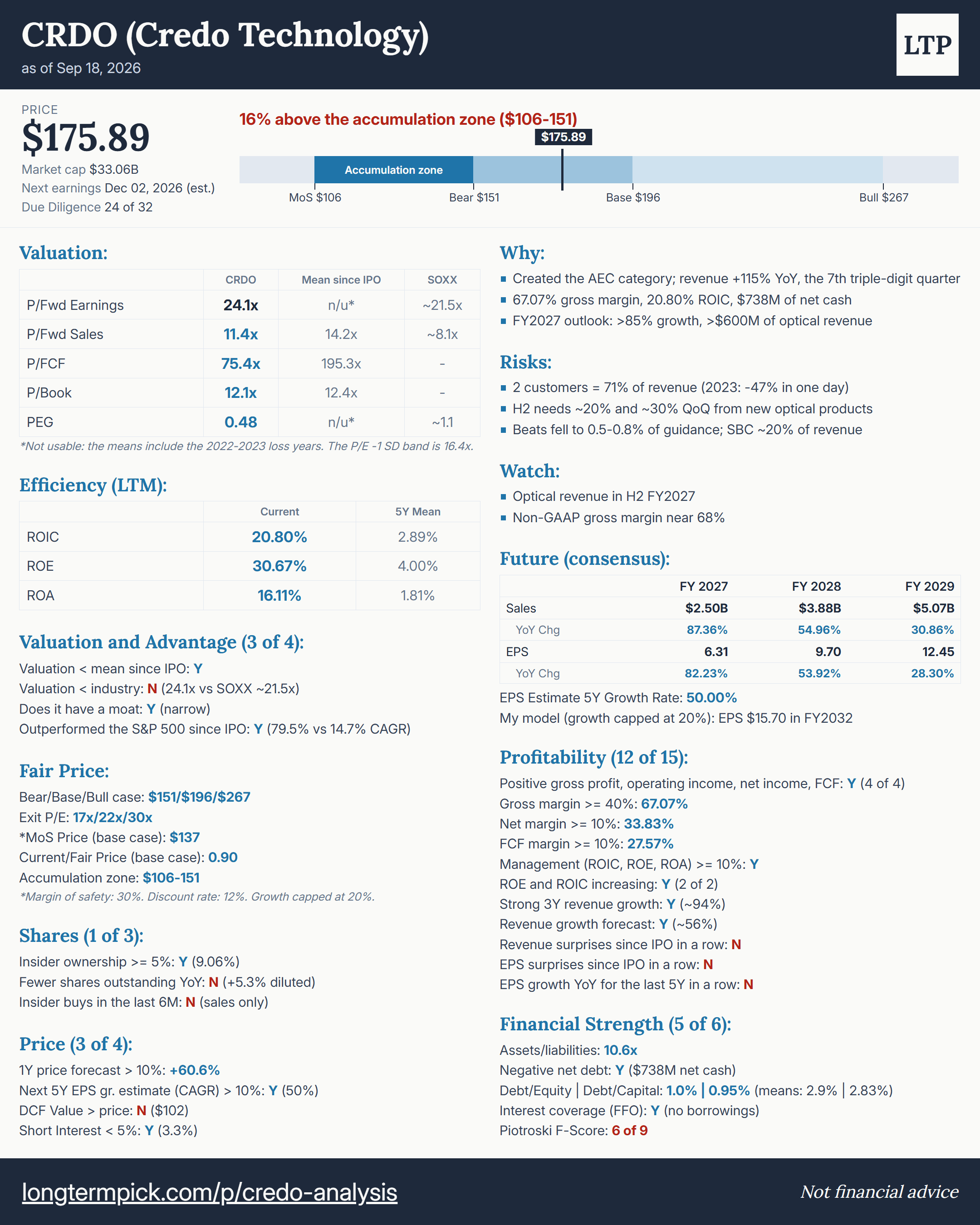
This is not a financial or investing recommendation. It is solely for educational purposes.