

Paid subscribers got this analysis on Oct 04. Upgrade your subscription to get the next one early.

TL;DR: Micron (MU) is one of three companies that make most of the world's DRAM (the working memory of servers, PCs, and phones), and it sells high-bandwidth memory (HBM) for AI chips and solid-state drives (SSDs) for data centers. The Q4 FY2026 report was another record: revenue increased 379% YoY to $54.2B, and gross margin reached 87%. FY2026 net income of $85.0B is 1.85x Micron's combined net income of the previous 10 years. At the same time, the stock is at 6.2x FY2027 consensus earnings, since the market does not believe these margins will last. Management says this cycle is different, because 26 multi-year contracts now have floor prices. I see a better cycle, not the end of cycles - only ~26% of revenue through 2030 has a defined price. Verdict: a record business priced for a peak that lasts. My model holds FY2027 EPS flat for 5 years instead of growing it, and MU is far above my accumulation zone.
Investment Thesis
Micron reported Q4 FY2026 on Sep 30 with revenue, gross margin, and EPS above the top of its own guidance, and it guided another record for Q1 FY2027. In my July analysis, I decided not to buy MU at $879, since a 6x P/E on peak memory earnings is a trap. Since then, the stock is up 25%, and it is still at 6x forward earnings, because the EPS estimates increased almost as fast. Micron has also signed contracts that, as management says, change the economics of the industry. My idea here is to test that claim against 25 years of memory cycles.
The upcycle is still getting stronger. Revenue increased 379% YoY to $54.23B, the sixth record quarter in a row, and non-GAAP EPS reached $33.42. Part of the jump is the calendar, since Q4 had 14 weeks. On a 13-week basis, revenue grew ~22% QoQ, and the Q1 FY2027 guidance of $61.5B is another ~22% above that.
Analysts raise the estimates, and the market still pays 6x. Consensus expects FY2027 EPS of $176.69 (+134%) on revenue of $274.7B (+106%), and the EPS estimate increased 11% in the last 7 days and 18% in 90 days. At $1,097, MU trades at 6.2x that EPS, a 16.1% earnings yield. The PEG ratio of 0.03 means nothing here, since consensus itself expects EPS to stop growing in FY2029. The better question is what the price assumes. At a 12% required return and a 12x exit multiple, MU needs FY2032 EPS of ~$161, 9% below the FY2027 consensus.
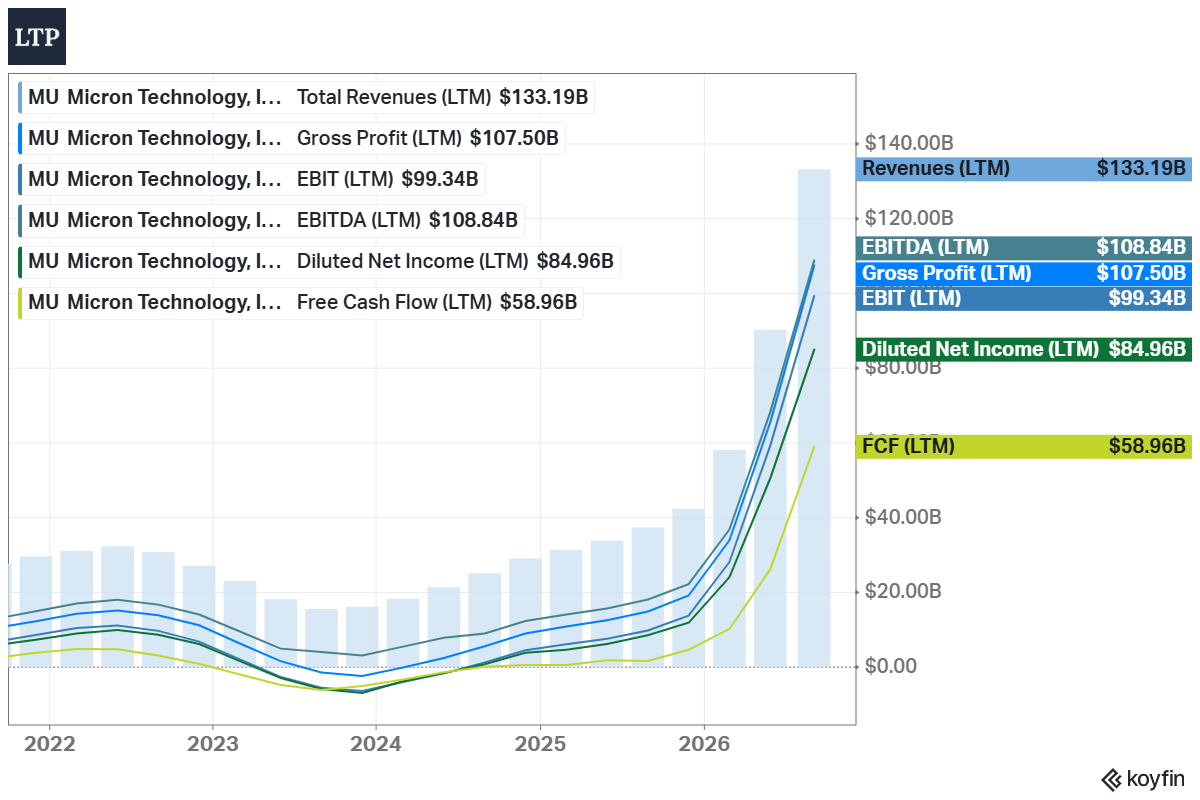
FY2026 was by far the best year in Micron’s history. The GAAP gross margin was 80.72%, net margin 63.80%, and FCF $59.0B after $30.7B of capex. LTM ROIC is 67.49% against a 13.26% 5Y mean. Micron has $68.3B of net cash, against $2.6B of net debt a year ago.
The multiple is low, but it is always low at the top. MU trades at 6.2x forward earnings against a 17.7x 5Y mean, and the mean is distorted by 2023, when forward EPS was close to zero. My own 10Y history from SEC filings gives a better picture. The median trailing P/E at Micron’s reports was 14.6x, but at the two previous earnings peaks, it was 2.6x (December 2018) and 6.1x (July 2022). By then, the stock was already 45-50% below its high.
The bear case: new cleanrooms from all three large producers start output in 2027-2028, customers already cut memory per system, and by TrendForce’s estimate, memory will take 68% of the capex of large cloud companies in 2027. My model takes this into account by holding FY2027 EPS flat for 5 years instead of growing it, and today’s 6x is the Bear Case exit multiple. With these inputs, the Bear Case fair price is $602, and MU trades 82% above it.
Company Overview
Next Earnings Date: Dec 16, 2026 (estimated)
Market Cap: $1.24T
Sector: Information Technology | Industry: Semiconductors
Type: Large Growth
Short Interest: 2.60%
Micron Technology was founded in 1978 in Boise, Idaho, and it is still headquartered there. It is the only US-based DRAM producer. Memory is the whole business: DRAM brought 73% of revenue in Q4 FY2026, NAND 26%, and NOR the rest. Sanjay Mehrotra has been CEO since 2017. Before that, he co-founded SanDisk and was its CEO from 2011 until its sale in 2016. Micron had ~53,000 employees at the end of FY2025.
The product range covers the whole memory hierarchy of a data center. DRAM: HBM stacks that are placed next to AI accelerators (HBM3E and HBM4), high-capacity DDR5 server modules, low-power LPDDR5X (including SOCAMM modules for servers), and graphics memory. NAND: data center SSDs, client SSDs for PC makers, and managed NAND for phones and cars. In December 2025, Micron decided to exit its Crucial consumer business, so that the supply goes to larger customers in faster-growing segments.
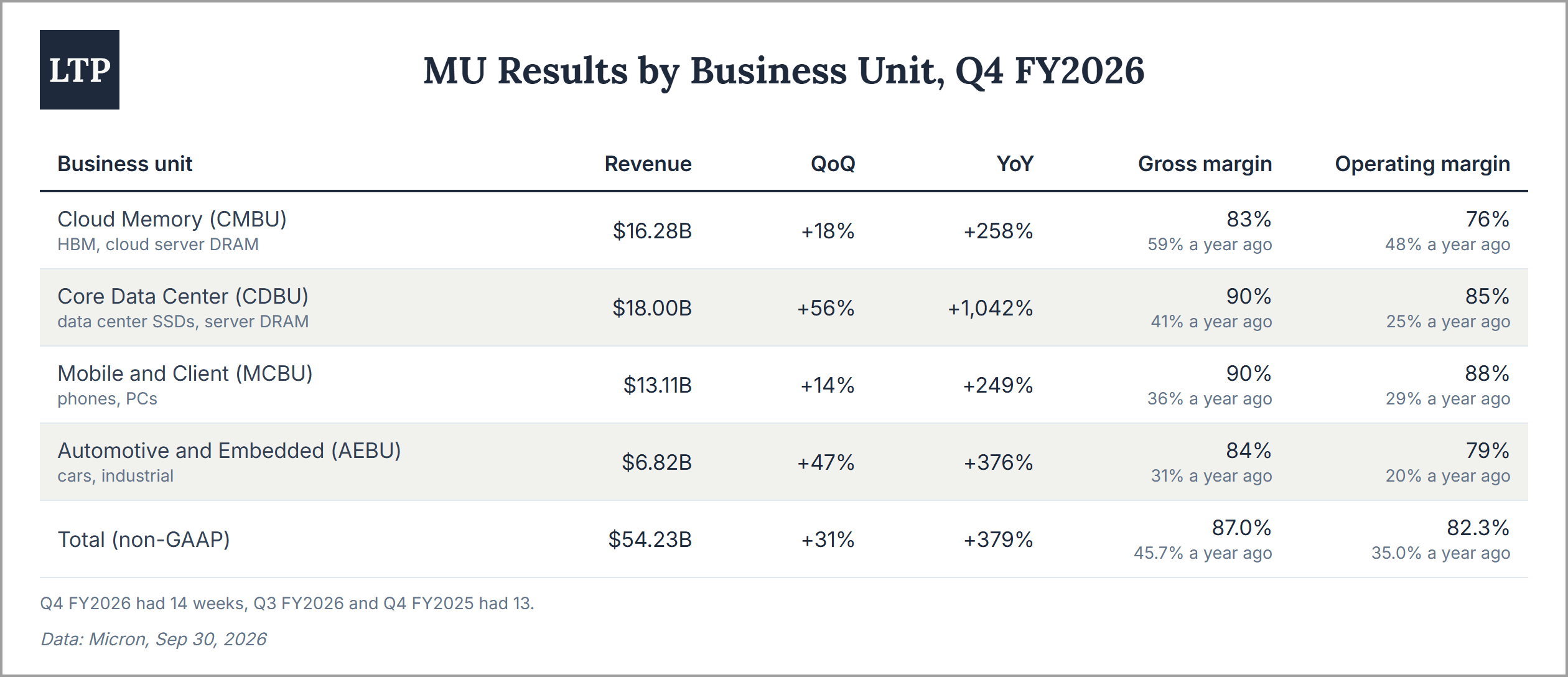
Micron reports four business units. The two data center units brought 63% of Q4 revenue, and the Core Data Center unit grew more than 11x in one year. At the same time, every unit has a gross margin of 83-90%, including phones, PCs, and cars, since prices increased in every market at once.
Micron makes the chips itself. According to its FY2025 10-K, wafers are produced in the US, Taiwan, Singapore, and Japan, and chips are assembled and tested in Taiwan, Singapore, Malaysia, China, and India. New fabs in Idaho, Japan, Singapore, and New York are under construction. Sales go mostly directly to large customers. In FY2025, the top 10 customers brought more than half of revenue, and ~80% of revenue was shipped to locations outside the US.
Market Overview
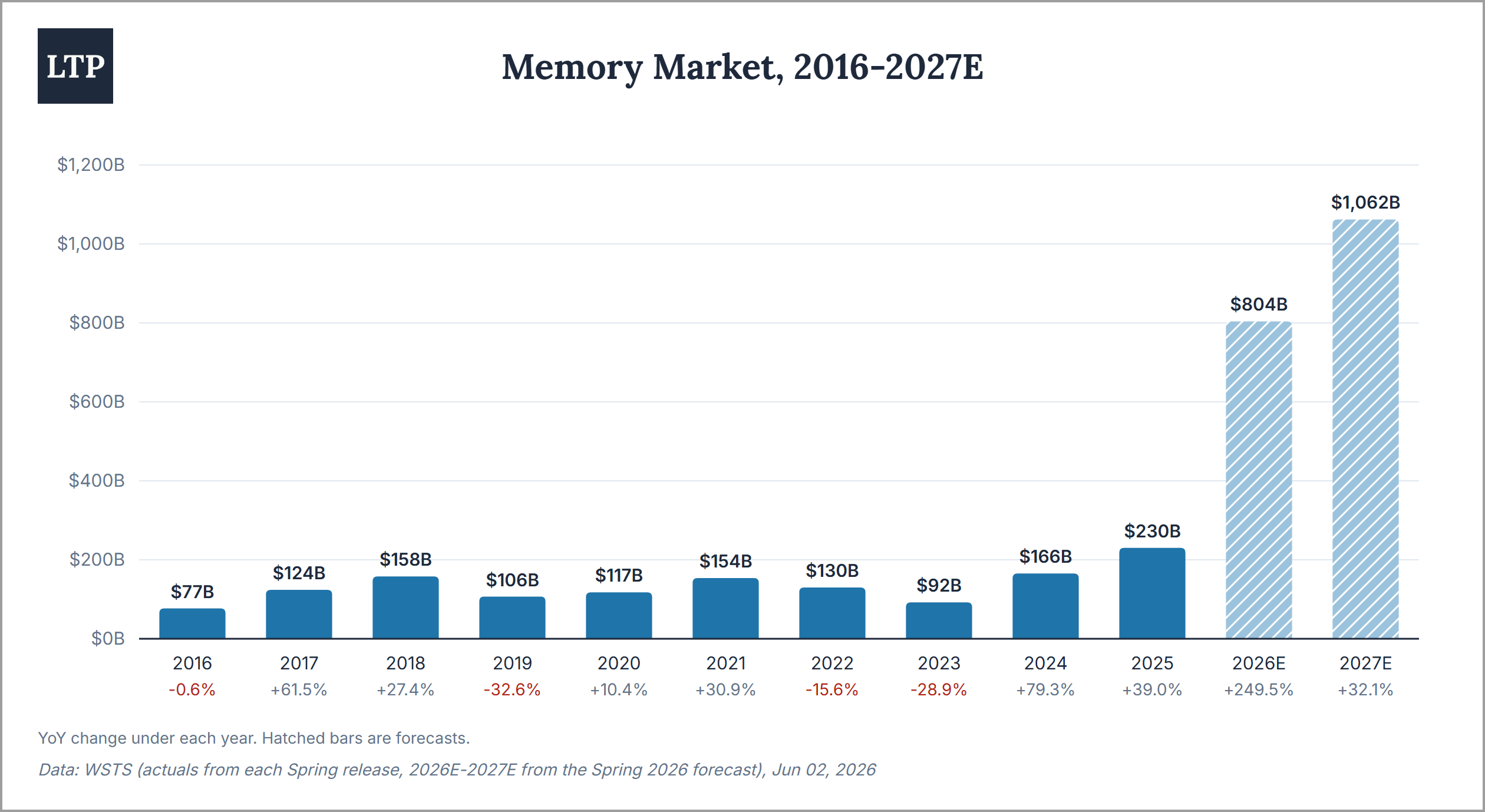
The memory market is set to grow ~4.6x in 2 years. In its June 2026 forecast, World Semiconductor Trade Statistics (WSTS) expects the memory market to grow from $230B in 2025 to $804B in 2026 (+250%) and $1,062B in 2027 (+32%). To compare, the market was $158B at the peak of the 2018 cycle. The same chart also shows what this market does after a peak: -33% in 2019, -16% in 2022, followed by -29% in 2023.
Most of the growth is price, not volume. In Q3 FY2026, Micron’s DRAM revenue increased 343% YoY. In its 10-Q, the company explains it by a “low-260% range” increase in average selling prices and a “low-20% range” increase in bit shipments. In Q4, DRAM prices increased again by a high-teens percentage QoQ, NAND prices by ~30%, while bit shipments grew by a mid-single-digit percentage and ~10%, in a quarter with one extra week. So the revenue growth depends on prices that continue to rise.
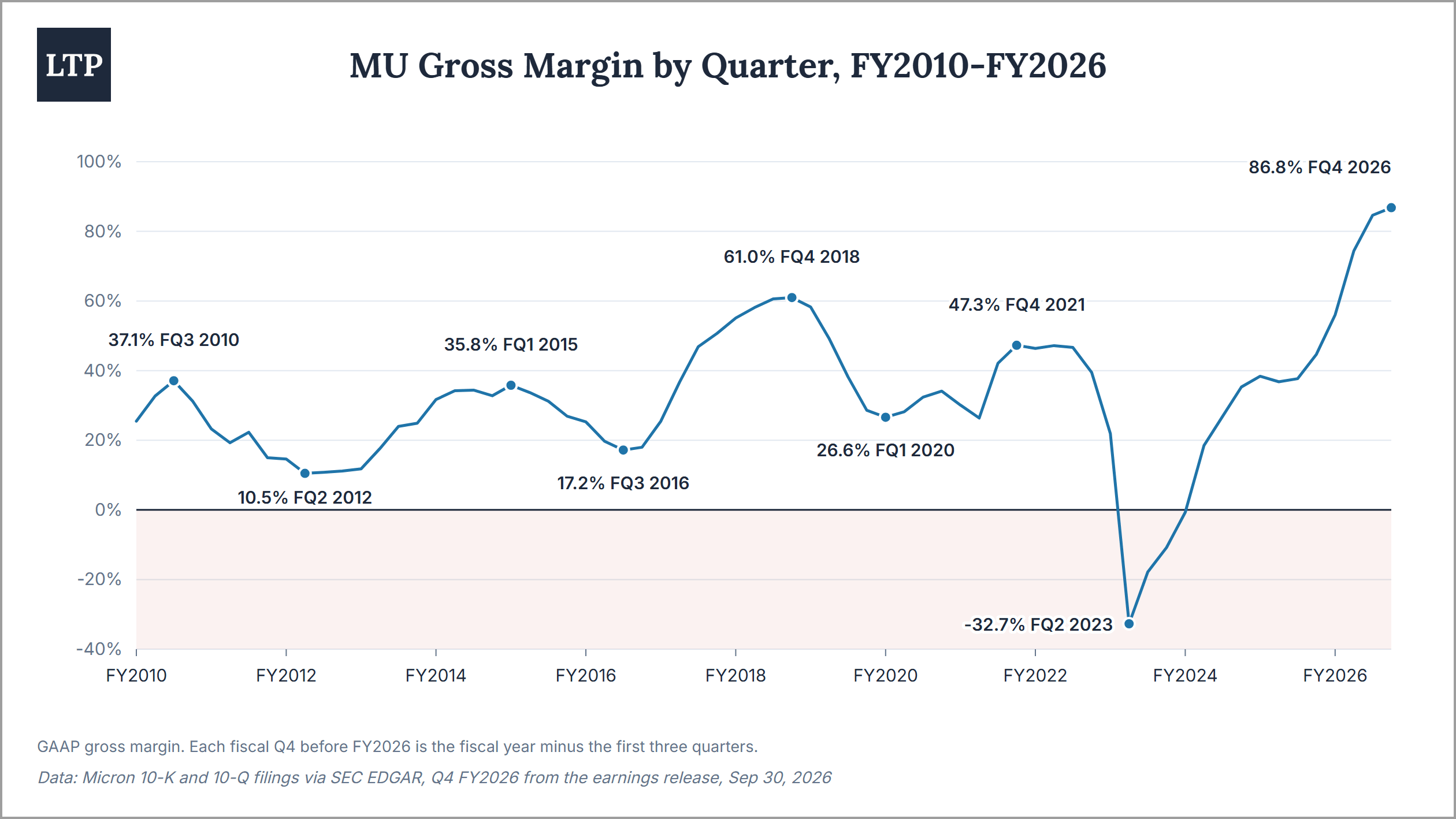
Micron’s margin history shows what happened after every previous price peak. GAAP gross margin reached 61.0% in FQ4 2018, then fell to 26.6% in 5 quarters. It reached 47.3% in FQ4 2021, then fell to -32.7% in FQ2 2023, when Micron sold chips below their cost. Today it is 86.8%, 25.8 points above the previous record.
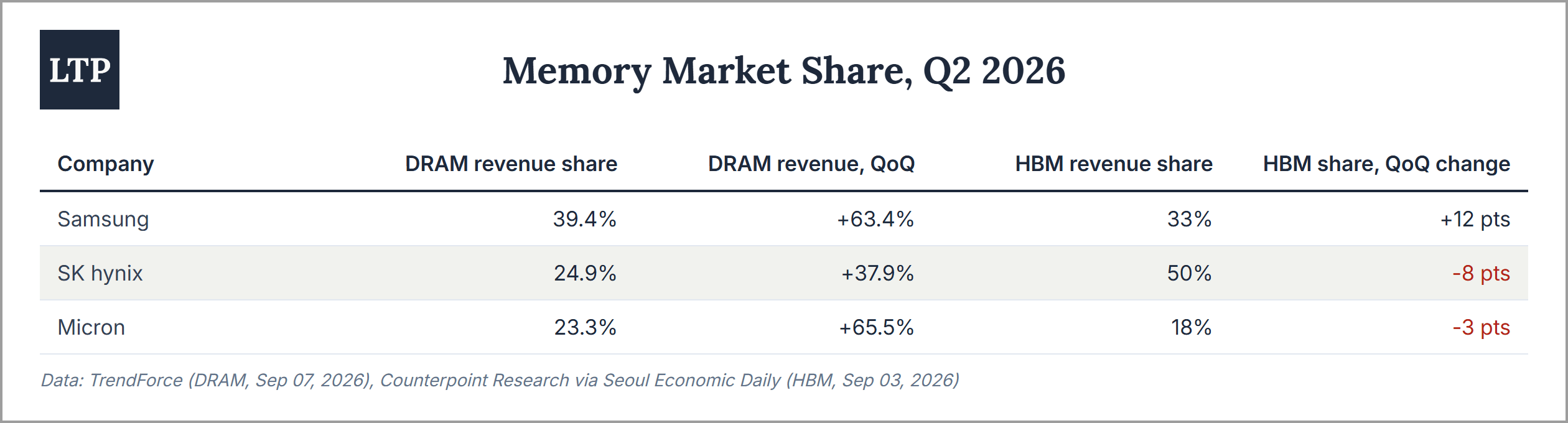
The structure is an oligopoly. In Q2 2026, Samsung, SK hynix, and Micron had 87.6% of DRAM revenue, according to TrendForce. Micron's share was 23.3%, 1.6 points behind SK hynix. In HBM, Micron is the smallest of the three with 18%, down 3 points in one quarter, while Samsung, the first to ship HBM4, increased its share from 21% to 33% (Counterpoint Research data). The fourth DRAM producer is China's CXMT. Its revenue grew 716% YoY in Q2 2026, and Counterpoint expects it to use its recent IPO to expand capacity.
Supply is tight until 2028, and then new capacity arrives. Micron expects industry DRAM bit shipments to grow in the low-20s percentage range in 2027 and 2028, with the industry supply constrained in both years. TrendForce agrees for DRAM - new fabs ramp in the second half of 2027, and “substantial output contributions are not expected to materialize until 2028”. On NAND, the two disagree. Micron expects the NAND industry to stay supply constrained in 2027 and 2028. TrendForce expects NAND supply to become looser in the second half of 2027, with “downward pressure on prices”. NAND was 26% of Micron’s Q4 revenue.
The demand risk is the price itself. TrendForce estimates that DRAM and NAND will take 47% of the total capex of large cloud service providers (CSPs) in 2026 and 68% in 2027. Its suggestion is that CSPs may reduce memory capacity per system. This is already happening. CSPs and server makers reduced server DRAM capacities in the first half of 2026, and NVIDIA (NVDA) is evaluating lower HBM configurations for its next-generation Rubin Ultra. Micron also expects server units to grow in the high teens in 2026 and 2027, with “a modestly lower rate of content growth” per server. In my view, the market here is not limited by demand for AI, but by what customers are ready to pay for memory.