

TL;DR: NVIDIA is the dominant AI compute platform (GPUs + CUDA + networking) and the fastest-growing mega cap in the market. At ~21x forward earnings (vs a 37.7x five-year average) and a PEG of 0.47, this is the cheapest the stock has been in five years. Quality stays extreme: 74% gross margin, 70% ROIC, ~$119B of free cash flow. Verdict: I am starting to accumulate at these levels as a core Long-Term Pick position. My full fair price math and the accumulation zone are at the end of this post.
Investment Thesis
I first covered NVIDIA in February 2025, with a fair price of $187, back when the market was arguing about whether AI demand had already peaked. Since then, earnings have more than doubled, the stock has climbed to ~$200 - and the multiples have decreased anyway. I see that combination as rare, and it is the reason for this update.
NVIDIA is the fastest-growing mega cap in the market at its lowest relative valuation in five years: ~21x forward earnings against a 37.7x five-year average - below even the -1 standard deviation band.
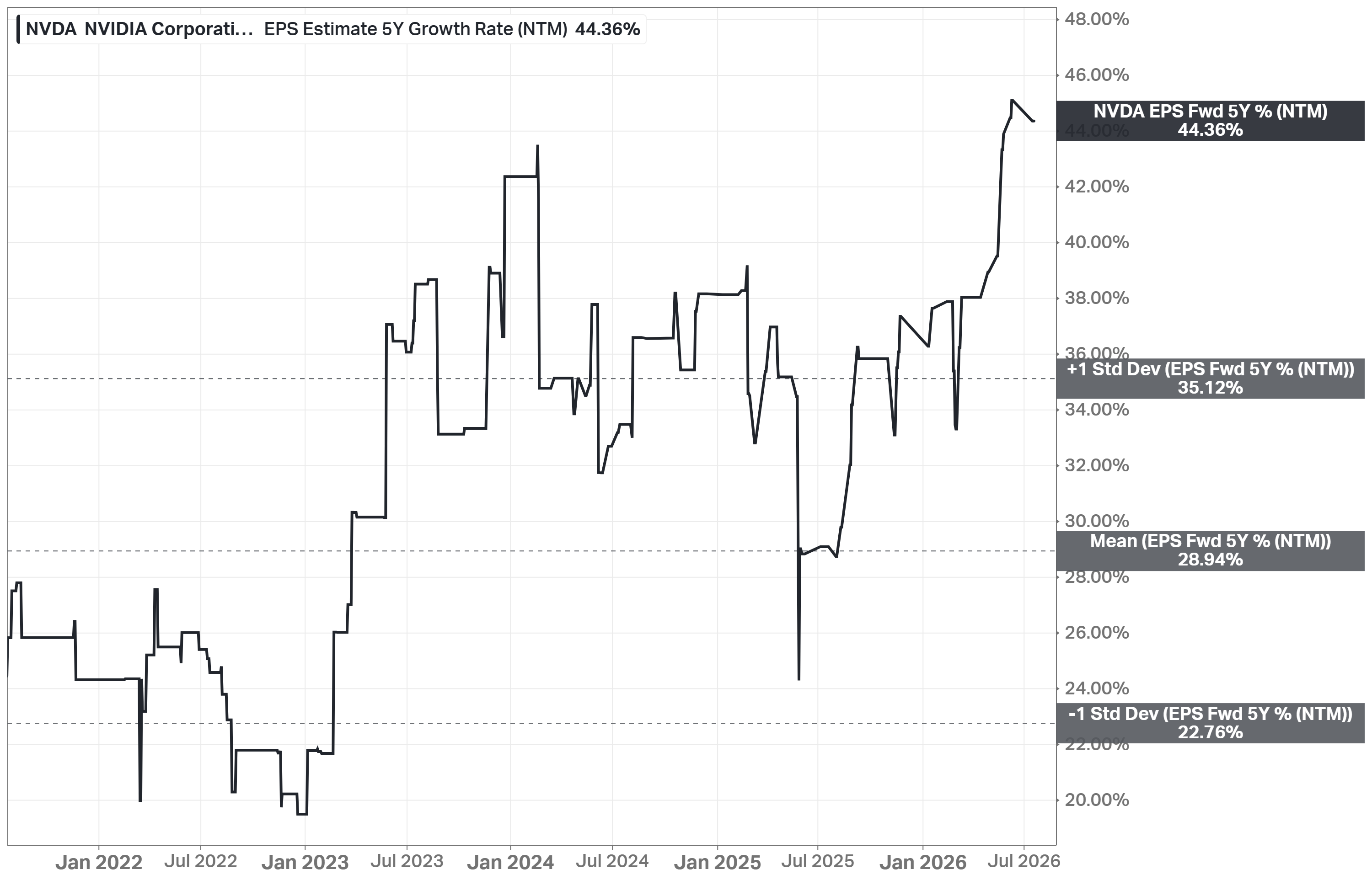
Consensus expects ~44% annual EPS growth for the next five years. That puts the PEG at 0.47 - either consensus is badly wrong, or the stock is cheap.
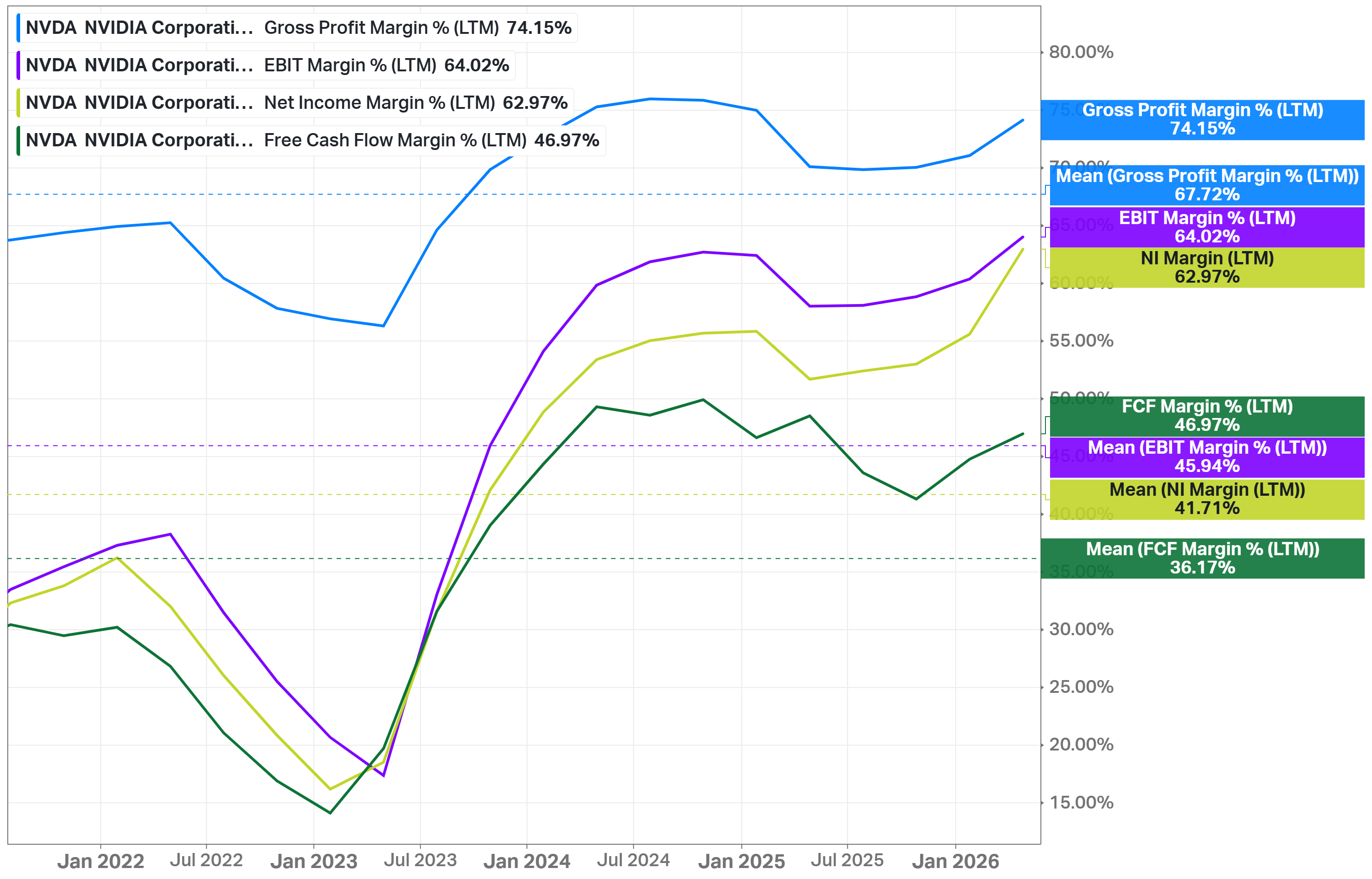
Quality is not the debate: 74% gross margin, 63% net margin, 70% ROIC, ~$119B of free cash flow, ~$40B of net cash, and management sees more than $1 trillion of cumulative Blackwell and Rubin revenue through 2027.
The risks are real and partly binary: customer concentration, custom silicon, China closed off, Taiwan, peak margins. My model cuts consensus growth by more than half to absorb them.
Even with that cut, the stock trades below my Bear Case fair price. The full math is in the Fair Price section below.
Company Overview
Next Earnings Date: Aug 26, 2026 (after-market, confirmed)
Market Cap: ~$5T
Sector: Information Technology | Industry: Semiconductors
Type: Mega Growth
Beta (5Y Monthly): 2.21 | Short Interest: 1.30%
Dividend Yield: 0.49%
Employees: ~42,000
NVIDIA is the leading designer of GPUs and the dominant supplier of AI computing infrastructure. GPUs process data in parallel across thousands of cores, which turned out to be exactly what training and running large AI models requires. And NVIDIA owns that market. The company has evolved from a chip vendor into a full-stack platform: it designs the processors, the networking, the systems, and the software layer on which most of the world’s AI is built, while TSMC handles manufacturing.
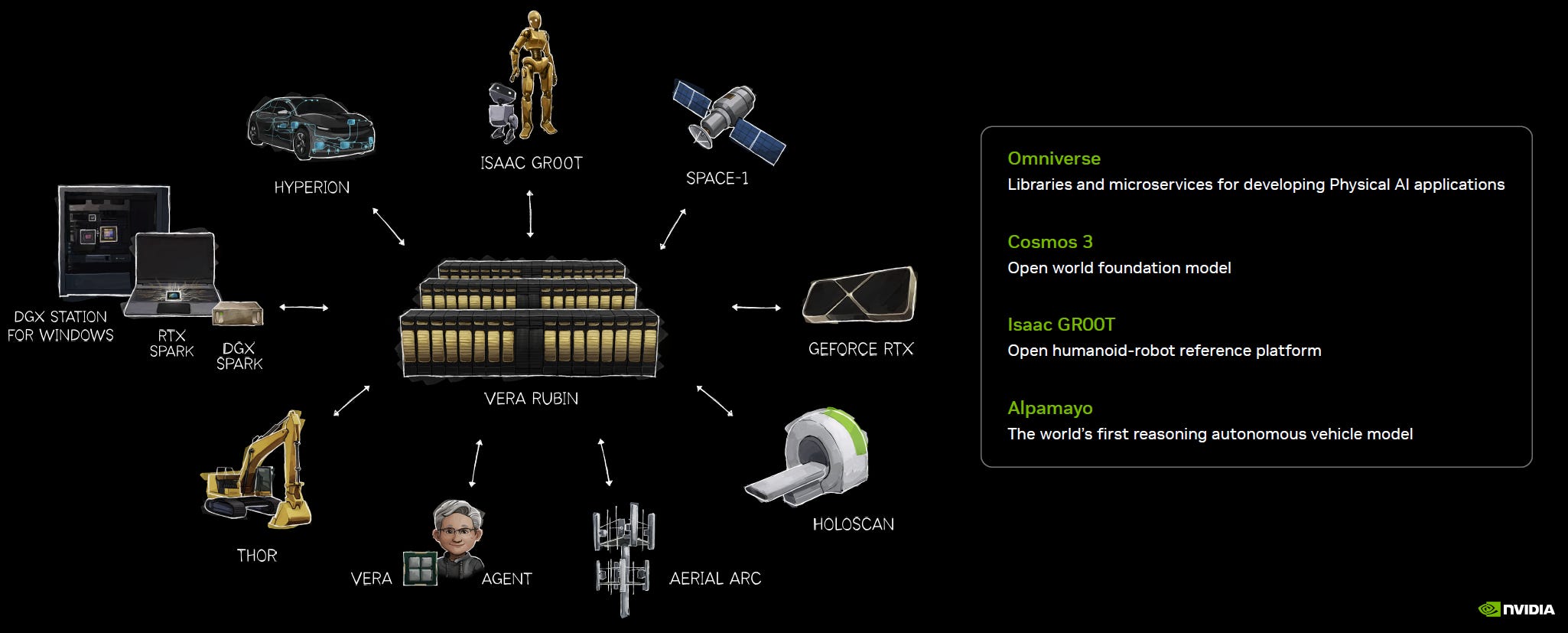
The product stack today: Data Center accelerators (Hopper, Blackwell, Blackwell Ultra GB300, and the Vera Rubin rack-scale systems now in full production); the new Vera CPU; networking that ties clusters together (NVLink, InfiniBand, Spectrum Ethernet, ConnectX NICs, BlueField DPUs); the CUDA platform and CUDA-X libraries with 7,000+ accelerated applications, models, and libraries; GeForce RTX graphics cards for gaming; the RTX Spark superchip taking NVIDIA into the PC processor market against Intel and AMD; DGX systems and DGX Cloud; professional visualization; automotive (DRIVE platform and the Alpamayo reasoning model for autonomous vehicles); Jetson Thor modules for robotics and edge AI; Omniverse and Cosmos for simulation and world models; the Isaac GR00T humanoid-robot platform; and the Nemotron family of open models.
Market Overview
The core question for NVIDIA is not market share - it is whether the AI infrastructure buildout continues. The freshest data say demand is accelerating, not cooling:
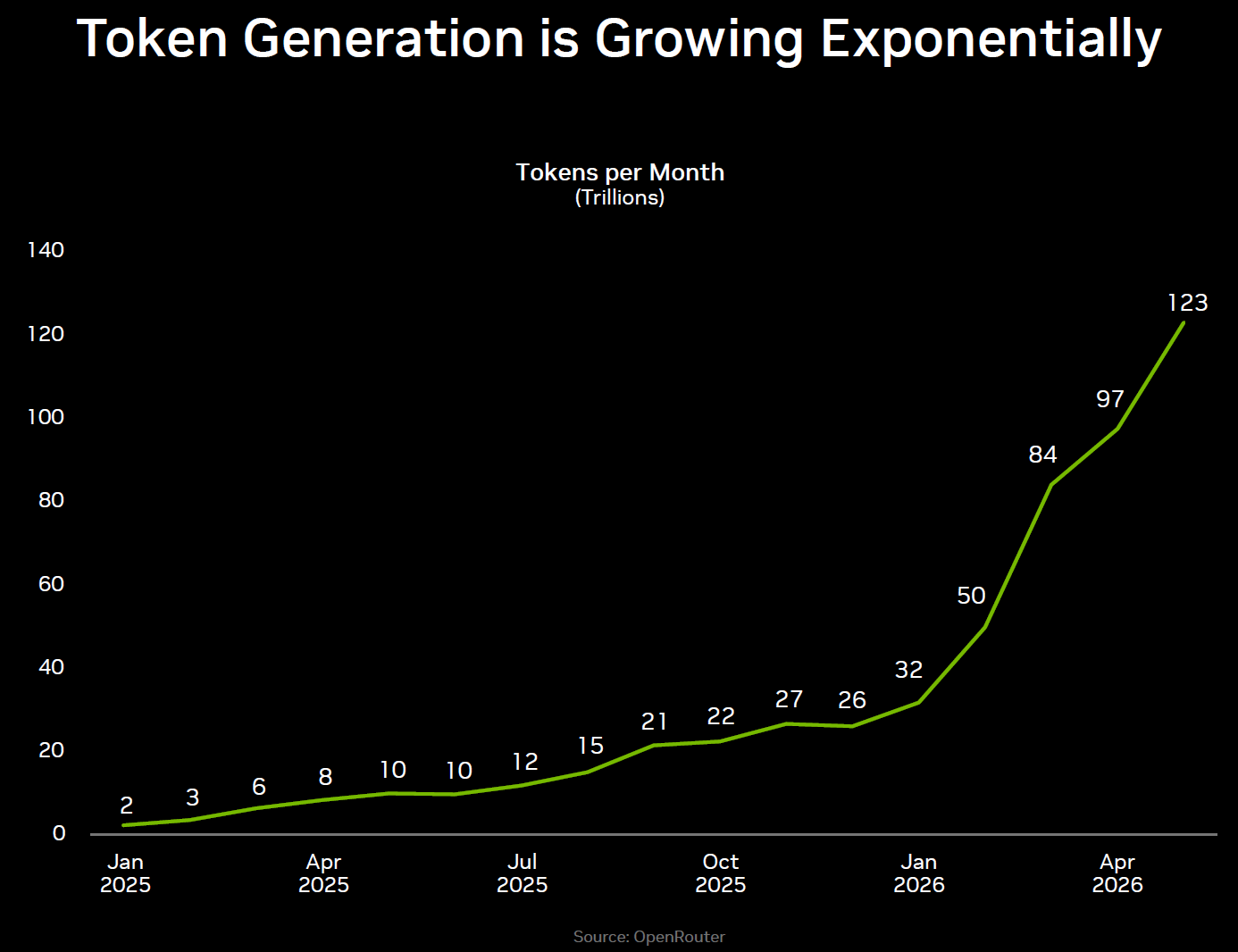
Token generation is growing exponentially: from ~2 trillion tokens per month in January 2025 to ~123 trillion in April 2026 on OpenRouter alone - roughly 60x in fifteen months.
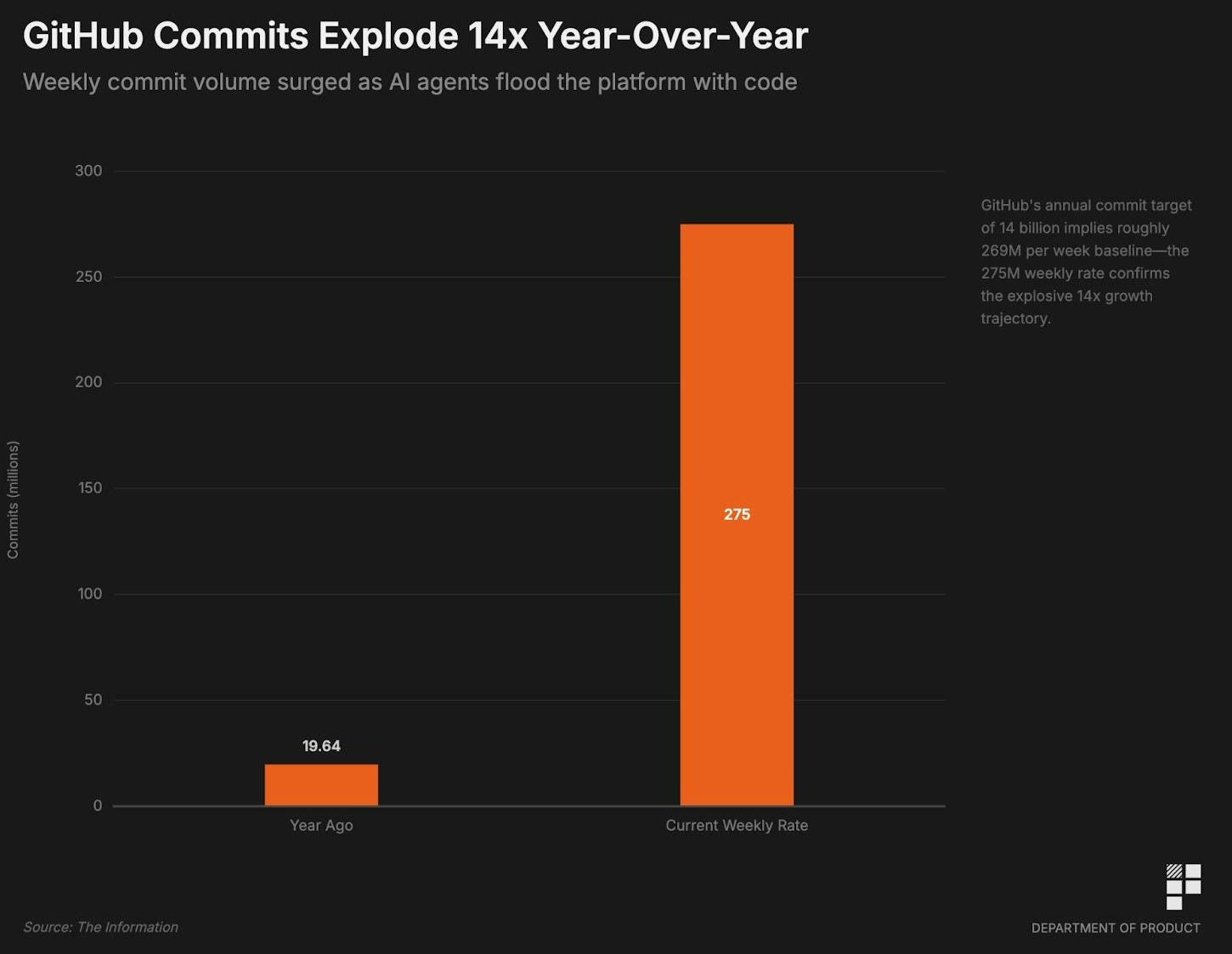
GitHub shows what those tokens produce: 1.4B commits in early 2026 (nearly 3x the prior pace), 90M pull requests merged, 20M new repositories per month. The weekly rate is even steeper: ~275M commits per week versus ~20M a year ago - a 14x jump, as AI agents flood the platform with code. AI is now useful, and tokens are profitable, which is what stimulates operators to keep expanding compute.
The economics behind that: ~30-40M software developers earning ~$3T in annual salaries are producing roughly 3x the output. And companies are hiring more engineers, not fewer. When the tool visibly pays for itself, the infrastructure spending behind it is not discretionary.
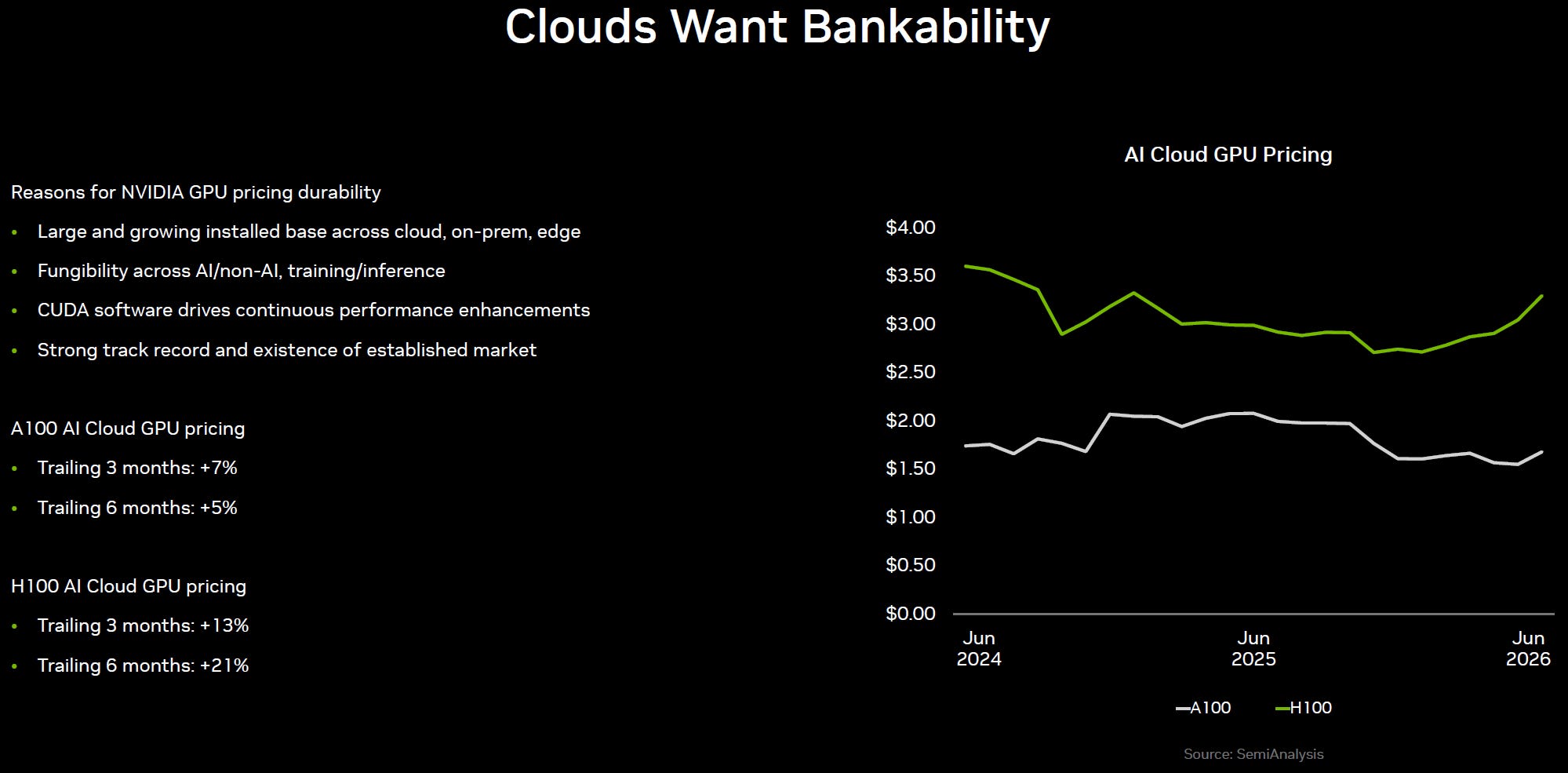
Cloud GPU pricing is rising, not falling: per SemiAnalysis data, H100 rental prices are up ~21% over the trailing six months, and even the six-year-old A100 is up ~5%. Supply is still not catching up with demand.
Management projects $3-4 trillion of annual AI infrastructure spending by 2030.
The bear narrative says AI capex is a bubble about to deflate. The market data says the opposite: used-generation GPUs are getting more expensive to rent. Bubbles do not usually raise the price of four-year-old hardware.
Economic Moat
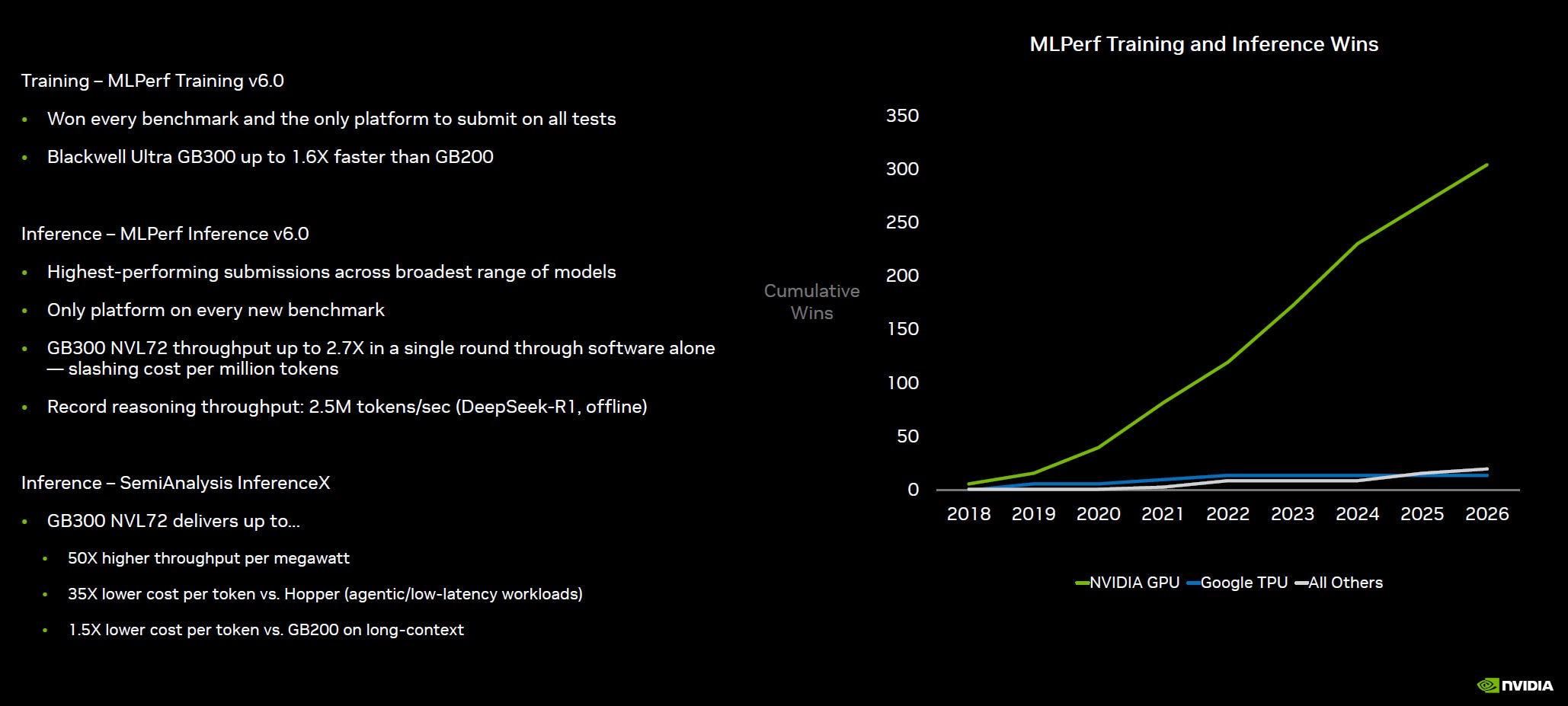
NVIDIA has a wide moat built on two reinforcing layers. The first is CUDA: virtually all AI development of the last 15 years is built on it, and millions of developers create switching costs so high that even hyperscalers designing their own chips keep buying NVIDIA at scale. The second is extreme co-design: NVIDIA engineers the CPU, GPU, DPU, networking fabric, systems, and software as one integrated platform on a one-year cadence - a bar that a single-chip competitor cannot clear.
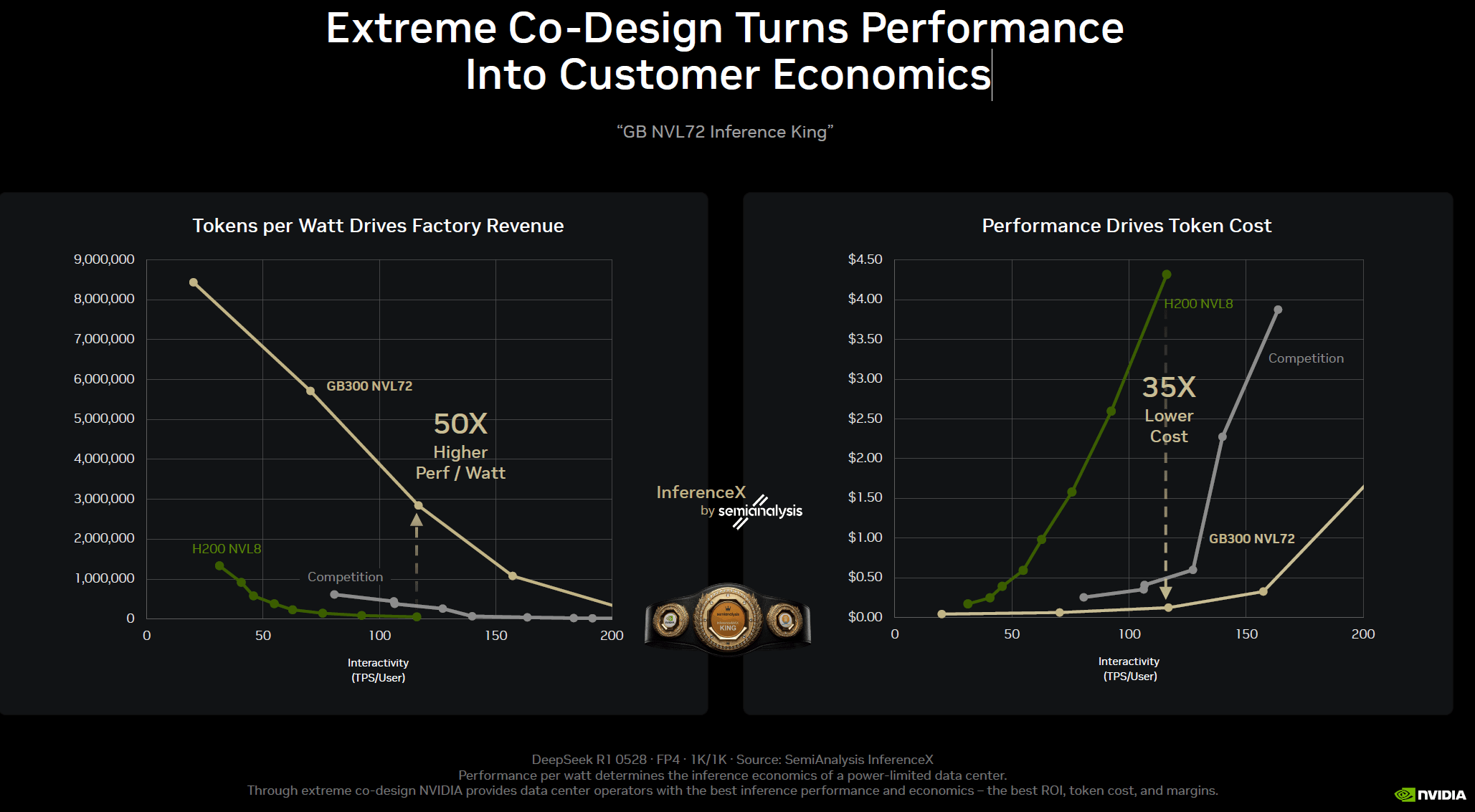
In the industry-standard MLPerf round, NVIDIA won every training benchmark and was the only platform submitting on all tests. In SemiAnalysis’s independent InferenceX testing, the GB300 NVL72 delivers up to 35x lower cost per token and 50x higher throughput per megawatt versus Hopper; Artificial Analysis measured 20x more coding agents per megawatt than H200. The reasoning-throughput record of 2.5M tokens per second is company-reported. In a power-limited data center, tokens per watt decide the economics - and that is exactly where the integrated platform wins.
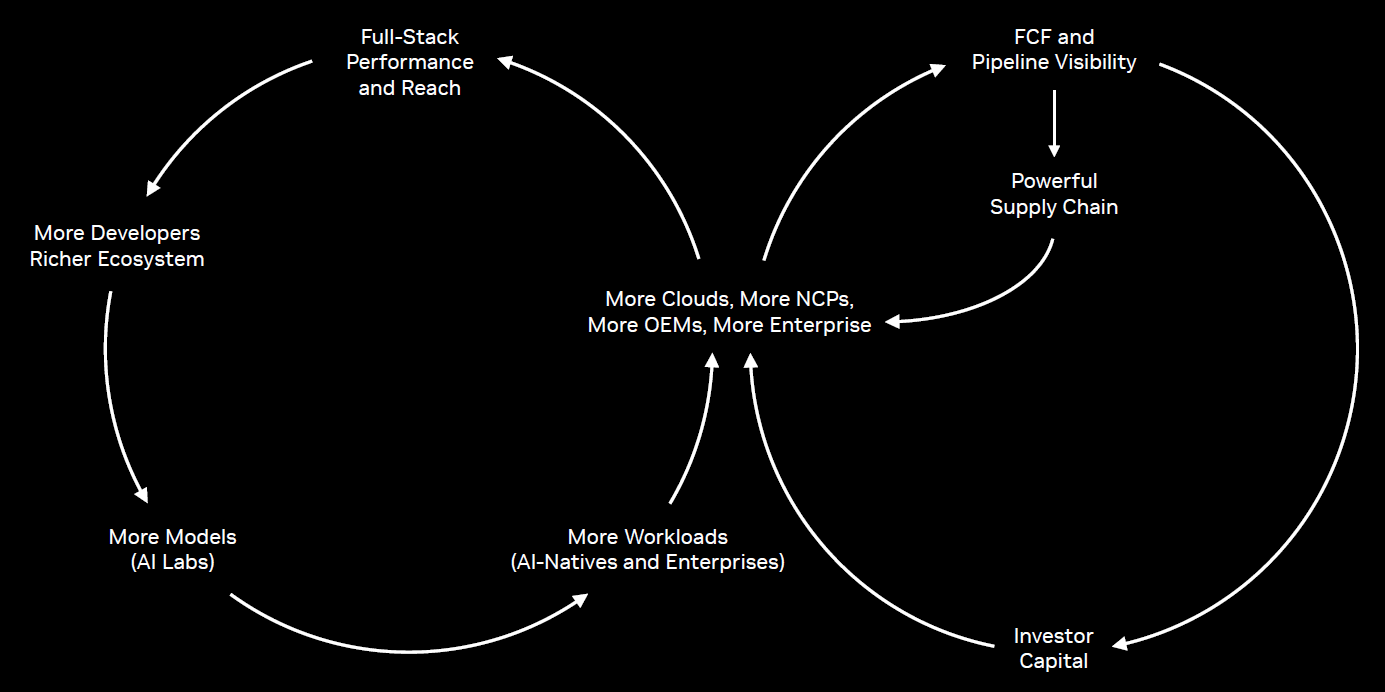
More developers build on NVIDIA -> more models are optimized for it -> more workloads run on it -> more clouds deploy it -> which funds the next platform generation. Each turn of the wheel raises the cost of leaving.
Business Strategy
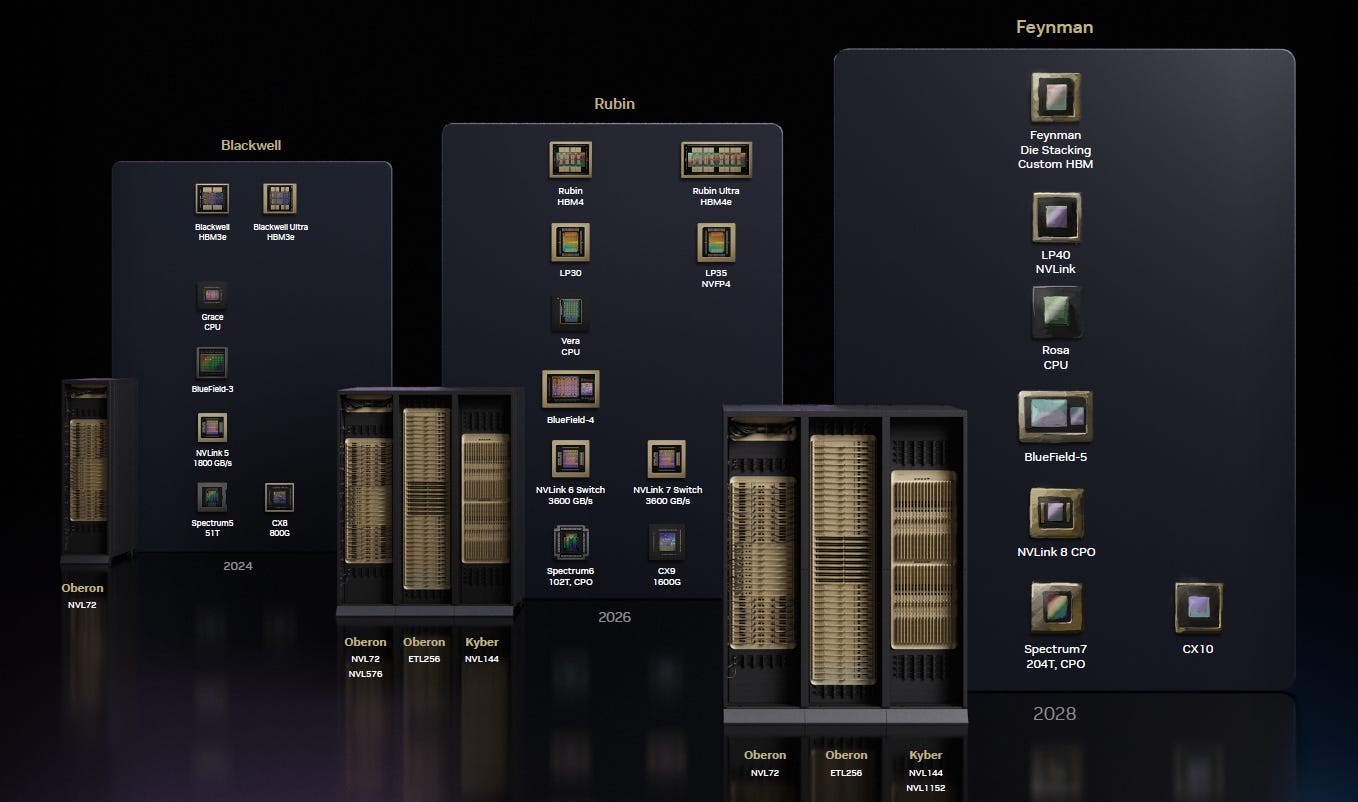
Three things stand out in the current strategy. First, the relentless roadmap cadence: Blackwell (2024) -> Rubin with HBM4 (2026, in full production) -> Rubin Ultra -> Feynman (2028), with networking, CPUs, and DPUs advancing in lockstep.

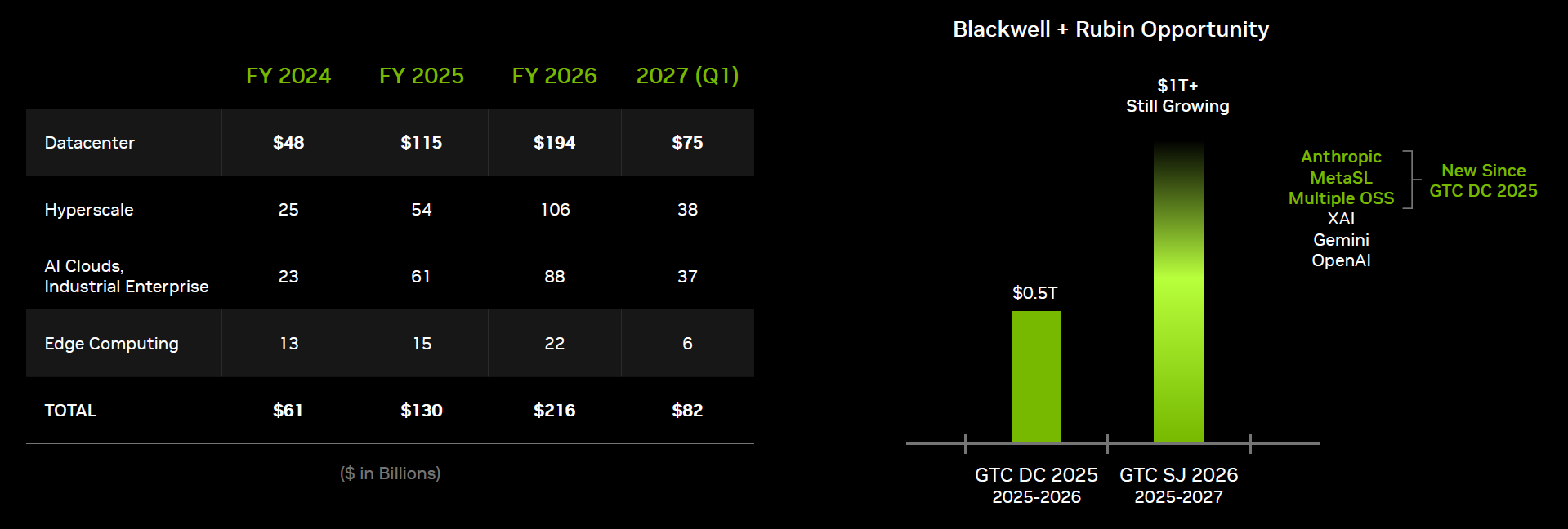
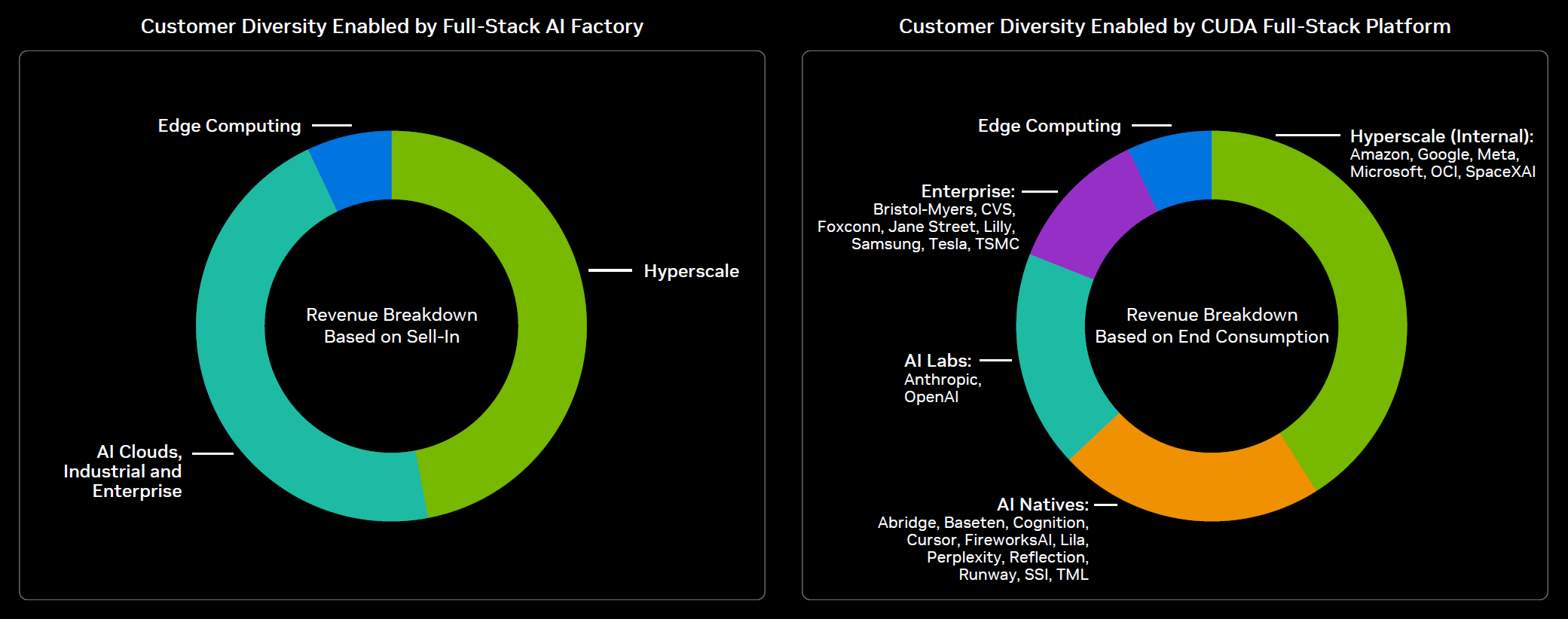
Second, demand diversification. AI Clouds, Industrial, and Enterprise customers now account for ~50% of Data Center revenue - the half that is not hyperscalers - and management expects it to outgrow hyperscale long-term. Data Center revenue itself went from $48B (FY2024) -> $115B (FY2025) -> $194B (FY2026) -> $75B in Q1 FY2027 alone. The customer list now spans AI labs (Anthropic, OpenAI), AI natives (Cursor, Perplexity), and enterprises (Eli Lilly, Samsung, Tesla, TSMC itself).
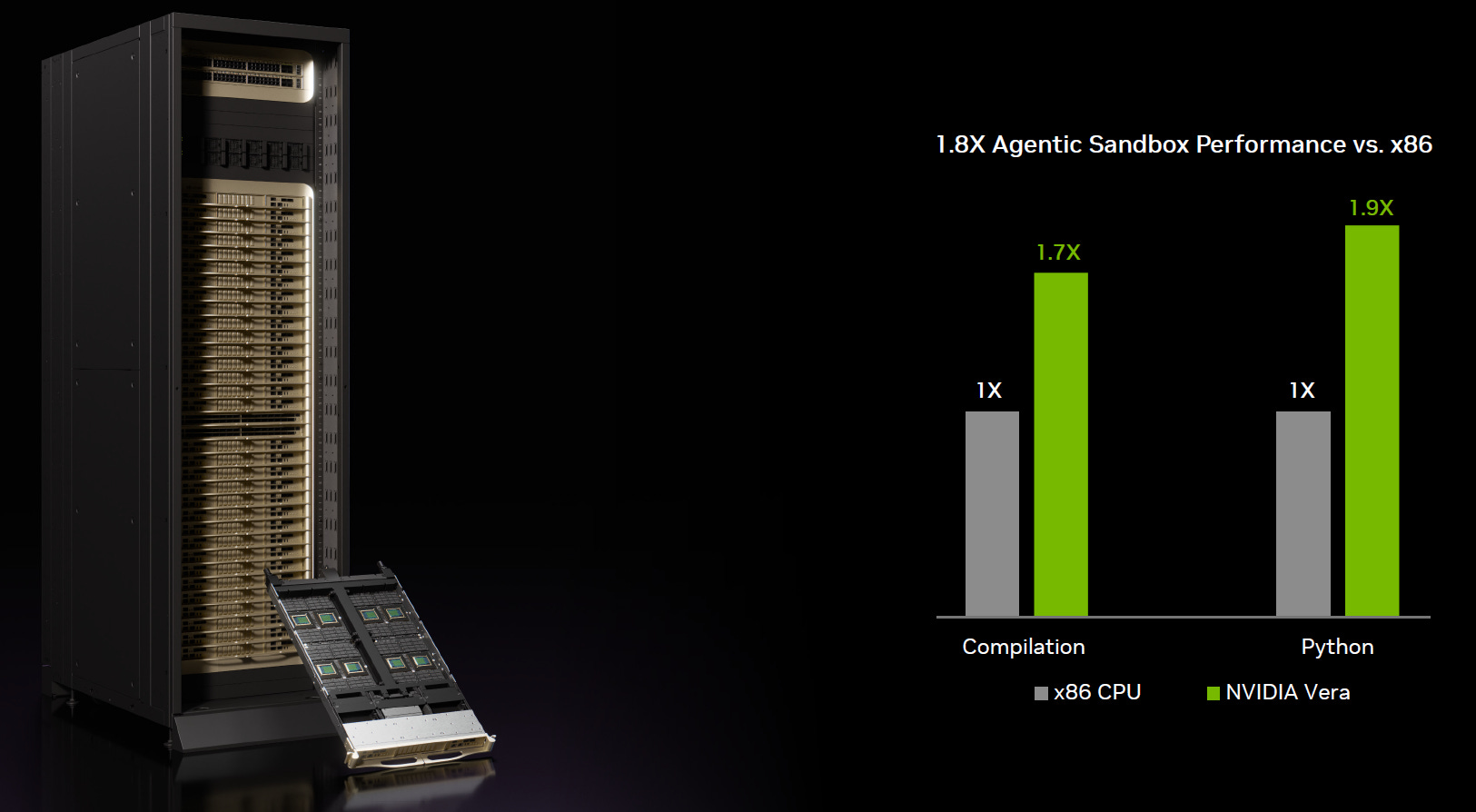
Third, new fronts beyond the GPU: the standalone Vera CPU (1.5x the performance of the latest 128-core x86 in company-cited benchmarks), RTX Spark in PCs, and physical AI - robotics, autonomous vehicles, and industrial automation, which management sizes at $50 trillion; treat that number as ambition, not addressable market. NVIDIA is the only company offering all three computers physical AI needs: train (DGX), simulate (Omniverse + Cosmos), run (Jetson Thor).
Capital Allocation
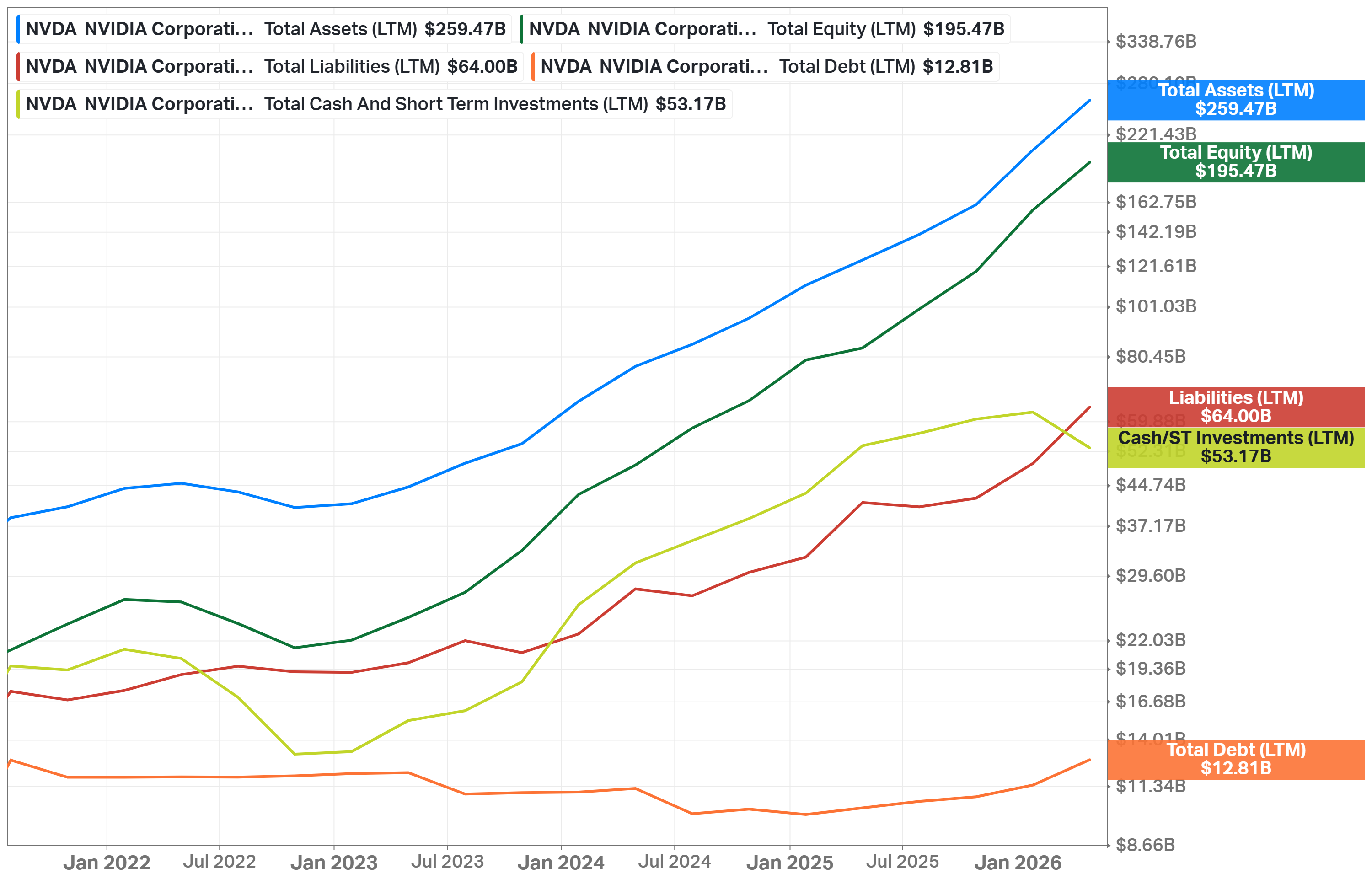
The numbers here barely need commentary: operating cash flow grew from $64B in FY2025 to $103B in FY2026, and hit $50B in Q1 FY2027 alone. Free cash flow went from $61B -> $97B, with $49B in the first quarter of FY2027.
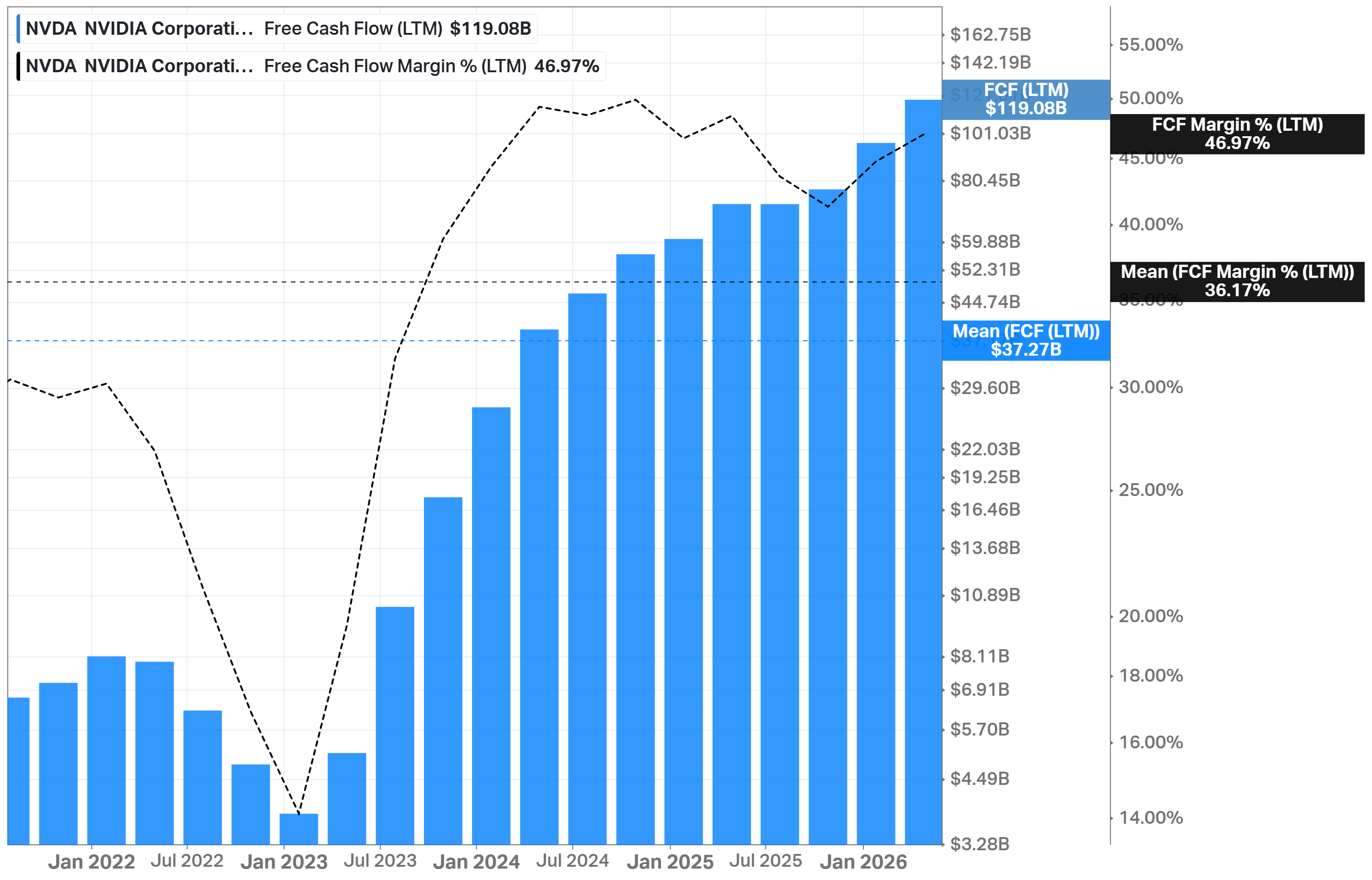
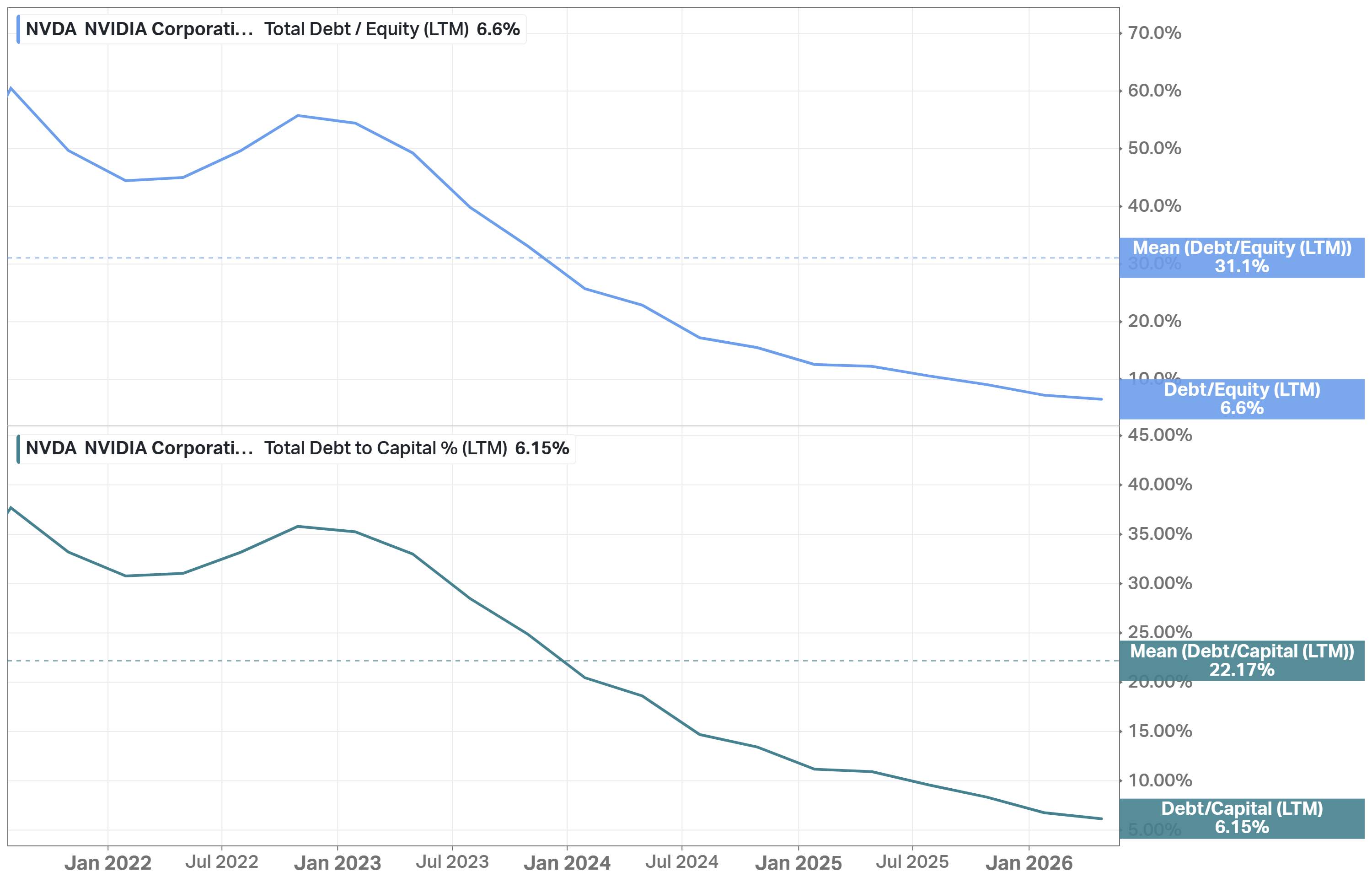
Cash and short-term investments of $53B against $12.81B of debt - ~$40B of net cash after adjustments, with interest coverage above 400x.
Capital returns are stepping up to match: a new $80B buyback authorization on top of ~$39B remaining, ~$20B returned in Q1 FY2027 alone, and a commitment to return 50% or more of free cash flow to shareholders going forward.
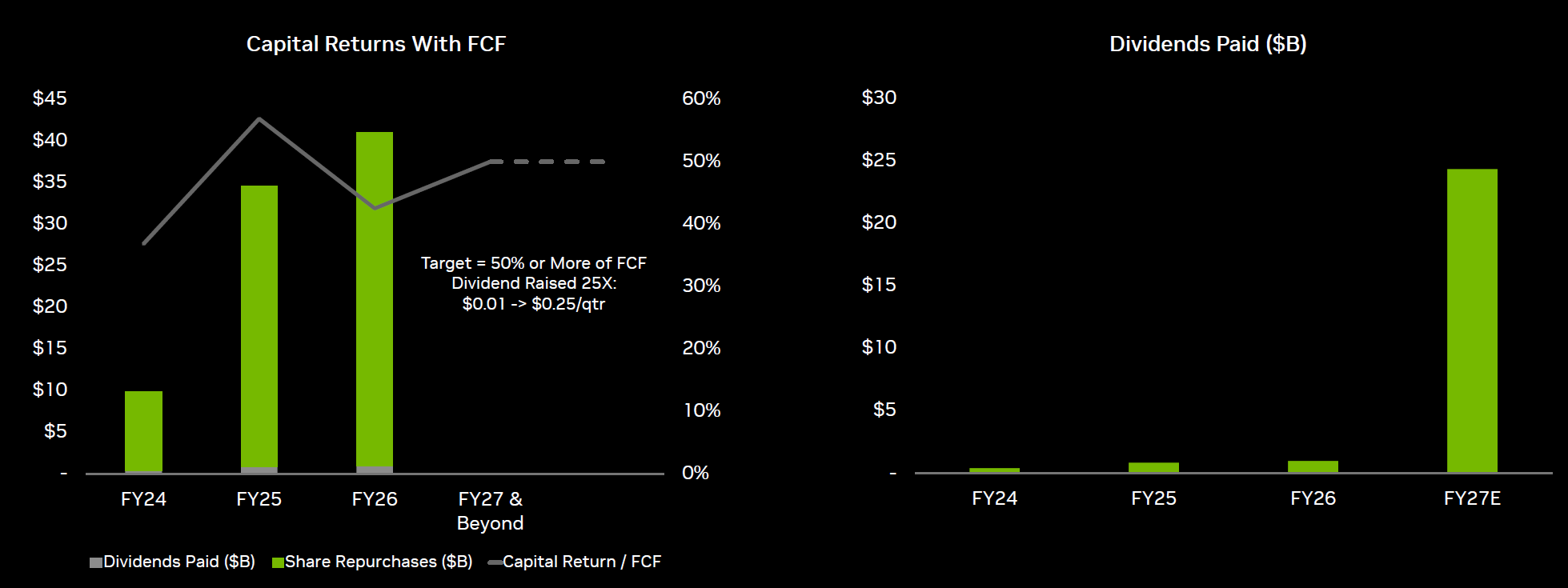
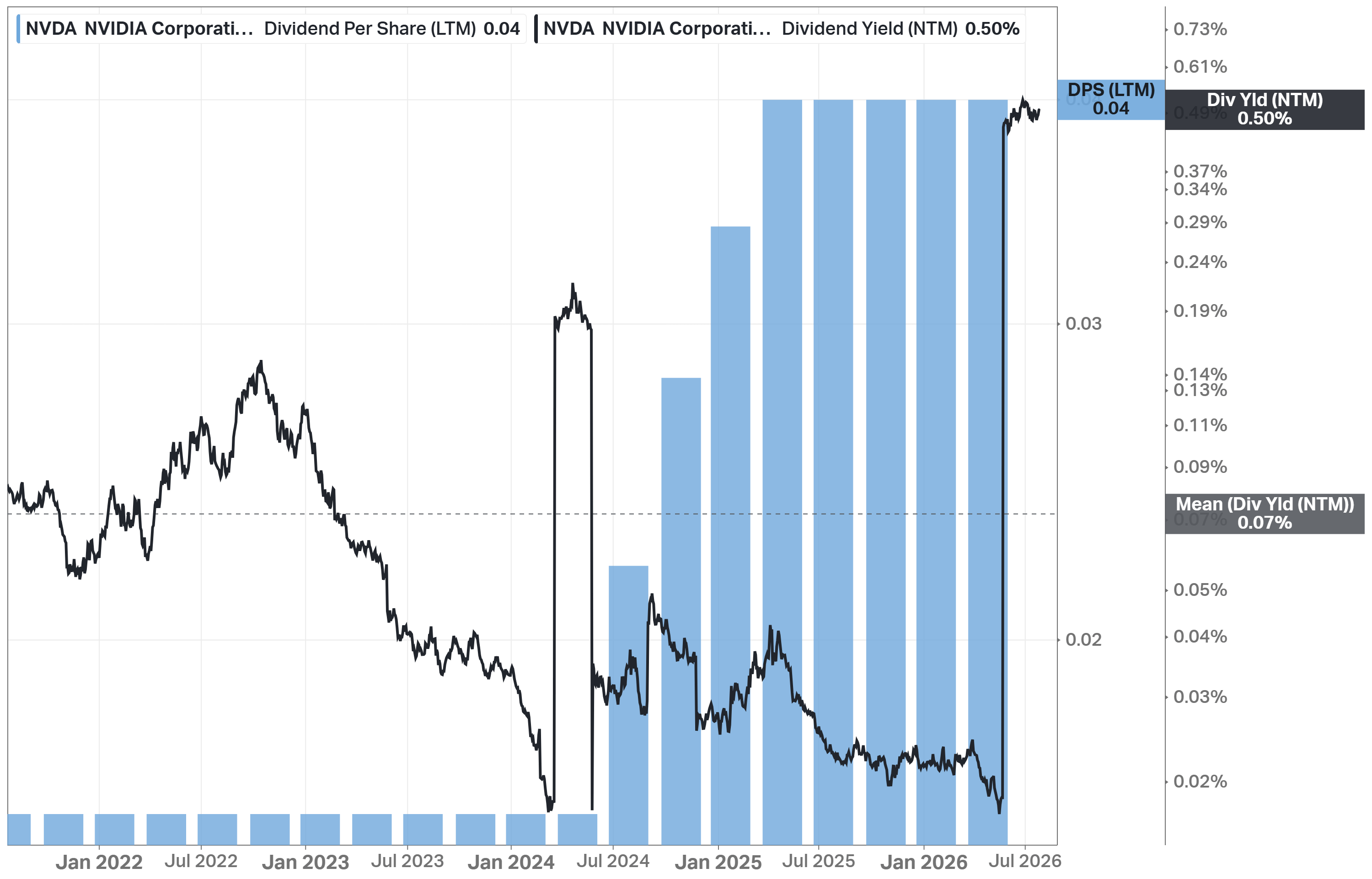
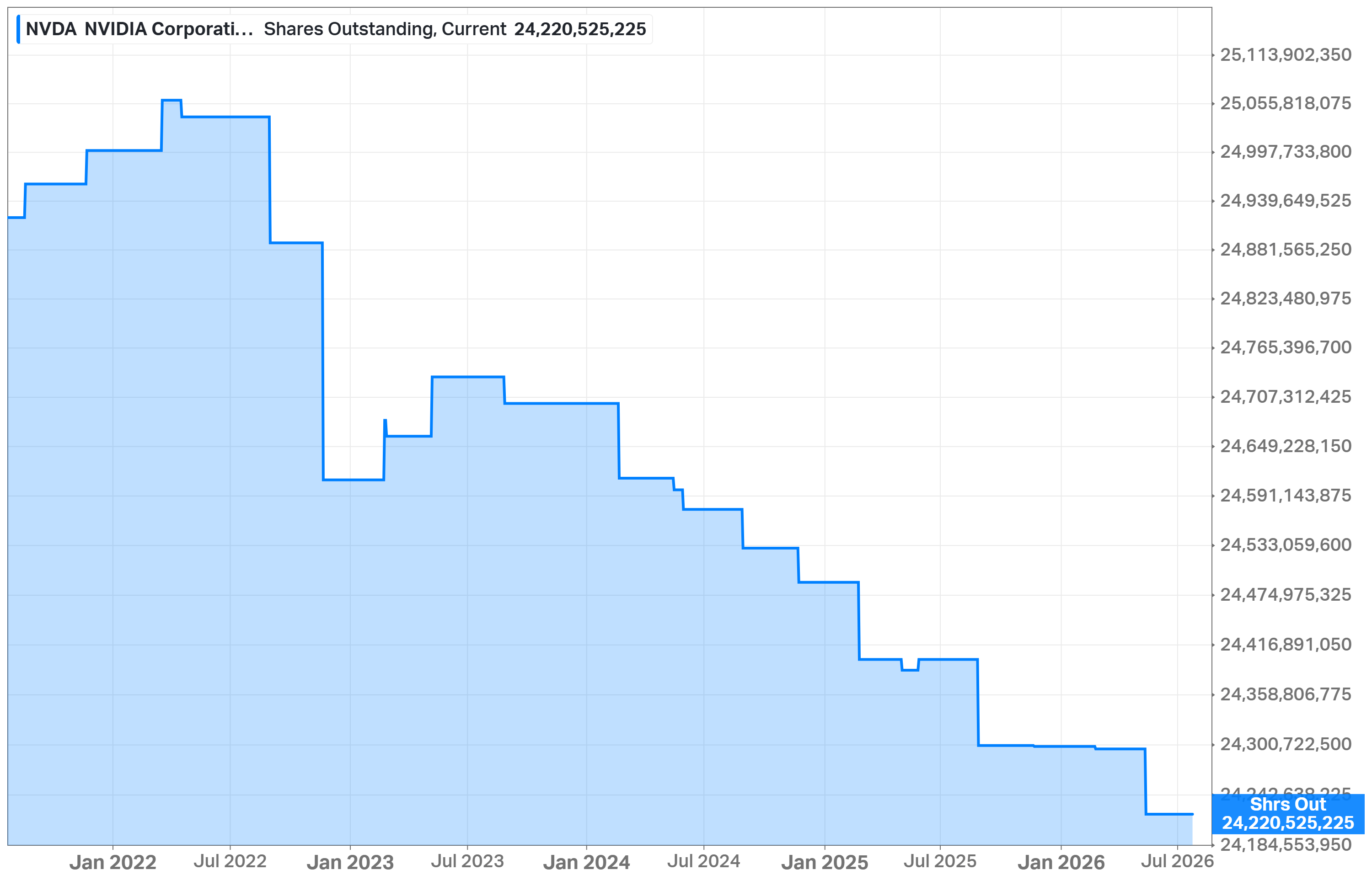
The May 2026 dividend raise from $0.01 to $0.25 per quarter - a 25-fold jump; the trailing payout ratio is still just 0.61%, and even the new run-rate is ~15% of earnings. It is a statement of confidence, not an income proposition; buybacks remain the main channel, and the share count is already reducing.
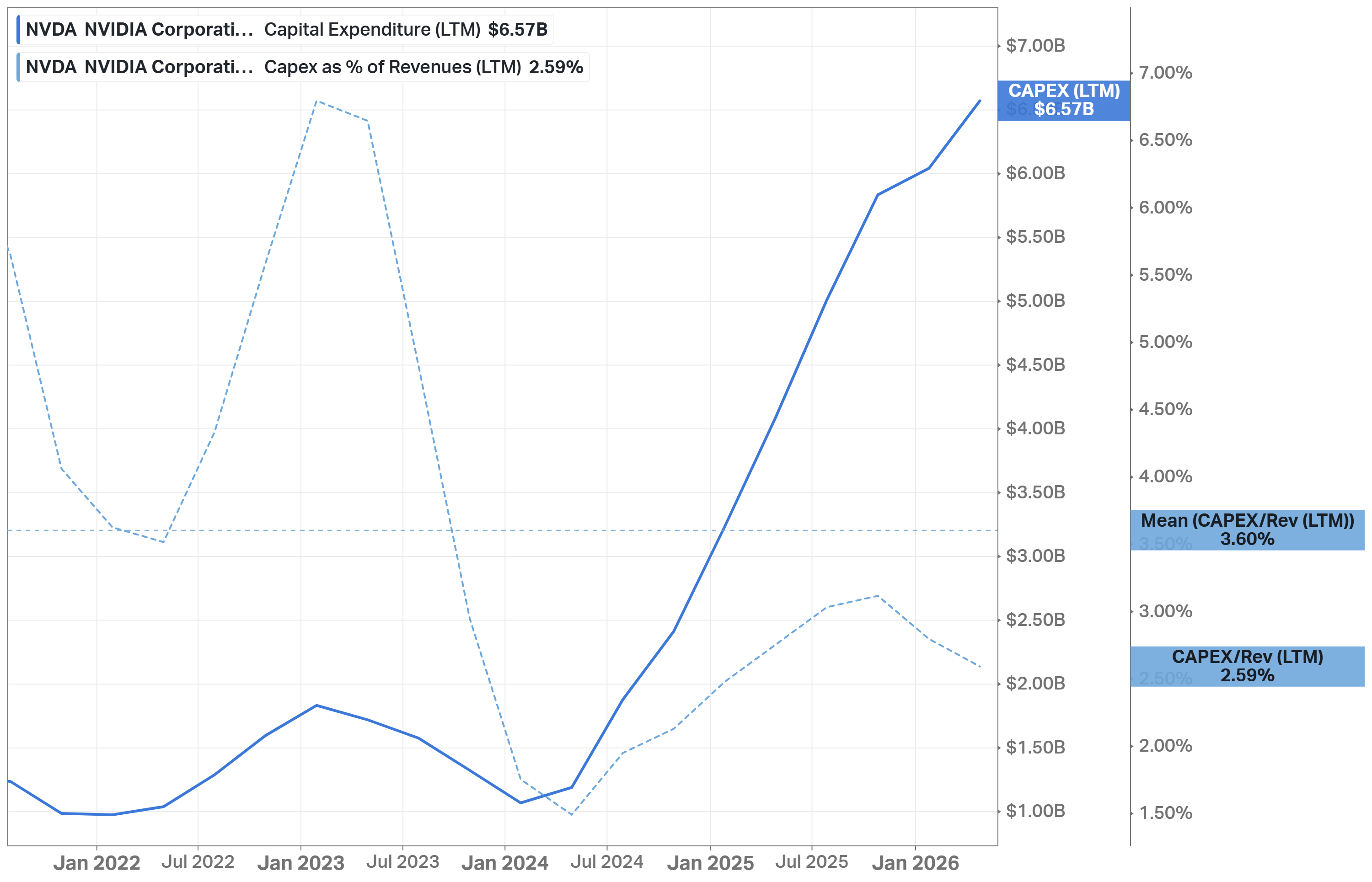
Unlike its hyperscaler customers, NVIDIA carries almost no capex burden: 2.59% of revenue, versus 3.60% on average over five years. It designs chips; TSMC builds them. That is why a 47% FCF margin is even possible.
Advantages
De facto monopoly on AI compute. GPUs plus CUDA form the default platform for training and inference; switching costs are so high that even customers building their own silicon keep buying NVIDIA at scale. Networking deepens the lock-in at cluster level, and new fronts (PCs, robotics, CPUs) keep opening.
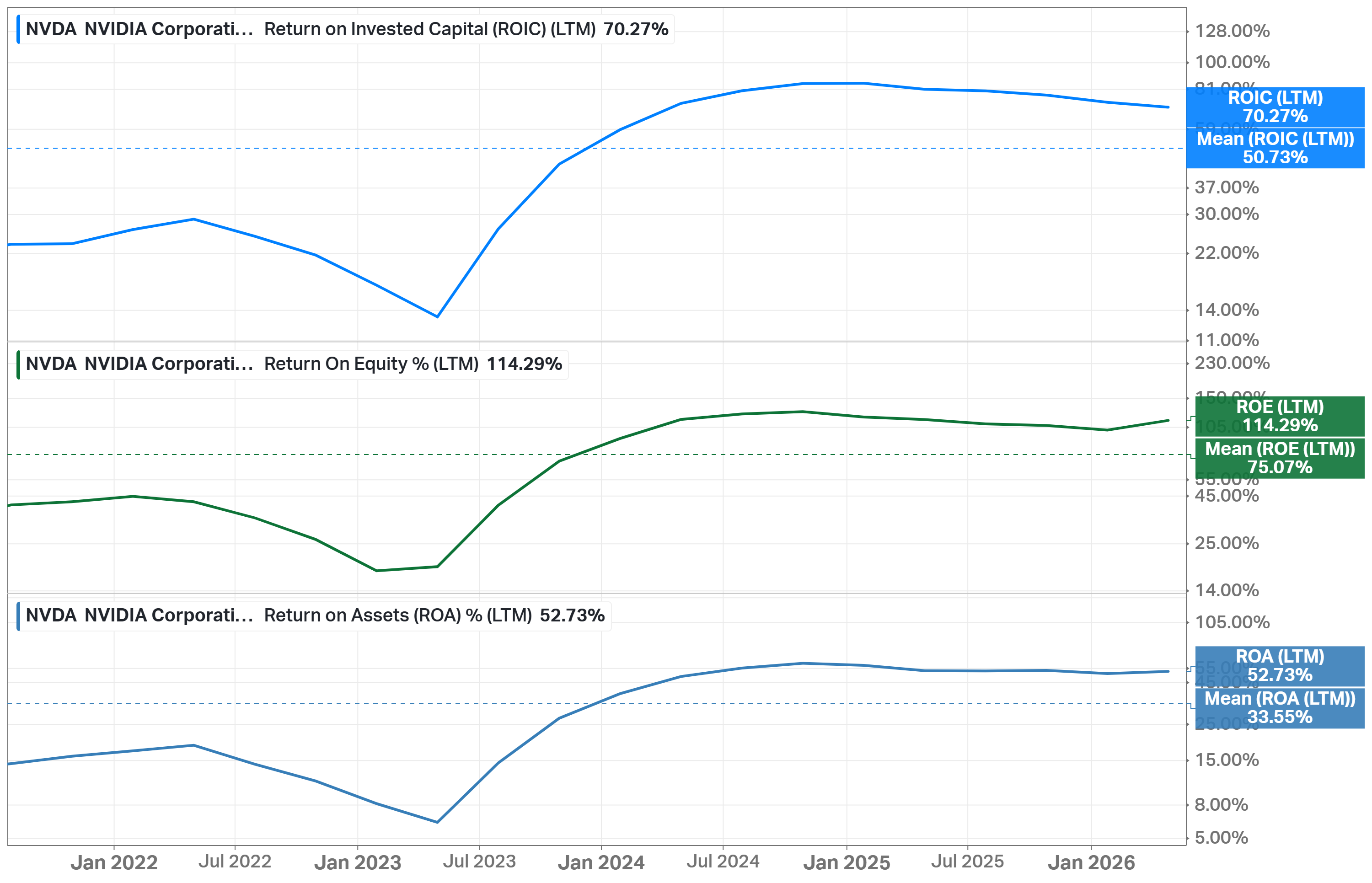
Unmatched financial profile. 74% gross margin, 63% net margin, 70% ROIC, 114% ROE, ~$119B of free cash flow, ~$40B net cash - every margin and return metric is far above its own five-year average. Nobody else converts demand into cash this efficiently.
Hypergrowth priced as a mature company. ~21x forward earnings (vs a 37.7x average) for ~44% expected EPS growth is a PEG of 0.47 - the cheapest the stock has been relative to its growth in five years, with a +51% average analyst target on top.
Demand is diversifying. AI Clouds, Industrial, and Enterprise now generate ~50% of Data Center revenue - the non-hyperscaler half - and management sees $1T+ of cumulative Blackwell and Rubin revenue through 2027. The single-customer-type risk of 2023-2024 is fading quarter by quarter.
Capital returns. A new $80B buyback on top of $39B remaining, the dividend raised 25-fold, a commitment to return 50%+ of free cash flow, a decreasing share count - and stock-based compensation of only 2.7% of revenue, rare for a company this dominant.
Disadvantages
Customer concentration and cyclicality. A handful of hyperscalers and AI labs generate most Data Center revenue, and every one of them is developing in-house silicon. If AI capex pauses because returns disappoint, the same operating leverage that created 63% margins works brutally in reverse.
Geopolitics. Export controls have largely cut NVIDIA off from the Chinese AI market, Taiwan concentration is a single point of manufacturing failure, and the AI supply chain is in the middle of US-China tensions. These risks are real, partly binary, and outside management’s control.
Peak-margin risk. Consensus extrapolates 74% gross margins years forward. AMD’s accelerators, Broadcom’s custom ASICs, and customers’ own chips all target exactly this profit pool; even modest erosion would compound with decelerating growth (+82% -> +23% by FY2029) to make today’s multiples look less cheap.
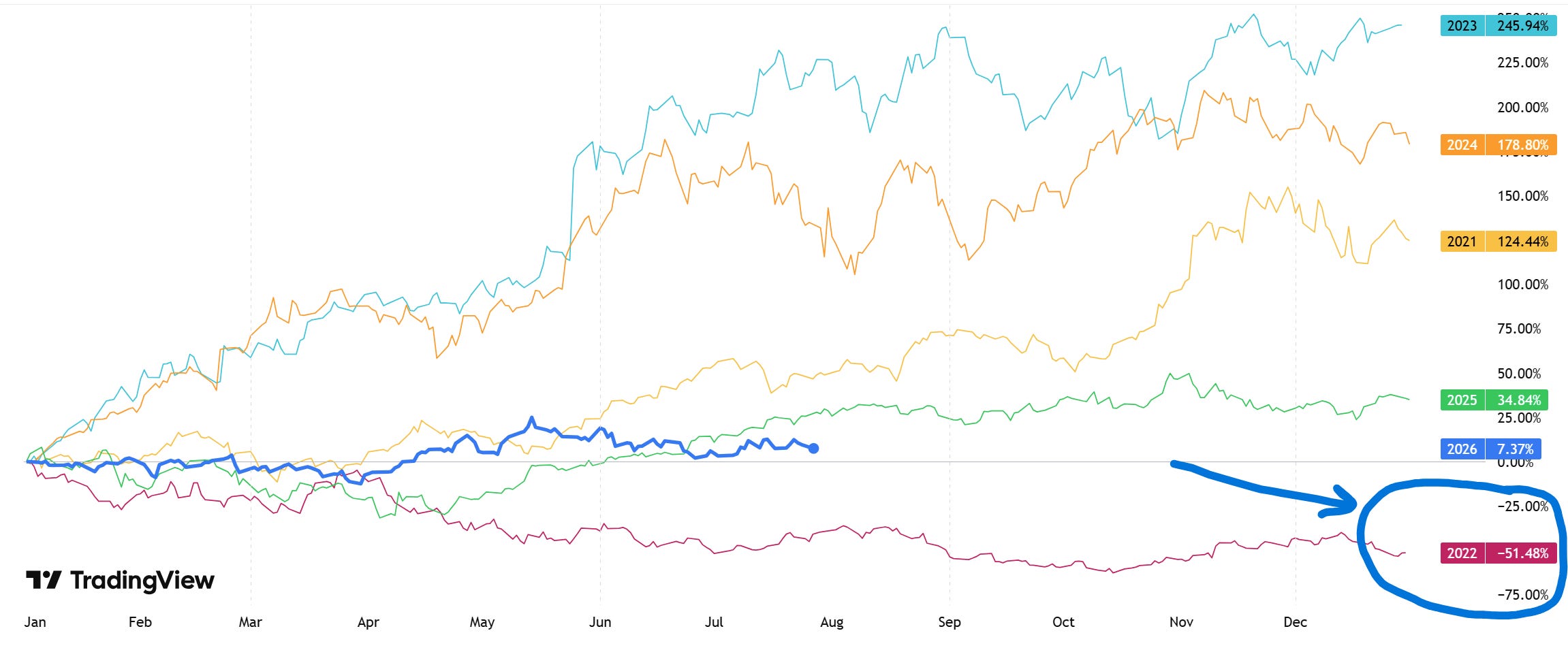
Volatility. Beta of 2.21, and NVDA’s own history includes 50%+ drawdowns inside secular uptrends (2022: -51.48%). Whatever the fair price says, the market will periodically offer this stock 30-40% cheaper - and holding through that is part of the price of admission.
The supply chain. Leading-edge manufacturing is concentrated at TSMC, advanced packaging capacity is scarce, and HBM memory comes from a handful of suppliers - any bottleneck there caps growth regardless of demand. Add the key factor: no mega cap is more identified with one founder-CEO than NVIDIA with Jensen Huang.
What the bears get right: nobody, including NVIDIA, actually knows the demand curve past 2027. Semiconductor consensus has been wrong at every cycle turn in history, and it is currently extrapolating the greatest earnings boom ever recorded. AI monetization might face a slowdown. Today's "cheap" 21x becomes an expensive 40x retroactively, because the E collapses faster than the P. I do not dismiss that scenario - I price it: the 20% growth cap, the 20x bear exit multiple, and a 30% margin of safety on top exist precisely because the bears have a point.
Competitors
AMD is the only merchant GPU alternative with a credible roadmap; Broadcom builds custom AI ASICs for hyperscalers; Intel remains behind in both.
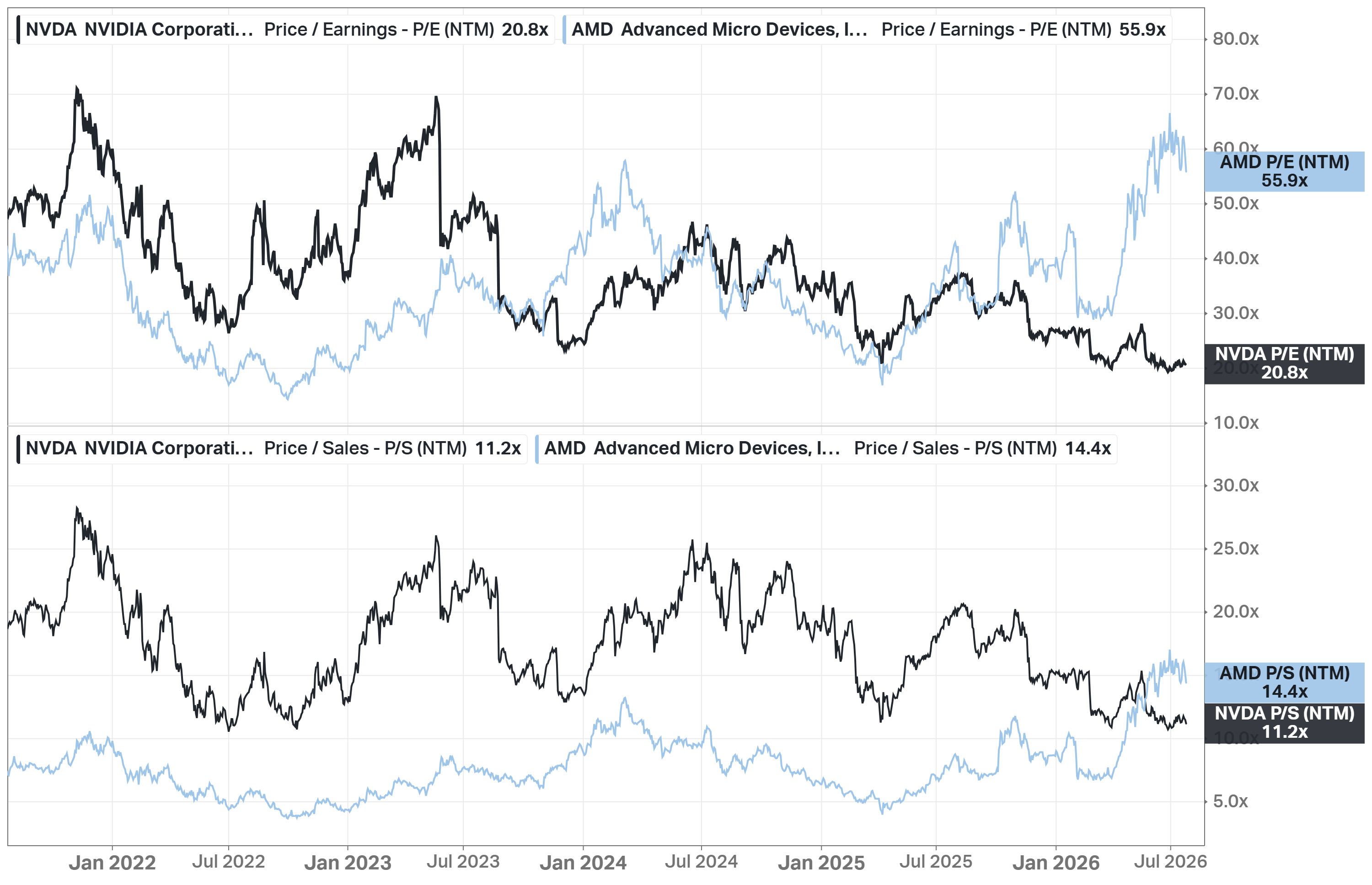
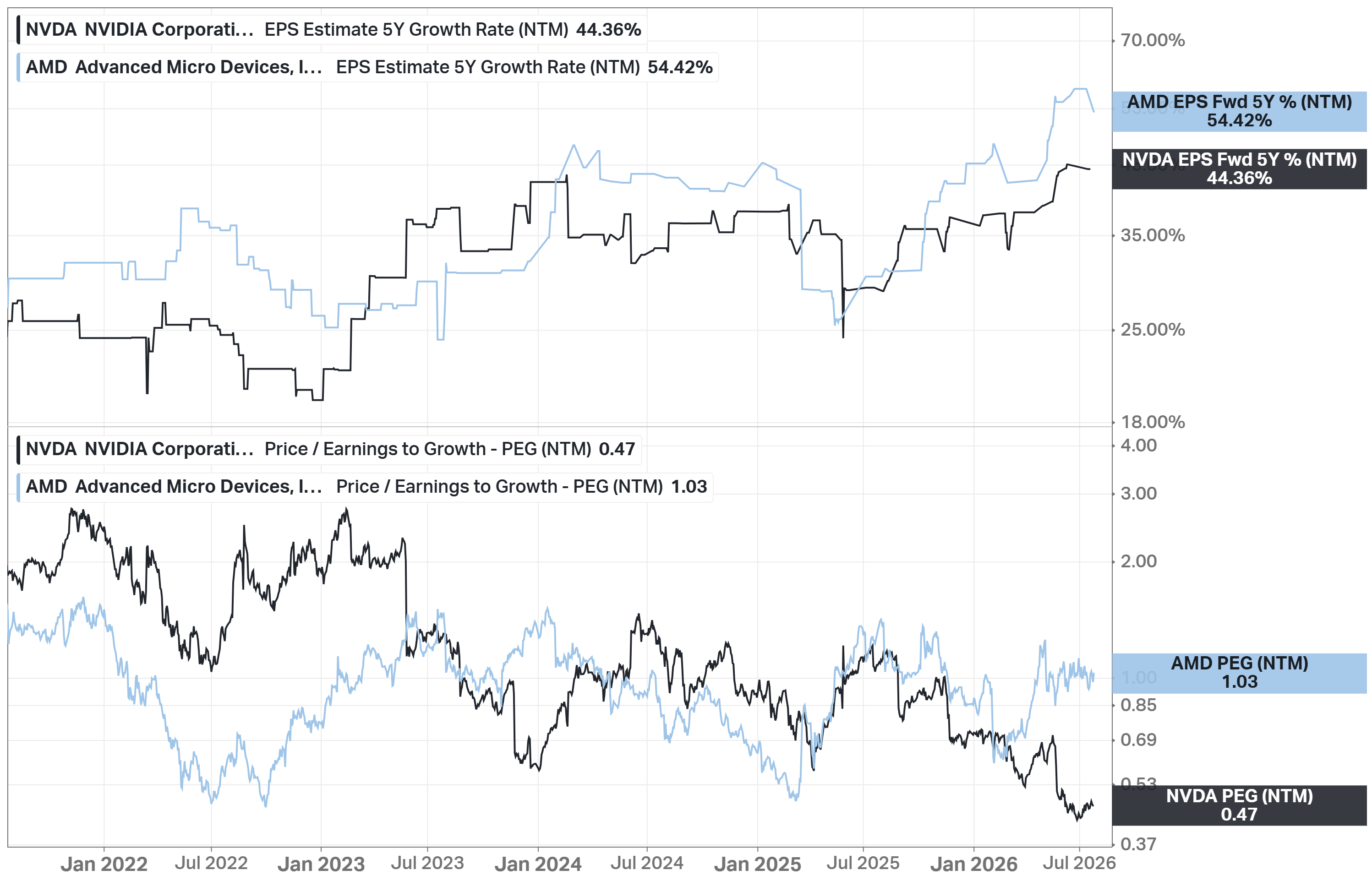
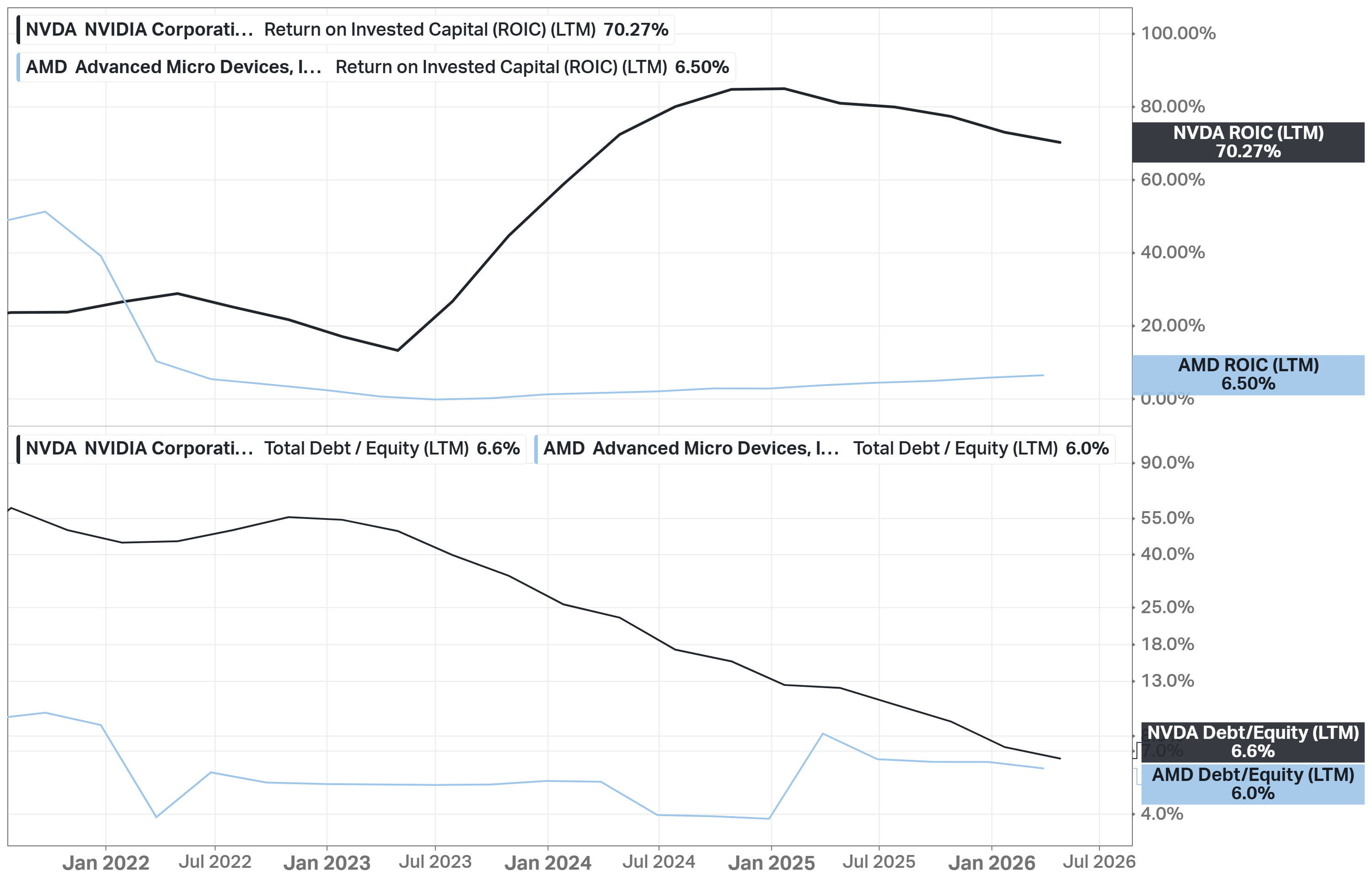
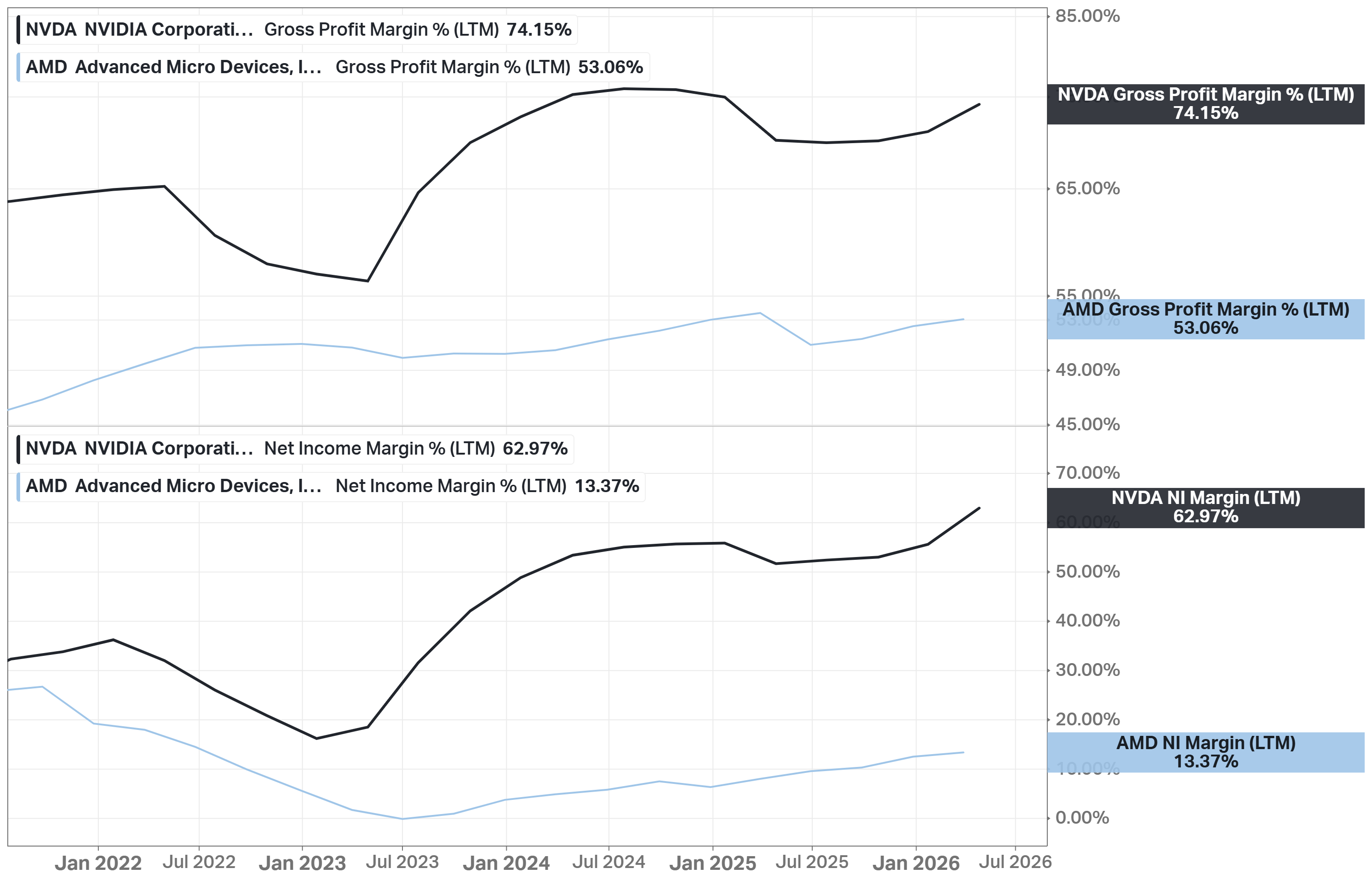
The charts below answer the obvious question. Yes, consensus expects AMD to grow EPS faster over the next five years - 54.42% a year versus NVIDIA’s 44.36%, but that is the only line AMD wins, and the market has already paid for it: ~56x forward earnings versus ~21x, and a PEG of 1.03 versus 0.47.
Everything else is not close. NVIDIA turns a dollar of revenue into 63 cents of profit, AMD into 13; NVIDIA’s ROIC is 70%, AMD’s is 6.5%. Both balance sheets are clean, so leverage decides nothing here. I like AMD as a business, and competition keeps NVIDIA honest - but at these prices the “cheaper alternative” is the expensive one.
The real long-term competition is the customers themselves - Google’s TPU is the only non-NVIDIA platform deployed at serious scale, with Amazon’s and Microsoft’s chips further back. So far the pattern has held for a decade: in-house chips absorb some internal workloads, while external demand and frontier work stay on NVIDIA.
Past
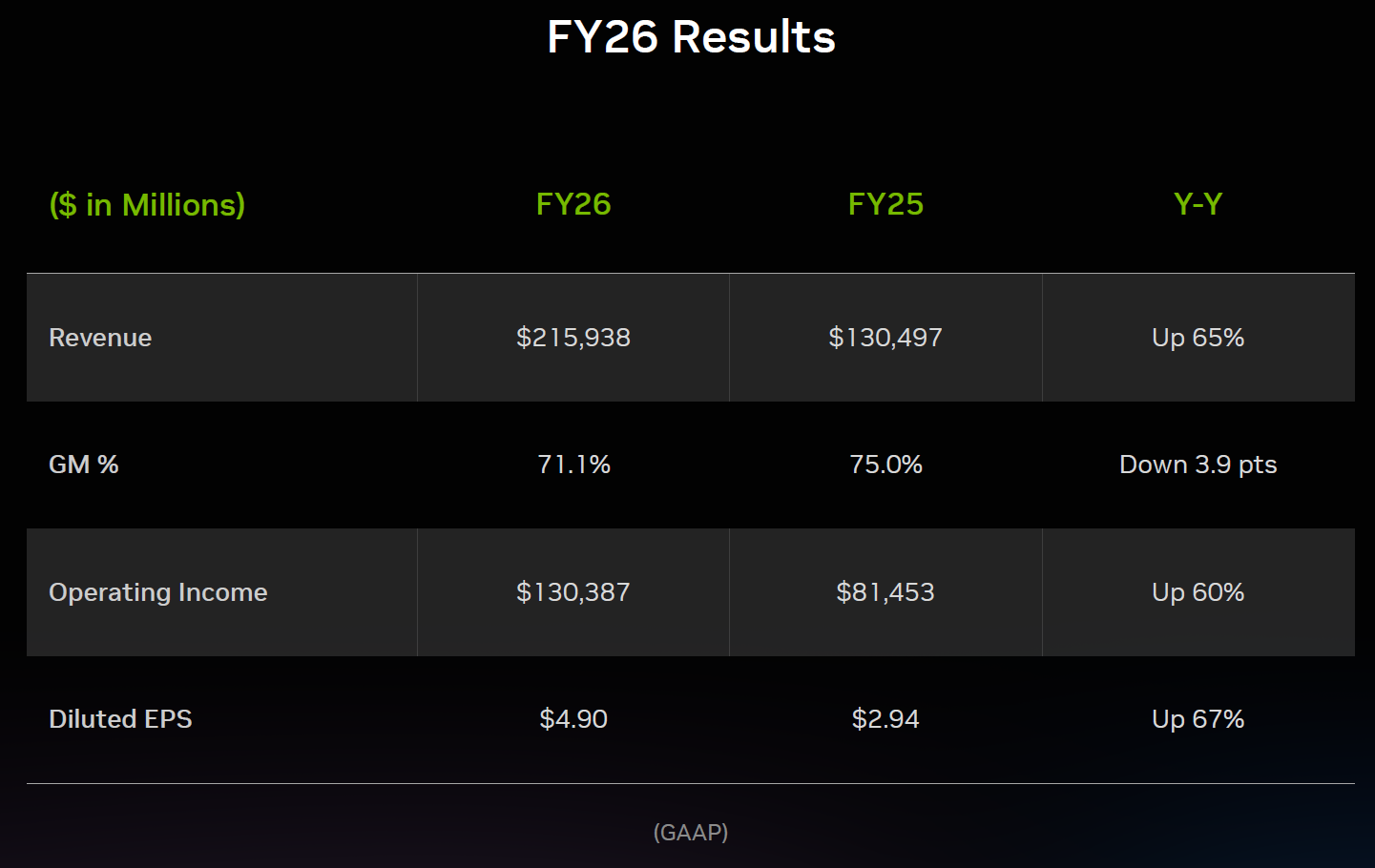
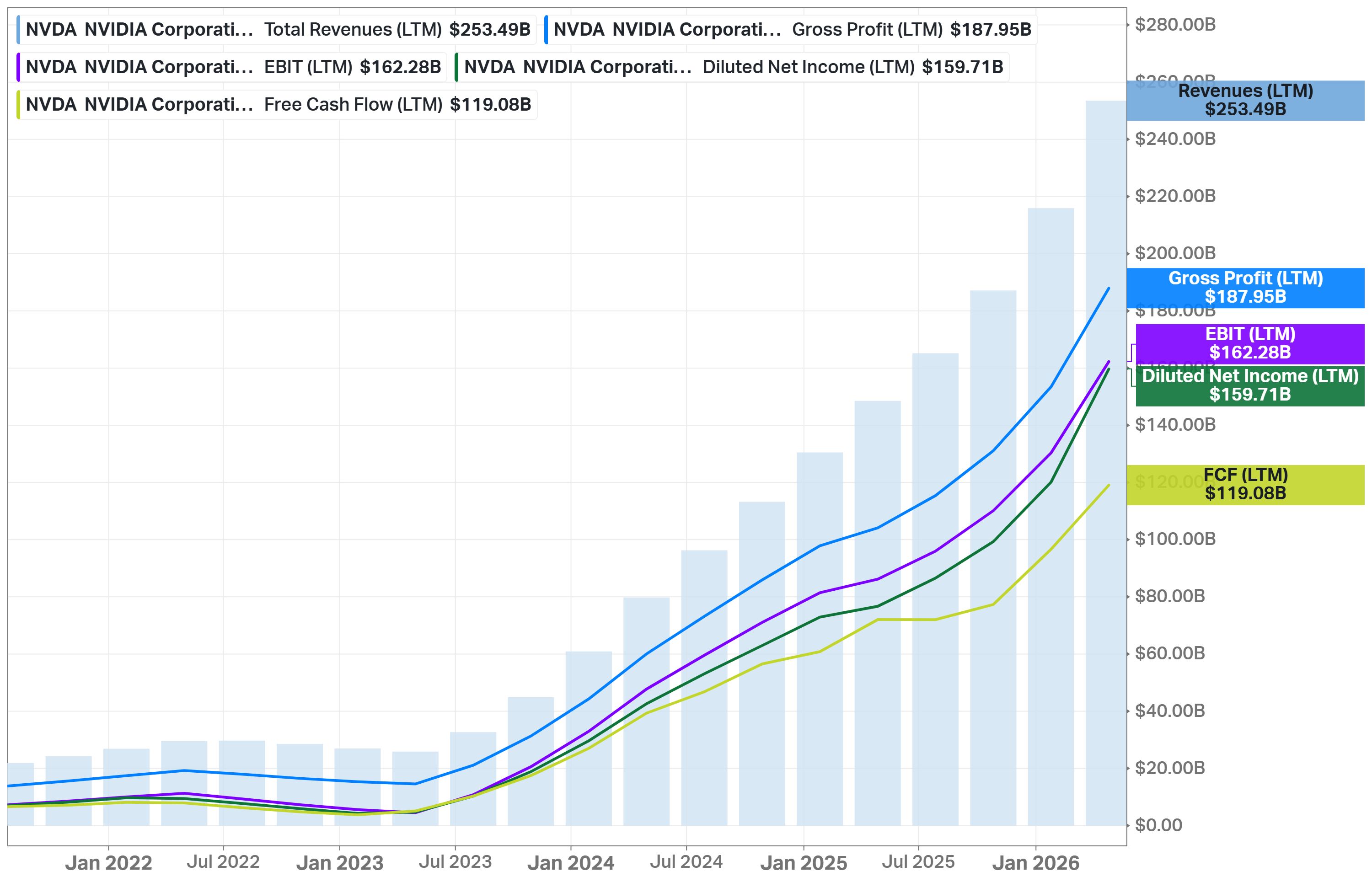
FY2026 results: revenue $215.9B, up 65%; GAAP operating income $130.4B, up 60%; diluted EPS $4.90, up 67%; GAAP gross margin 71.1%, down 3.9 points on the Blackwell ramp (LTM gross margin has since recovered to 74%).
LTM: revenue $253.5B, net income $159.7B, free cash flow $119.1B.
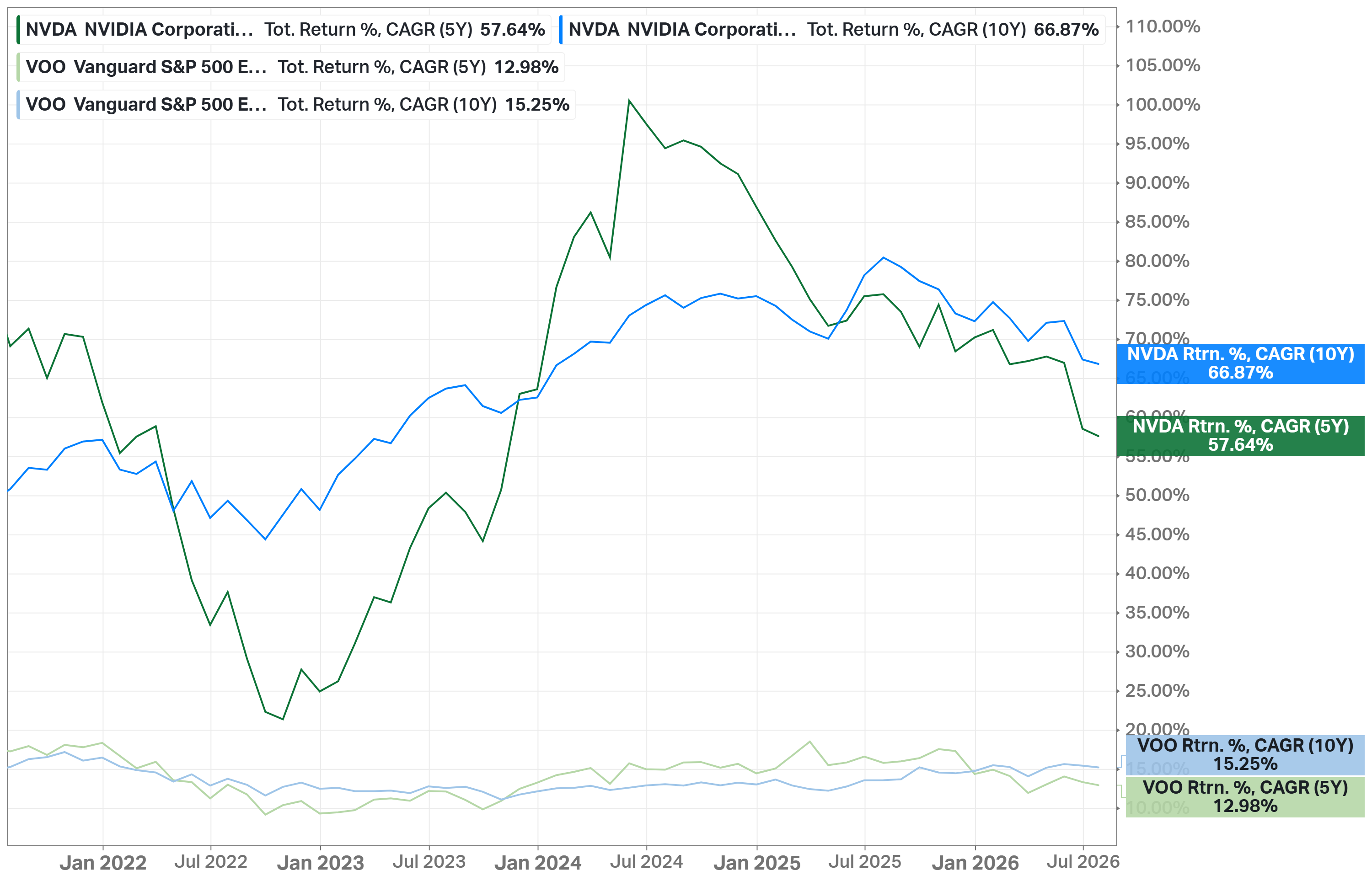
Total return CAGR: 57.6% over five years and 66.9% over ten, versus 12.98% and 15.25% for the S&P 500.
Future

Consensus revenue: FY2027 $393.6B (+82%), FY2028 $560.8B (+42%), FY2029 $688.0B (+23%).
Consensus EPS: $8.99 -> $12.87 -> $15.98 (FY2027-FY2029). Five-year forward EPS CAGR: ~44%, versus a ~29% five-year mean of that same estimate.
Next report Aug 26: revenue estimate $91.8B, EPS estimate $2.08.
Analysts: Strong Buy (10 Strong Buy/48 Buy/2 Hold/1 Sell, 61 covering), average target $302.83, +51% upside; the lowest target on the street is $180.
Growth is decelerating in percentage terms, which is normal at this size.
Current Valuation
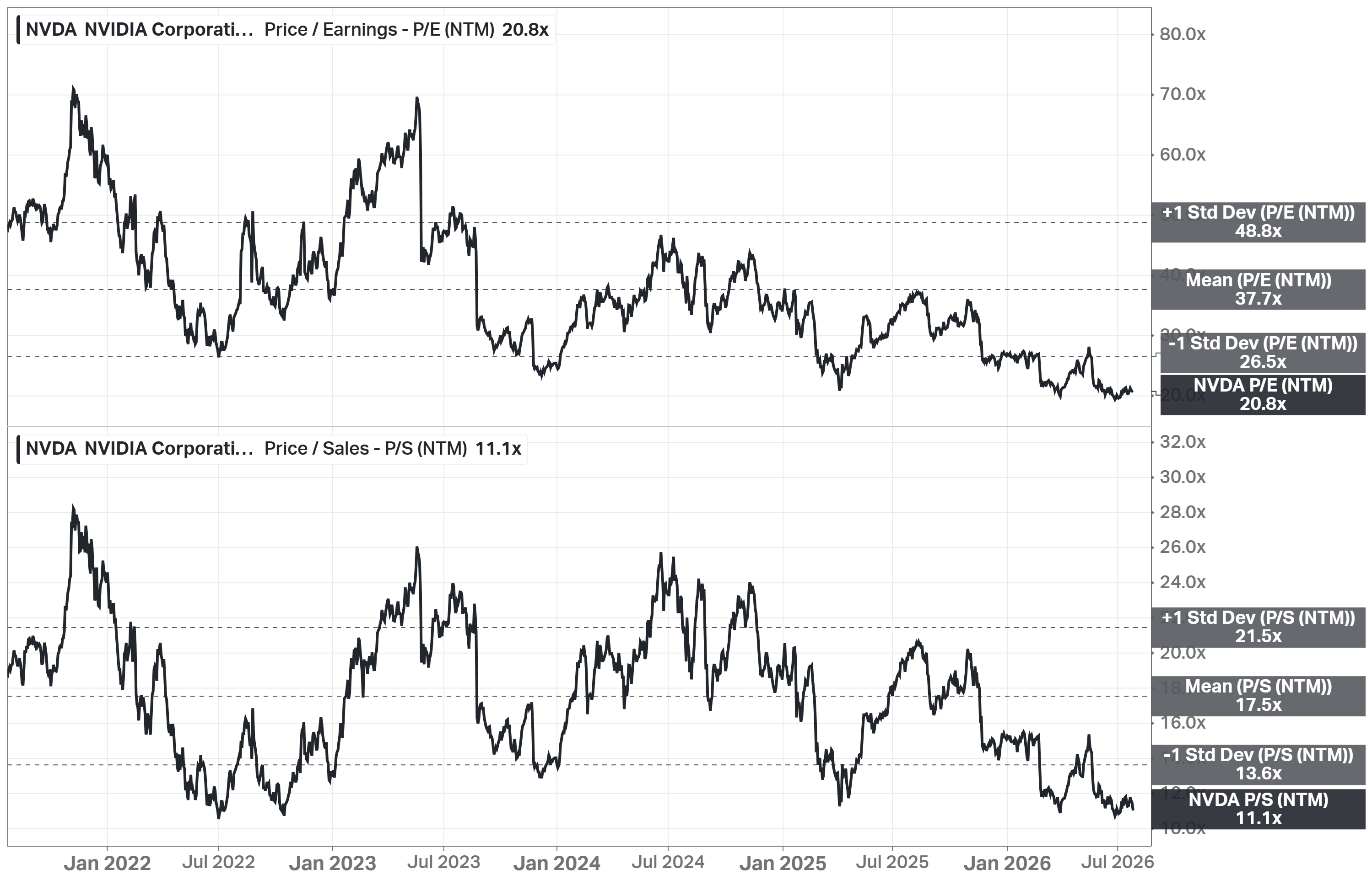
Price/Fwd Earnings: 20.8x vs 37.7x 5Y average
Price/Fwd Sales: 11.1x vs 17.5x
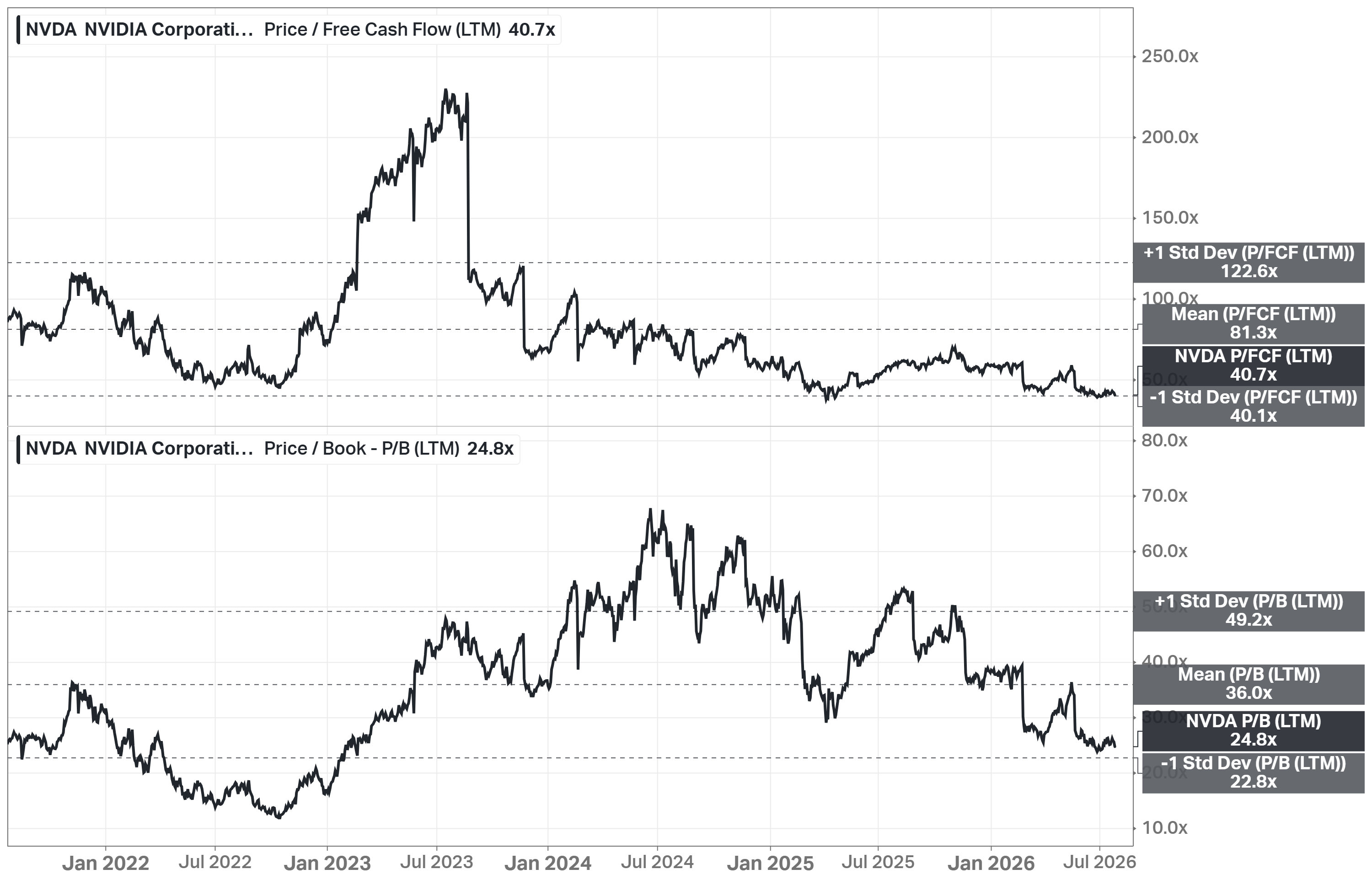
Price/FCF: 40.7x vs 81.3x
Price/Book: 24.8x vs 36.0x
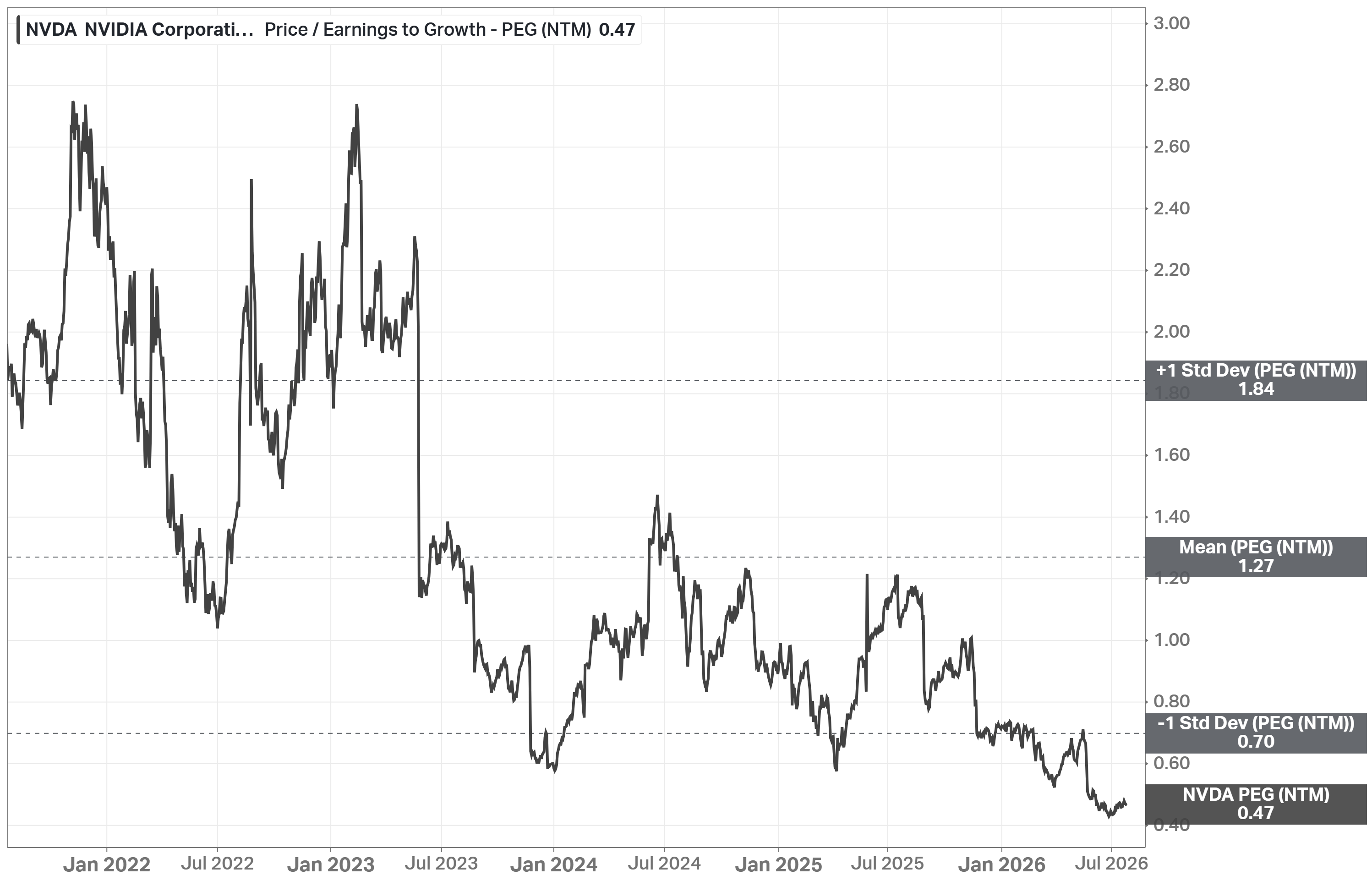
PEG: 0.47 vs 1.27
Fwd Earnings Yield: 4.81% vs 2.65%
Every multiple is far below its five-year average, several below their -1 standard deviation bands. Earnings simply grew much faster than the price. The forward EPS estimate has now overtaken what the market is willing to pay for it - the market pays less than half a unit of valuation per unit of expected growth.
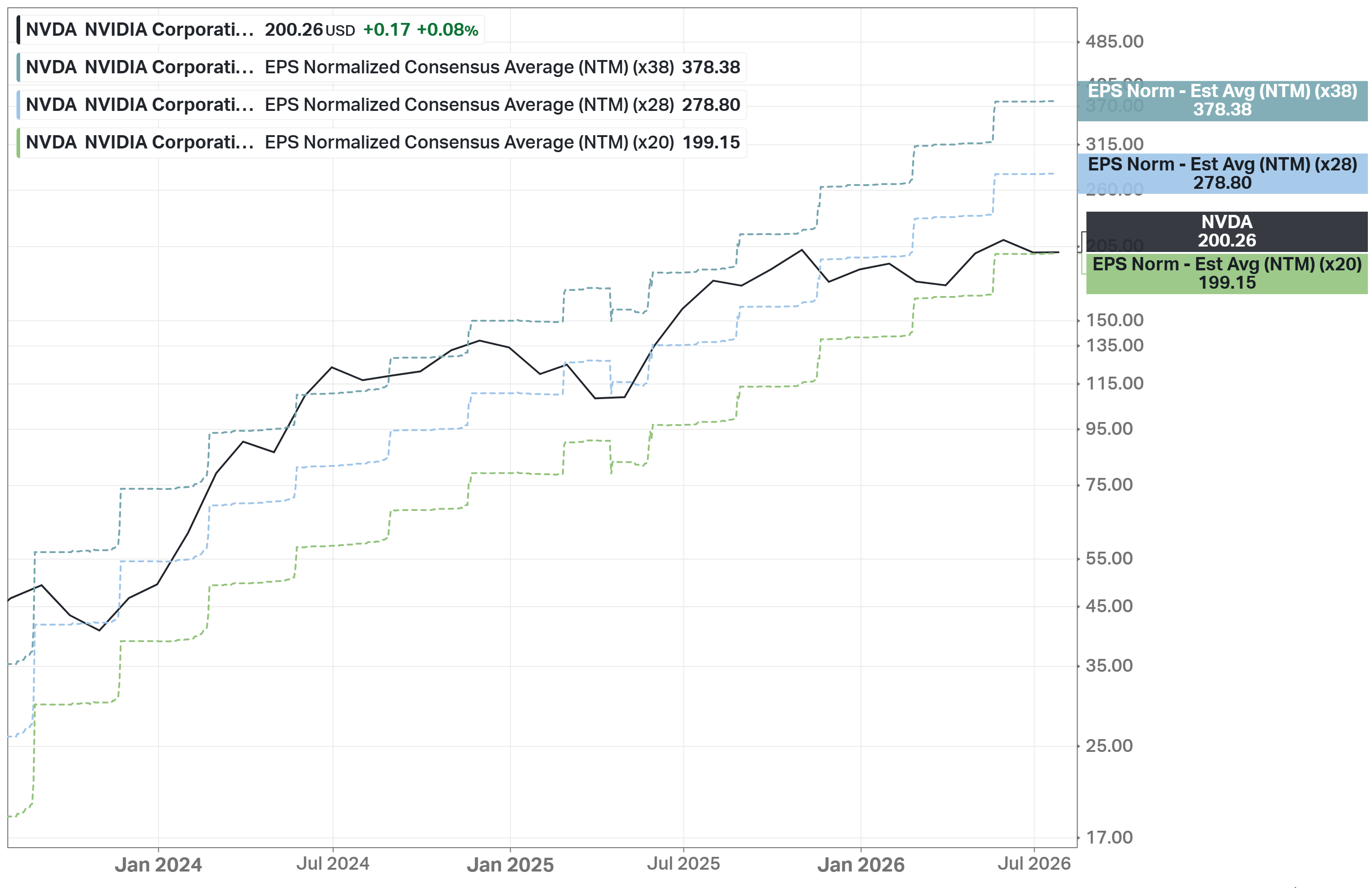
One chart frames this whole section. The corridor below takes the consensus forward EPS estimate and multiplies it by the three exit multiples from my fair price model: 20x - roughly today’s multiple, a market that never re-rates; 28x - roughly the -1 standard deviation band of recent years; and 38x - NVIDIA’s own five-year average. Today that corridor runs from ~$199 to ~$378, and the price, at ~$200, is pressed against the very bottom of it. The market is pricing NVIDIA as if today’s skepticism is permanent - every re-rate scenario is upside.
Fair Price
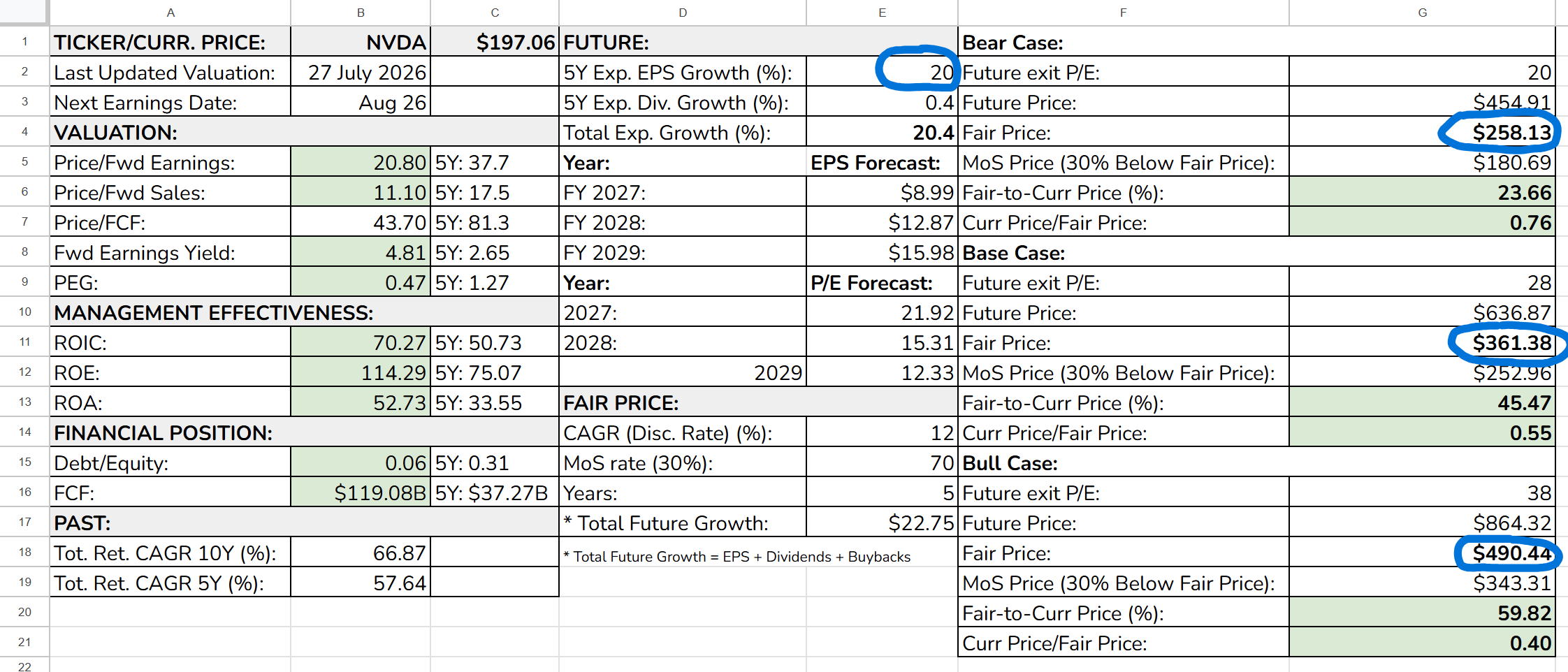
I use 20% annual EPS growth - and that is not a forecast; it is a rule: 20% is the maximum growth rate I ever plug into this model, no matter what the estimates say. Consensus expects ~44%; the FY2026-FY2028 estimates imply ~34% a year. NVIDIA’s estimates are also the most fragile in mega-cap tech, so the model should not need them to be right. With ~0.4% from dividends, total expected growth is 20.4% a year, turning FY2026 EPS of $8.99 into ~$22.75 by 2031.
The exit multiples are 20x/28x/38x: 20x is roughly today’s forward multiple (the market never re-rates), 28x is roughly at the -1 standard deviation band of recent years, and 38x is simply NVIDIA’s own five-year average.
Bear case (exit P/E 20x): fair price $258 - MoS price $181
Base case (exit P/E 28x): fair price $361 - MoS price $253
Bull case (exit P/E 38x): fair price $490 - MoS price $343
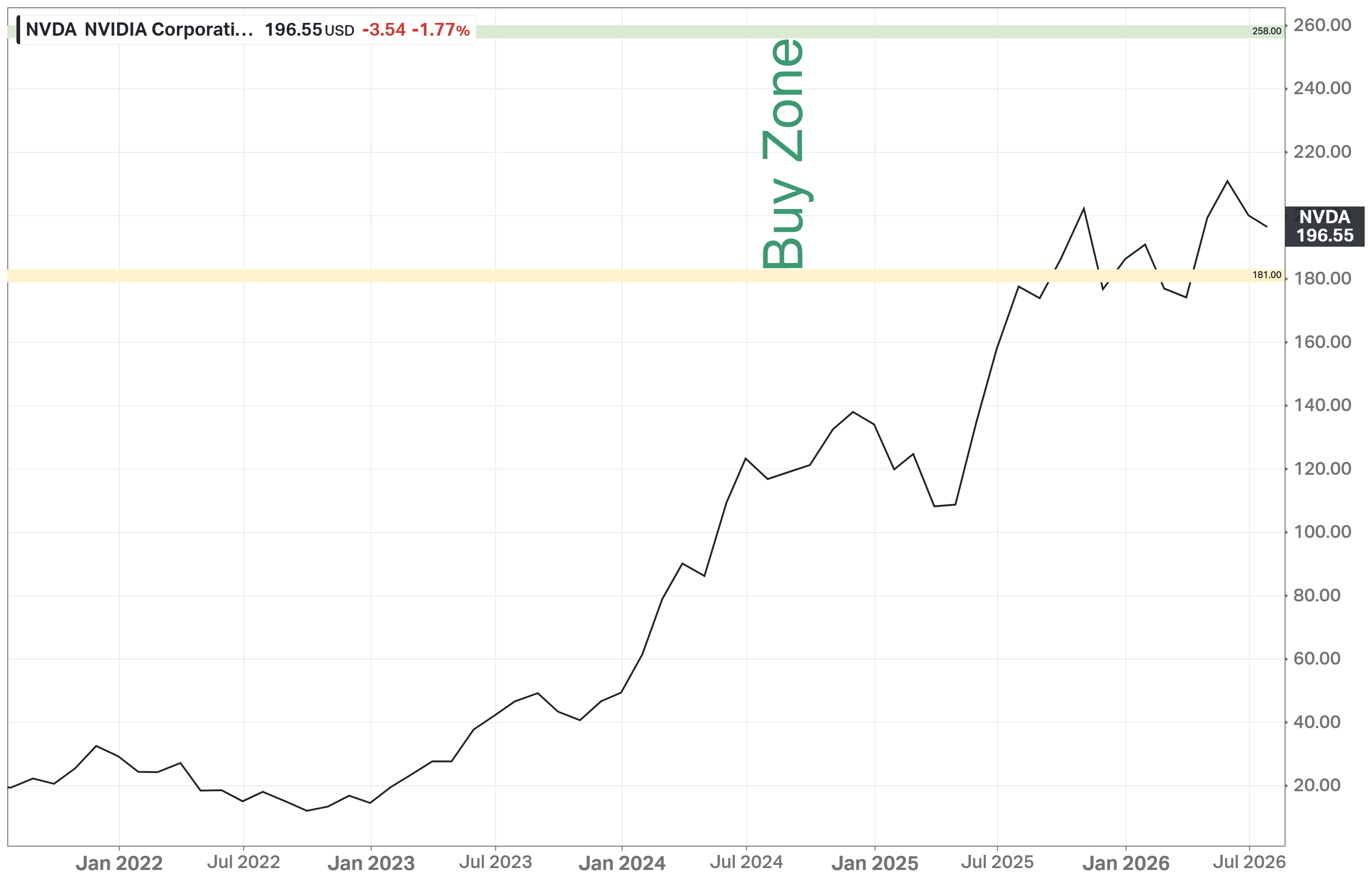
At ~$200, the stock trades below the Base Case MoS price of $253 - the full 30% margin of safety is already in the price even though the model cuts consensus growth by more than half. Even against the bear case, the stock is ~24% below a $258 fair price, and the Bear Case MoS price of $181 is almost exactly the lowest analyst target on the street. The accumulation zone is $181-258, and today’s price is inside it.
For the track record: my February 2025 fair price was $187. The stock passed it, and instead of becoming expensive, it became cheaper - because earnings more than doubled while the multiple compressed. That is the update in one sentence.
Verdict: NVIDIA belongs in a long-term portfolio as a core AI-infrastructure position - sized for its volatility, not its quality. I am personally starting to accumulate at these levels, inside the $181-258 zone, and I treat NVDA as one of the core companies of my Long-Term Pick portfolio going forward. The realistic bear case (capex digestion, margin normalization) hits the multiple and the estimates at once, so drawdowns of 30-40% are a feature of the position, not a broken thesis. Buy with a multi-year horizon, and judge the thesis on hyperscaler capex guidance and the Rubin ramp, not the share price.
Checklist
Profitability:
Gross margin at least 40%: 74.2%
Net margin at least 10%: 63.0%
FCF margin at least 10%: 47.0%
Management (ROIC, ROE, ROA): Yes (all far above 10%: 70%/114%/53%)
Piotroski F-Score: 8 of 9
Revenue surprises in last 5 years: Yes (Based on TradingView’s data)
EPS surprises in last 5 years: Yes (Based on TradingView’s data)
EPS growth YoY 5 years in a row: No (the 2022 downcycle; Based on TradingView’s data)
Valuation and Advantage:
Valuation below its 5Y averages: Yes (every multiple, several below -1 standard deviation)
Valuation below the industry: Yes (P/Fwd E 20.8x vs SOXX at 23.3x)
Does it have a moat: Yes (wide)
Outperformed the S&P 500 10-year CAGR: Yes (66.9% vs 15.3%)
Shares:
Insider ownership at least 5%: No (~4%, mostly Jensen Huang)
Fewer shares outstanding YoY: Yes
Insider buys last six months: No (Based on FinViz’s data)
Price:
1Y price forecast is above 10%: +51%
Next 5Y EPS growth estimate (CAGR) is above 10%: Yes (~44%)
DCF Value: ~$213; undervalued by ~8% (5 years, revenue CAGR ~29% - below consensus, discount rate: 10%, terminal growth: 3%, equity model: FCFF)
Short Interest below 5%: Yes (1.30%)
Due Diligence
Profitability (12 of 12):
Positive Gross Profit: $187.95B (for the last twelve months)
Positive Operating Income: $162.28B (for the last twelve months)
Positive Net Income: $159.71B (for the last twelve months)
Positive Free Cash Flow: $119.08B (for the last twelve months)
Exceptional 1-Year Revenue Growth: 65% (FY2026)
Exceptional 3-Year Revenue Growth: ~100% (per year for the last 3 years: $26.97B -> $215.94B)
Exceptional Revenue Growth Forecast: ~47% (per year over the next 3 years, consensus)
Exceptional ROE: 114% (for the past 12 months)
Exceptional 5-Year Average ROE: 75%
ROE is increasing: ~20% -> 114% (in the last 3 years)
Exceptional ROIC: 70% (for the past 12 months)
ROIC is increasing: ~14% -> 70% (in the last 3 years)
Solvency (6 of 6):
Total assets ($259.47B) exceed total liabilities ($64.00B) by 4x
Negative Net Debt: -$40.36B (cash and short-term investments of $53.17B against $12.81B of debt)
Low Debt-to-Equity Ratio: 0.07
Debt-to-Capital: 6.2% (5-year mean: 22.2%; the balance sheet keeps getting cleaner)
Interest coverage (FFO): 421.6x
Altman Z-Score: 51.13
Watchlist Note
Dominant AI compute platform (GPUs + CUDA + networking). ~21x fwd P/E vs 37.7x 5Y avg for ~44% consensus EPS growth; PEG 0.47. 74% GM, 63% NI margin, 70% ROIC, ~$119B FCF, ~$40B net cash. Fair price: bear $258 / base $361 / bull $490 (20% growth cap). Accumulation zone: $181-258. Watch: hyperscaler capex guidance, GM >=70%, Rubin ramp. Earnings: Aug 26.
One-Pager
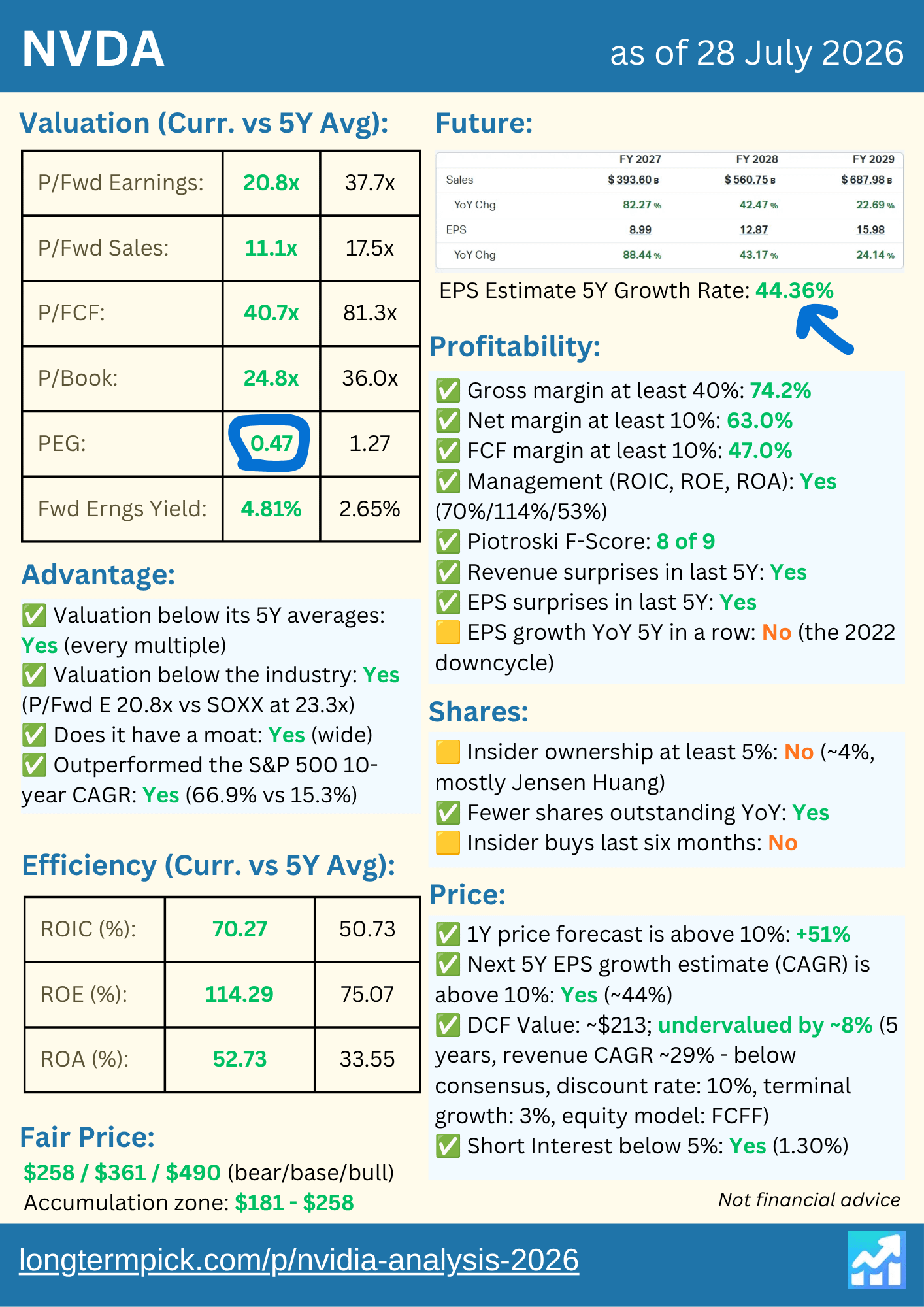
The whole analysis on one page - save it or share it with someone who still thinks NVDA is expensive.
This is not a financial or investing recommendation. It is solely for educational purposes.