

TL;DR: NVIDIA sells AI computing for data centers: GPUs, rack-scale systems, networking, and software. Since my deep dive on Jul 28, the Q3 FY2027 report showed revenue of $115.8B (+103% YoY), and consensus FY2028 EPS rose 26%. At the same time, NVDA fell from ~$197 to $150.96; its forward P/E halved to 10.6x. Four of the six things I bet on held; two are open. One risk from my list happened: Jensen Huang resigned. As I see it, the market prices in higher rates and doubts about AI demand across the chip sector, plus two NVIDIA questions: leadership and demand after 2027. My Base Case fair price is $327, 9% below July; that cut came with my August refresh, not with this report. NVDA is 34% below the Base Case MoS price of $229. My rule is to buy below that price, so this is a buy, with larger risks than in July. NVDA is 11% above my accumulation zone of $95-136, because my Bear Case puts today's multiple (rounded down to 10x) on EPS capped at 20% growth.
Thesis Check
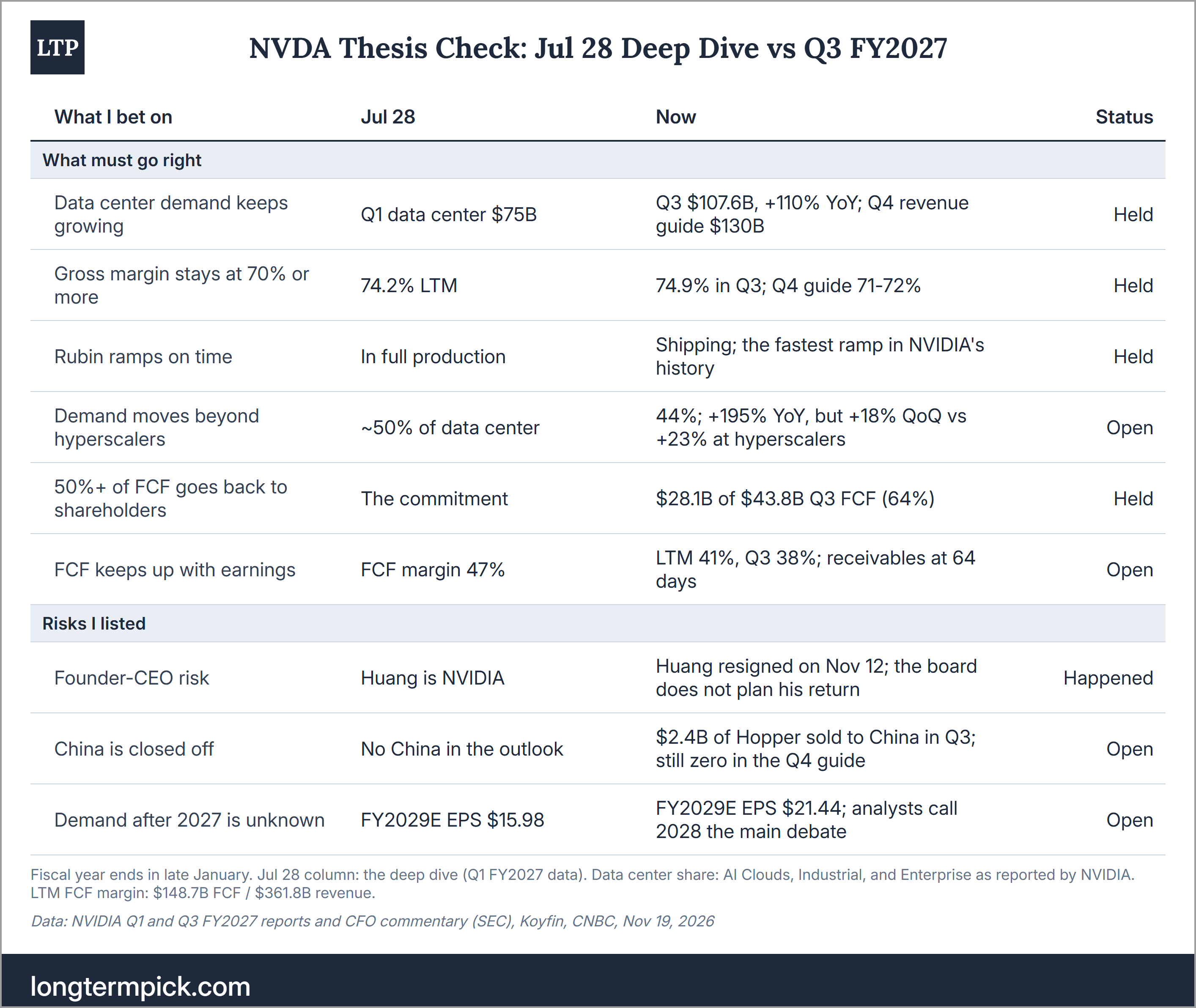
The business did most of what the July thesis needed, but not all of it. Data center demand, the gross margin, Rubin, and capital returns held. Customers outside the hyperscalers (AI clouds, industrial, and enterprise) grew 195% YoY against +71% at the hyperscalers, so their share of data center revenue increased to 44% from 31% a year ago. Still, it is below the ~50% of Q1 that my July post used: it decreased to 45% in Q2, and in Q3 these customers grew 18% QoQ against 23% at the hyperscalers. Cash conversion is the second open point: the FCF margin decreased to 41% LTM from 47%. On Nov 12, the founder-CEO risk I flagged in July materialized: Jensen Huang resigned. These 4 months fit what Peter Lynch wrote in Beating the Street:
Often, there is no correlation between the success of a company's operations and the success of its stock over a few months or even a few years. In the long term, there is a 100 percent correlation between the success of the company and the success of its stock. This disparity is the key to making money; it pays to be patient, and to own successful companies.
Peter Lynch, Beating the Street
For NVIDIA, every sentence of that quote matters. The first describes the last 4 months: consensus FY2028 EPS increased 26%, while the stock fell 23%. The second is why I look at earnings first and price second. But the last one has a condition: the company has to stay successful. If demand flattens after 2027 and EPS falls, the price will follow those earnings down too. So the gap alone isn't a reason to buy; the rest of this post checks whether earnings can hold.
The Report
Q3 beat consensus on revenue, EPS, and the Q4 revenue guide. Revenue of $115.8B beat the LSEG consensus of $109.1B by $6.7B; non-GAAP EPS of $2.68 beat the $2.47 analysts expected. NVIDIA guides Q4 revenue to $130B ±3%, above the $125.1B expected.
The Q4 guide is less clean than it looks. Q4 has 14 weeks instead of 13; on a 13-week basis, $130B is ~$121B, or +4% QoQ after +20% in Q3. That is my rough estimate, since revenue does not scale exactly with days. The gross margin guide is 71-72%, down from 74.9% in Q3. NVIDIA linked the small Q3 decrease (from 75.0%) to the initial Rubin ramp, but the CFO commentary gives no reason for the larger Q4 step. At $130B, 3.4 points at the midpoint are ~$4.4B of gross profit in one quarter; as I see it, this is the first test of the peak-margin risk I raised in my July post.
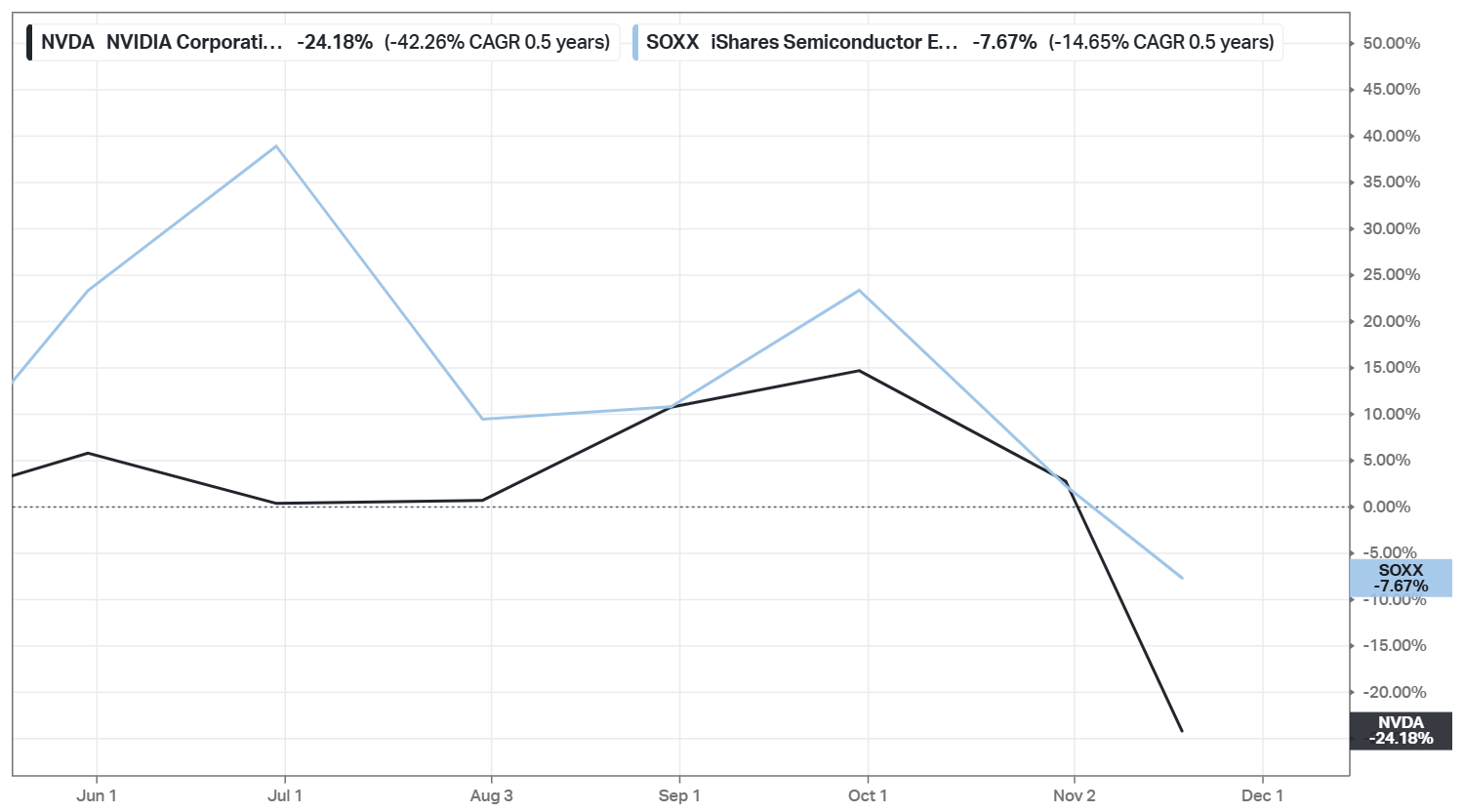
Analysts raised their numbers; most of the fall came before the report. In 30 days, the consensus EPS for FY2027 increased 3.7%, and for FY2028 3.9% (Yahoo Finance); over 90 days, FY2028 is up 27.3%. From the Oct 06 high of $239.24 to Nov 05, NVDA lost 24%. The whole chip sector fell even more: SOXX lost 33% over the same period, while the market priced in a December rate hike. NVDA's own part came after. From Nov 05 to Nov 18, SOXX recovered 7.5%, but NVDA lost another 17%, including 5.5% on Nov 10, two days before Huang resigned, and 2.9% on the day after the report. So I read the move as three discounts stacked on top of each other: higher rates and AI-demand doubts for the whole sector, the CEO change, and questions about 2028 that a slower Q4 guide didn't answer.
Cash flow recovered from a weak Q2; it still trails net income. According to the CFO commentary, operating cash flow was $48.3B, double Q2, partly because of the timing of tax payments. FCF was $43.8B against $65.3B of net income. The reason is working capital. Receivables reached $81.0B, or 64 days of sales (60 in Q2), due to Rubin shipment timing and longer payment terms on large, multi-quarter agreements with certain investment-grade customers. Inventory increased to $39.7B for the Rubin ramp.
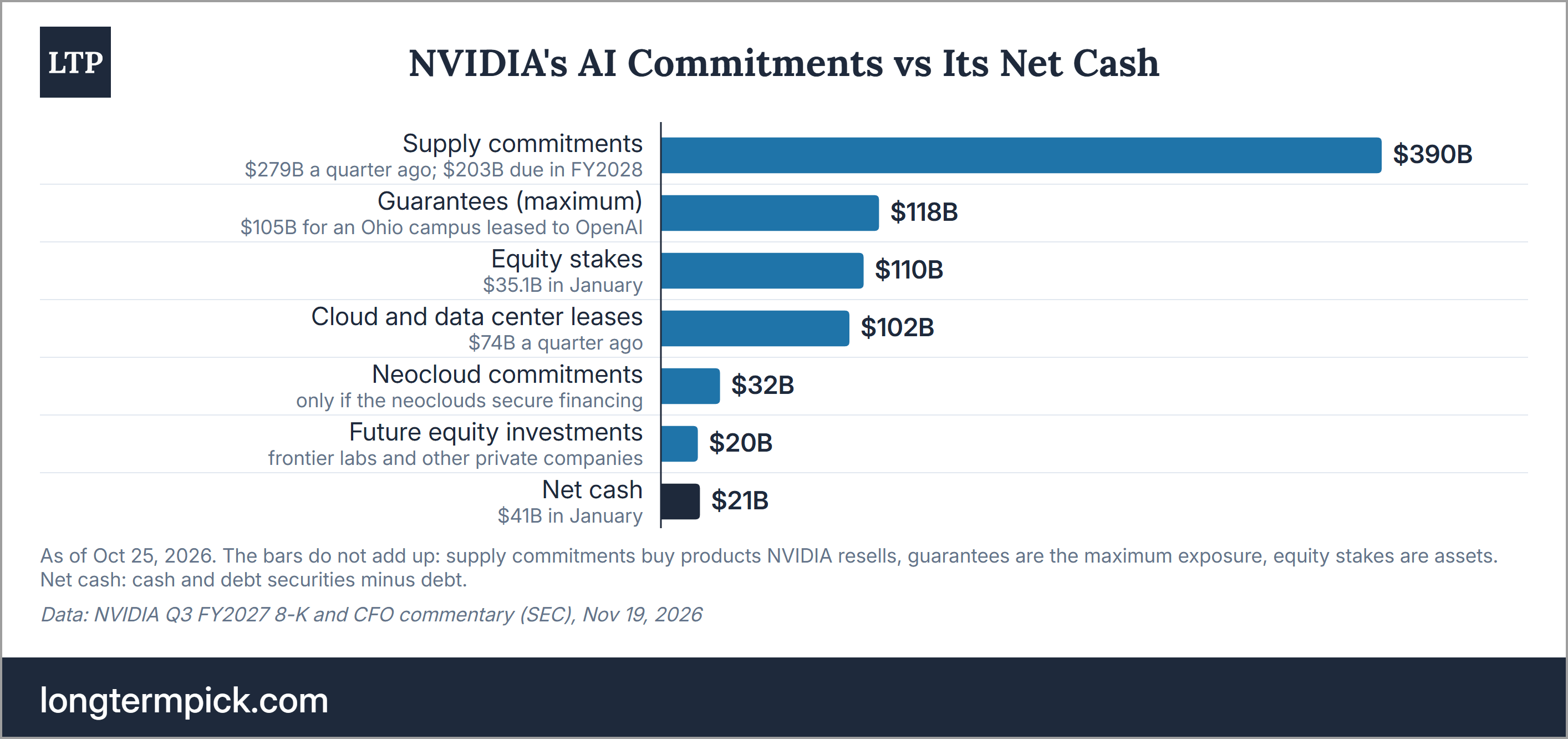
Capital returns stayed above the promise; together with equity stakes, they exceeded FCF. NVIDIA returned a record $28.1B in Q3, 64% of the quarter's FCF, against the 50% it committed to. In September, the board added $150B to the buyback; $227.3B is left, and NVIDIA plans to use it through FY2028. That is ~$45B a quarter over the next 5 quarters, about all of Q3's $43.8B FCF. Diluted shares are 1.2% lower YoY. Over 9M FY2027, buybacks and dividends ($73.5B) plus net purchases of equity stakes ($48.6B) were $8.4B above the $113.7B of FCF. With taxes paid on employee stock ($6.2B), acquisitions ($3.0B), and the Groq payment ($2.9B), NVIDIA spent ~$20B more cash than it generated. It borrowed $24.9B; net cash (cash and debt securities minus debt) decreased to ~$21B from ~$41B in January.
What Changed
For the first time in its 33 years, NVIDIA has no permanent CEO. Jensen Huang resigned on Nov 12, days after the board opened an independent investigation. NVIDIA gave no reason; the Q3 report lists the investigation as a risk. Morgan Stanley also points to reports of DOJ and SEC investigations. Colette Kress is interim CEO and stays CFO. Harvey Jones, Synopsys' former CEO, became the first-ever Chair of the board. On the call, Jones said the board does not plan to bring Huang back, although Huang said he is open to a return.
In my opinion, the next quarter is the smaller risk, since Kress gave the Q4 guidance herself. The bigger risk is the next deals. Bernstein sees the risk in supplier negotiations, roadmap setting, speed of action, and employee retention, plus headline risk from possible new investigations.
Washington adds pressure, though China is outside the guide anyway. Congress is involved as well: Huang is due before Congressional committees on Dec 01, and a House committee asked Kress for a briefing by Dec 02. The Commerce Department moved to restrict Chinese companies’ remote access to advanced compute in overseas data centers. Worth noting that China is not fully closed: NVIDIA shipped $2.4B of Hopper products to China in Q3. Still, the Q4 guide assumes zero data center compute revenue from China, so any such sales are upside to the guide.
Commitments are growing faster than revenue. Supply commitments rose to $390B from $279B a quarter ago, mostly due to multi-year memory purchases. $203B of it falls in FY2028 alone. At the 71-72% gross margin of the Q4 guide, that equals the cost of revenue for ~$710B of sales, ~68% more than this year’s ~$424B (9M revenue plus the Q4 guide). This is my simplification, since part of the commitments is capacity, not product cost. Still, as I see it, NVIDIA has already bought supply for about the growth that consensus expects. Cloud service and data center lease commitments increased to $102B from $74B. On top of that, NVIDIA has up to $118B of guarantees. $105B of them is credit support for an Ohio campus that will host NVIDIA systems under 20-year leases to OpenAI; the first guarantee takes effect in FY2029.
Part of that money backs NVIDIA’s own customers. Separately, NVIDIA has up to $32B of commitments to neoclouds (AI clouds outside the hyperscalers); they take effect only if those neoclouds secure financing to buy NVIDIA’s systems, and NVIDIA earns revenue on that upfront sale. It has also committed $20B of future equity investments, focused on frontier labs, infrastructure financiers, and other private companies. In 9M FY2027, it bought $58.1B of equity securities ($48.6B net of sales); in Q3, it booked a $1.8B impairment on private stakes. Its equity stakes are now $109.7B ($44.2B listed, $65.5B private), against $35.1B in January. Over 9M FY2027, gains on them added $25.5B to GAAP pre-tax income; non-GAAP EPS, the base of my model, excludes them. These commitments suggest NVIDIA expects demand for years ahead. But from my perspective, part of the +195% growth outside the hyperscalers comes from customers NVIDIA helps finance, so a slowdown would hit its revenue and its balance sheet at once.
What the bears get right: my July post said nobody knows the demand curve past 2027; the report didn't answer that. TD Cowen calls the calendar 2028 outlook the main investor debate; UBS says the call added little to it. NVIDIA’s fiscal year ends in late January, so FY2028 is mostly calendar 2027. If demand in calendar 2028 flattens, the +68% EPS growth that consensus expects for FY2028 can hold while FY2029 falls; then 10.6x stops being cheap. With an open CEO search, longer payment terms for some large customers, $390B of supply commitments, and up to $118B of guarantees, the downside of a slowdown is larger than in July. My model does not fully absorb this scenario, because even its Bear Case grows EPS to $24 by FY2032. If EPS returns to the FY2027 level of $9.66 by FY2032 and the market pays 15x (about SOXX’s 14.3x today), NVDA is at ~$145 in 5 years. Discounted at my 12%, that is ~$82 today, 46% below the price.
Valuation, Then vs Now
Jul 28 vs now (5Y mean; -1 SD):
Price: ~$197 vs $150.96
Price/Fwd Earnings: 20.8x vs 10.6x (35.4x; 24.2x)
Price/FY2028 EPS: 15.3x vs 9.3x
Price/Fwd Sales: 11.1x vs 5.8x (16.8x; 12.7x)
PEG: 0.47 vs 0.22 (1.16)
SOXX Price/Fwd Earnings: 23.3x vs 14.3x
FY2028 consensus EPS: $12.87 vs $16.24
5Y consensus EPS growth: 44.36% vs 49.44%
The price is 23% lower, while FY2028 EPS estimates are 26% higher. On FY2028 EPS, the multiple fell 39%, from 15.3x to 9.3x; the rest of the move to 10.6x comes as the NTM window rolls into a year with +68% growth. To compare, SOXX fell from 23.3x to 14.3x, so most of the derating hit the whole sector. Still, NVDA's discount to SOXX widened from 11% to 26%. A PEG of 0.22 means the forward P/E is less than a quarter of the 49% EPS growth that consensus expects; even at my 20% cap, the PEG is 0.53.
Analyst’s note:
The 5Y means include 2022, when NVIDIA’s earnings fell and the multiples jumped. They still show the right direction: in the last 5 years, NVDA never traded this low against its own expected earnings. The July price is the Jul 27 close of $196.51, the day before the deep dive.
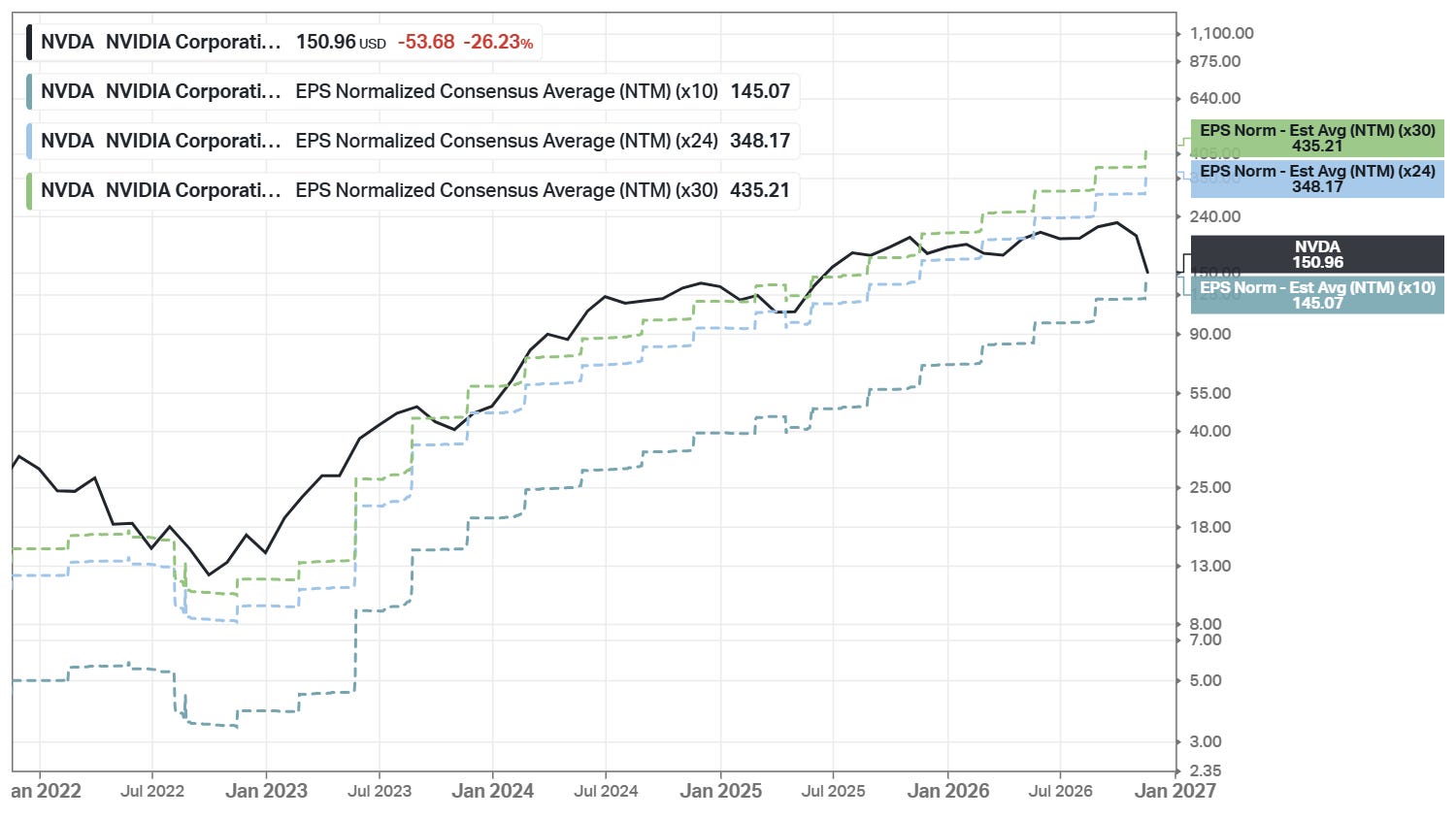
One chart frames this whole section. The corridor below multiplies the consensus NTM EPS by my model's three exit multiples: 10x, today’s multiple rounded down; 24x, the -1 SD band; 30x, the ceiling of my Manifest. Today, the corridor is ~$145-435 (Koyfin’s normalized NTM EPS of $14.51, which puts NVDA at 10.4x; the 10.6x above is Koyfin’s Price/Fwd Earnings field), and NVDA at $150.96 is near the bottom. From 2023 to the summer of 2026, the stock mostly traded at or above the 24x line. After the Oct 06 high, the price fell while the EPS lines kept rising.
Updated Fair Price
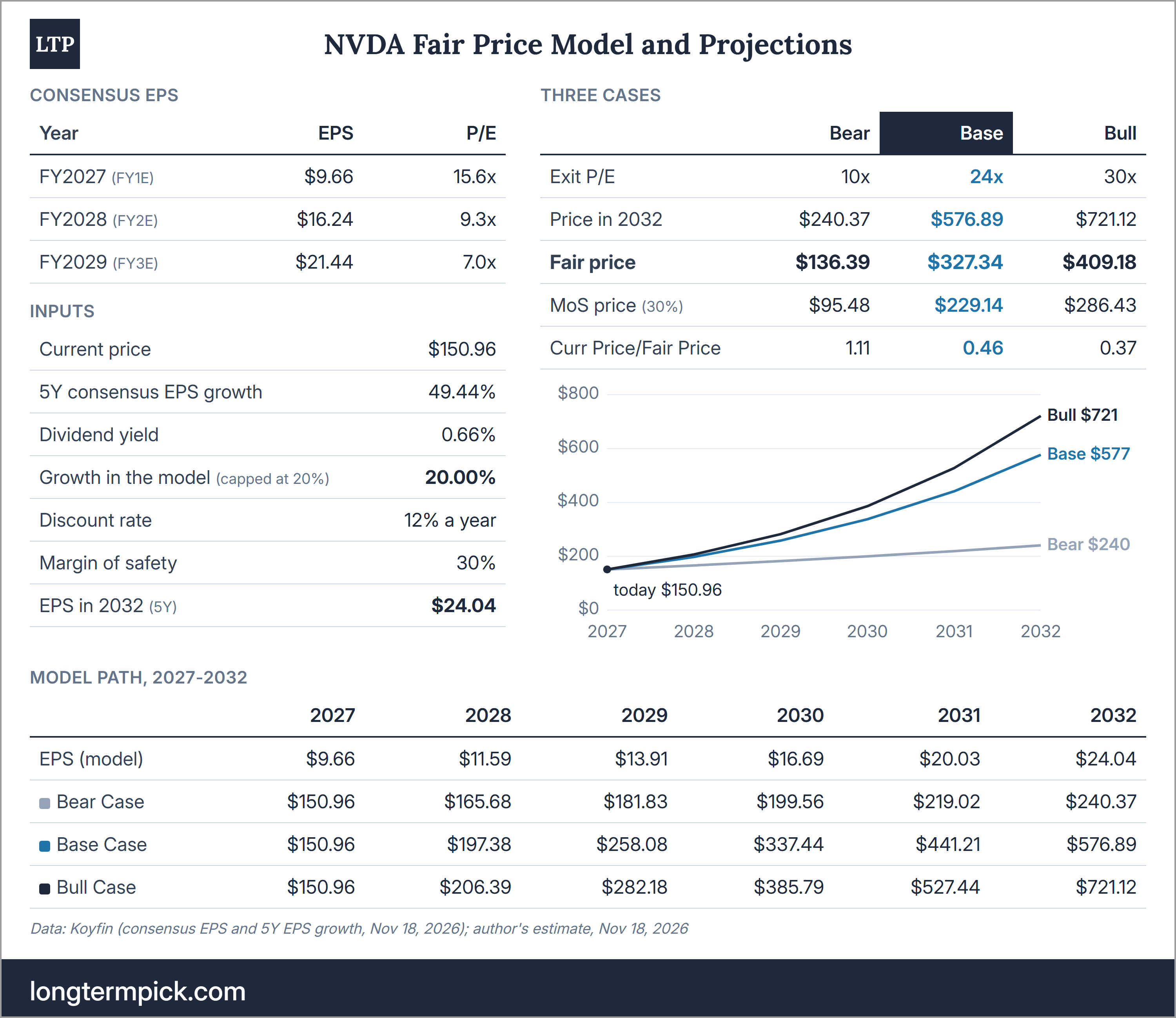
The method is the same as in July, with two rules I added in Portfolio #002 in August: the 20% cap now includes dividends (in July, the dividend yield came on top of it), and the Bull Case multiple is capped at 30x. I start from the FY2027 consensus EPS of $9.66 (it was $8.99) and grow it at 20% a year for 5 years. Consensus expects 49.44% a year, so the cap still decides. That gives EPS of $24.04 in 5 years. Actually, the cap makes the model far more cautious than the market: my EPS for FY2028 is $11.59, against the $16.24 consensus. Most of the change against July came with that refresh; this report moved the Base Case very little.
The discount rate is 12%; the margin of safety is 30%. My exit multiples are 10x/24x/30x (they were 20x/28x/38x). For the Bear Case, I use today’s multiple, rounded down; it assumes the market never pays more for NVDA than now. Base Case: the -1 SD band (24.2x, ~28x in July), rounded down, not the 35.4x mean that 2022 distorts. At 30x, the Bull Case is the ceiling of my Manifest (PEG 1.5 at the 20% cap); I lowered it from 38x in Portfolio #002.
Bear Case (exit P/E 10x): fair price $136 (was $258) - MoS price $95
Base Case (exit P/E 24x): fair price $327 (was $361) - MoS price $229
Bull Case (exit P/E 30x): fair price $409 (was $490) - MoS price $286
The higher starting EPS lifted every case by ~7%; the dividend, now inside the cap, took back ~2%. Lower multiples took back more than that. Because it follows the market, the Bear Case changed the most: in July, the market paid 20.8x; now it pays 10.6x. At 10x, my Bear Case assumes the market never re-rates a company with 74.9% gross margins and 68% ROIC. I keep it in the model because the same rule gave 20x in July, when it helped the fair price.
What does $150.96 assume? It assumes I earn 12% a year if FY2028 consensus EPS of $16.24 is the peak, EPS stays flat through FY2032, and the market then pays 16.4x. At my 24x Base Case multiple, the price needs only ~3% EPS growth a year from FY2027. By my rule (price below the Base Case MoS price), the buy holds as long as the exit multiple stays above 15.8x on my 20% path, or EPS grows ~10% a year at 24x.
At $150.96, NVDA is 54% below the Base Case and 34% below the Base Case MoS price of $229, so the full 30% margin of safety is already priced in. My accumulation zone is $95-136; NVDA is 11% above it. The reason is the Bear Case: it puts today’s 10x on EPS that grows only 20% a year, while consensus expects 49%. In July, at ~$197 and with weaker numbers, the stock was inside the zone.
Verdict
NVIDIA did most of what my July thesis asked: revenue doubled, the gross margin held, Rubin ramps fast, and capital returns stayed above 50% of FCF. The stock did the opposite. Part of the reason is sector-wide: from the Oct 06 high to Nov 05, SOXX fell even more than NVDA, as the market priced in higher rates and doubts about AI demand. The rest is NVIDIA's own: a CEO who resigned days after a board investigation opened, a slower Q4 guide on a 13-week basis, and a balance sheet that now backs some of its customers. At $150.96, NVDA is 34% below my Base Case MoS price of $229, even with growth capped at 20% against 49% consensus, so by my rule it is a buy. It is above my accumulation zone because the Bear Case puts today's 10x on EPS capped at 20% growth. In my view, the margin of safety is larger than in July, but so are the risks: if EPS returns to the FY2027 level by FY2032, the value at 15x, discounted at my 12%, is ~$82. That is why a position should be small enough to hold through a drawdown of 60% or more; from November 2021 to October 2022, NVDA fell 66%. What I watch now: the board investigation and any DOJ or SEC action, the name of the permanent CEO, the Q1 FY2028 guidance in February, receivables and guarantees against revenue, and whether the hyperscalers keep raising their 2027 capex.
Card
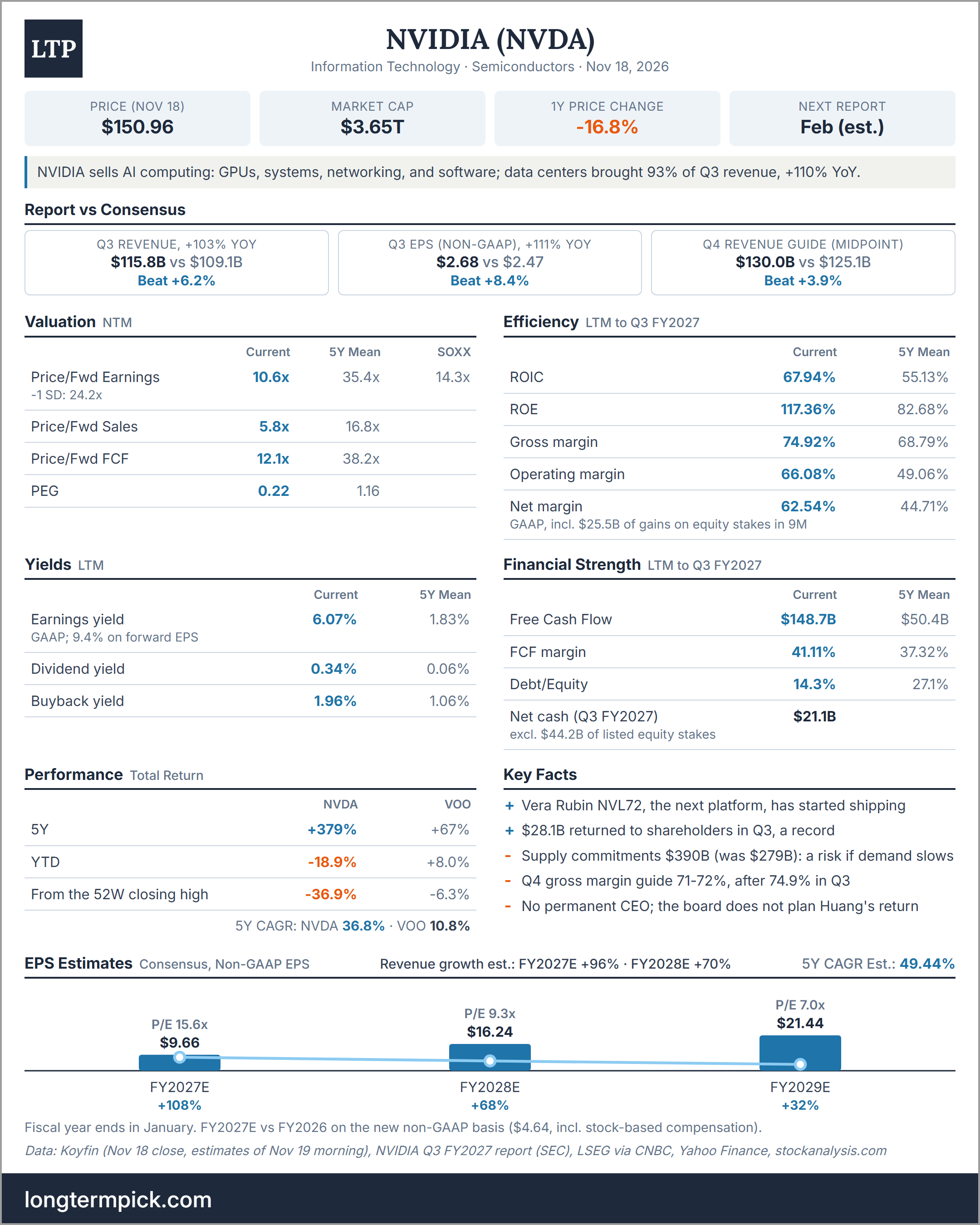
This is not a financial or investing recommendation. It is solely for educational purposes.
Thank you so much for this! I appreciate your work.